Doggie 101

(Making up for lost blogging time… This week has been trying, and the book I’m currently reading is taking me such a long time… harr.)
Shortly after we got our new (old) dog Macky (his old family migrated to Canada), who is somewhere between a shih tzu and what looks like an old english sheepdog (they told us he’s a shih tzu), I found a book that made the transition easier for us: The Dog Owner’s Manual: Operating Instructions, Troubleshooting Tips, and advice on Lifetime Maintenance by Dr. David Brunner and Sam Stall (illustrated by Paul Kepple and Jude Buffum).
Although a bit pricey for my regular Book Sale standards (P160), this immediately caught my attention primarily because of its cute vector graphics (it’s from one of my favorite publishers — Chronicle Books, which publishes a lot of quirky books), but mostly because of its smart concept.
It’s a pet care book that reads like an instruction manual for a gadget. The back reads:


At last! A Beginner’s Guide to Canine Technology

Pee stains on the carpet. Barking at all hours of the night. That embarrassing thing he does with your leg. It’s enough to make you cry out, “Why doesn’t my dog have an owner’s manual?” And now, thankfully, he does.

Through step by step instructions and helpful schematic diagrams, The Dog Owner’s Manual explores hundreds of frequently asked questions: Which breeds interface best with children? How can I program my model to fetch? And why is its nose always wet? Whatever your concerns, you’ll find the answers right here — courtesy of celebrated veterinarian Dr. David Brunner and acclaimed author Sam Stall. Together they provide plenty of useful advice for both new and experienced dog owners.

The chapter headings read: Welcome to your new dog! (includes diagram and parts list, memory capacity, product life span); Overview of Makes and Models (product history, top selling models, pre-acquisition checklists); Home installation; Daily Interaction; Basic Programming; Fuel Requirements; Exterior Maintenance; Growth and Development; Interior Maintenance; Emergency Maintenance, and Advanced Functions.
And the schematic diagrams are really schematic diagrams, and are quite entertaining. The book can show you how to give your dog a Heimlich maneuver, get your dog in a car, identify rabies, calculate age in dog years, give your dog a bath, and many more!

Tonight (several months later), I found The Dog Owner’s Maintenance Log (unused, for P15!), which is a spiral bound record book. It’s a great companion to the book, because you can personalize the details and use it to keep track of your dog’s progress. I plan to fill in this one (hehe, read: get my sister to) with Macky’s medical info and other important notes.

Squee for Book Sale! And squee for compulsive book buying!

***

My copy: Dog Owner’s Manual and Dog Owner’s Maintenance Log, both paperback
My rating: both 5/5 stars

Soliloquies

I count Shakespeare as one of my rites of passage while I was growing up.

In the grade school I attended, the highlight of our 6th grade year was our theater season — a full quarter of our school year was devoted to putting up a play production of A Midsummer Night’s Dream. It’s been a tradition for the 6th graders for so long that the school has original arrangements for songs (e.g. Philomel) in the play, as well as a full wardrobe of medieval costumes — bloomers and all — for the annual production.Too bad I don’t have any photos that survived, but I played Snout the bellows-mender / The Wall of Pyramus and Thisbe. It was an awkward stage — I’d always wanted to get cast as Puck since the first time I watched the play onstage back in first grade, but I’d hit a growth spurt in fifth grade (if you can call it that; obviously it wasn’t much of a spurt), so I was taller than everyone else who was vying for the part. I also read for Hermia but I was probably snorting my way through the dialogue so they didn’t cast me there so I ended up as one of the mechanicals who were putting on a play for Theseus and Hippolyta’s wedding.

This trip down memory lane was prompted by book #47 for 2009 (also book #8 for the Diversity Challenge, European), To Be or Not to Be: Shakespeare’s Soliloquies edited by Michael Kerrigan.

I bought the book on a whim at Book Sale (where else can I afford to buy books on a whim?) for P40, because it was brand new and I liked the cover design.

The introduction provides great insight into the nature of the soliloquy:

“Although set back from the main dramatic narrative, Shakespeare’s soliloquies are generally anything but interludes. Nowhere do we come closer to the centre of things than in those moments in which characters speak when alone, or unaware of being overheard — in coversation, as it were, with themselves and with their audience…

…The great soliloquies may not make much noise but they are often show-stoppers in the more literal sense that they appear to suspend all normal narrative logic, reaching out instead for universalities that transcend any immediate dramatic setting.”

The book contains over 80 soliloquies from Shakespeare’s various plays, organized by play and indexed by first line.

I am disappointed that only one from AMND is included and it is Helena’s (How happy some o’er other some can be); I think there were many other notable ones from the play, from Oberon or even from Bottom. Oh well. I really need to get a good edition of that play.

Aside from AMND, the only other Shakespearean plays I’ve read in their entirety are Romeo and Juliet and The Merchant of Venice, so I liked how this book functions as a sampler of the more popular plays.

I liked this one by Orlando in “As You Like It”:

Hang there, my verse, in witness of my love,
And thou, thrice-crowned queen of night, survey
With thy chaste eye, from the pale sphere above,
Thy huntress’ name that my full life doth sway.
O Rosalind, these trees shall be my books,
And in their barks my thoughts I’ll character,
That every eye which in this forest looks
Shall see thy virtue witness’d every where.
Run, run, Orlando, carve on every tree
The fair, the chaste, and unexpressive she.

It’s sweet, how Orlando wants to carve Rosalind’s name in every tree in the forest :D

***
My copy: mass market paperback, P40 at Book Sale

My rating: 4/5 stars

What happens when you cross the line…


when you discover a taste for the unthinkable?

Could you be drawn into a murder?

For friendship?

For a way out of your dreary experience?

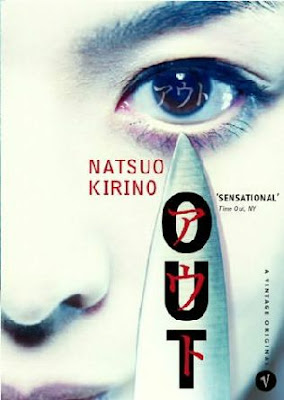
These are the haunting words on the back cover of the novel Out by female Japanese novelist Natsuo Kirino (Book #46 for 2009, Book 7 for diversity challenge – book discussion selection).

I had been mulling over my choices for this month’s FFP discussion, which will center around Japanese books. I have a bunch of Murakamis in my TBR, but I read Norwegian Wood last year and I don’t think I am ready for another one just yet. I also have Snow Flower, Secret Fan by Lisa Yee, but I also just recently read Memoirs of A Geisha and I wasn’t in the mood for another geisha novel so soon. I was considering reading a couple of manga books, when I took out the front stacks of my TBR shelf and found this book.

I’d been terribly busy the past week, so I was apprehensive that I wouldn’t be able to finish this book, at 520 pages, but I read a few odd chapters Wednesday night, polished off nearly half of it last night, and finally finished it off about an hour ago.

Researching on Natsuo Kirino for the weekend’s discussion, I found out that Out is actually an award winning novel: it received the Grand Prix for Crime Fiction, Japan’s top mystery award, and was a finalist (in English translation) for the 2004 Edgar Award. It is also Kirino’s first novel published in English, and the US film rights have been bought by New Line Cinema, to be directed by Nakata Hideo (of The Ring fame).

It was also interesting to find out that Natsuo Kirino is one of the most famous writers in the rise of Japanese women’s detective (misuterii) fiction that started in the 1990s, who have uniquely used the genre of detective fiction to depict and comment on present-day Japanese society and the Feminist situation.

Translated by Stephen Snyder, Out is a gritty crime novel about 4 women in contemporary, urban Japan: Yayoi, Masako, Yoshie, and Kuniko, who work on the night shift in the assembly line of a bento box factory. The foursome leads a troubled existence, each in their own way: Yayoi has a philandering and gambling husband; Masako is estranged from her husband and son right in her own home; Yoshie is a struggling widow with an ailing mother in law and a wayward daughter; and Kuniko is a shopaholic buried in debt.

One night Yayoi turns up at work dazed, and they find out her husband has beaten her, and she reveals that he has gambled away all their life savings. The next day, Masako gets a phone call from Yayoi asking for help — she has killed her Kenji in a fit of rage. Masako volunteers to dispose of the body, enlisting the help of Yoshie and Kuniko. The three dismember Kenji’s body and fill several trash bags, divided among themselves for disposal across the city.

The story gets more complicated after the body parts are discovered in a city park, and the police start investigating. But the women have more than the police to fear — a money-grubbing loan shark who figures out what they’re done, and a menacing nightclub owner who loses everything when he becomes the primary suspect in their crime and is now out to exact his revenge.

Out is definitely not for the weak of heart — it pushes the envelope on conventional views on sex, violence, feminism, and justice. I’m one of the less squeamish readers I know, but even I found this novel difficult to take in. It took me a while to remember why I actually mooched this book, and after racking my brains I remember why — I came across it in a recommendation list after I read Perfume by Patrick Suskind (which I have yet to review, but I’m looking forward to rereading it for an FFP discussion this year, so I’ll save it for then).

Out is similar to Perfume mostly because of the methodical procedures related to the murder (Grenouille’s approach to murder in Perfume and the carving of Kenji’s body parts in Out). Reading this book, I felt like I was watching episode after episode of Crime Night, and while uneasy, I was also reading in morbid fascination, much like I had read Perfume.

But the similarities end there. While I sympathized with Grenouille’s character in Perfume, I clearly knew he was psychotic and I can honestly say I would never go on a rampage like him. In Out, I could identify with the four women, as real as they come, who each dreamt of an escape from their lives, a way out. And it really got me thinking: would I do the same if I were in a similar bind?

I remember a text message I’d exchanged with some gal pals some years back; I don’t remember the exact words, but it went something like this: if I had killed a man, my friends would show up on the doorstep with a shovel, no questions asked.

Would I do it if a friend asked for my help?

What would it take to push me across the line?

The questions are haunting, but they do make you think.

As this is the first Japanese detective fiction I’ve read, I’m amazed that the Japanese culture has a long history of mystery writers, and is probably the only culture outside the Western world that has successfully assimilated this genre.

I’m also blown away that female Japanese writers were able to take this Western genre and make it their own (Japanese women’s detective fiction is a very popular genre, apparently), giving us an insight into the female situation. So many issues were successfully tackled in this book that were seamlessly incorporated into the story — domestic abuse, prostitution, poverty, climbing up the corporate ladder, beauty, weight, self-image — not easy, I imagine, but Natsuo Kirino does it quite well.

Now that I’ve discovered Japanese detective fiction, this opens a whole new world for me in mystery books — it’s a whole new genre to explore!

That’s it for now, must pack
for the weekend!

***
My copy: Vintage trade paperback, mooched from the US

My rating: 4/5 stars
Lost?

If you’re the type who is simply clueless, has a knack for perennially getting lost, or a regular at the city hall for racking up traffic violations, Periplus’ Manila Street Atlas might be the book for you, with its detailed maps (especially for the central areas), traffic notations (yes, even the one-way streets!) and user-friendly index filed by street and by building name.

Honey and I attended the book launch at Fully Booked — we got invited as members of their Bloggers’ Book Club.


They had a bunch of activities planned for the guests, such as a mini-treasure hunt (where I got a mini Moleskine cahier (pink!)) and a map challenge, and a raffle also (Honey won a gorgeous hardbound cookbook cum travelogue!). We also got to sample a range of SMB beers (of course I am partial to Cerveza Negra) and worked our way through the buffet (yes, the One More Extra Rice Club strikes again).


my prize
Navigation game
Honey with her prize

The Manila Street Atlas is available at Fully Booked, P1290

Taking fan art to the next level

In May last year, the Flippers’ first book discussion was on the book Life of Pi by Yann Martel.

Before the discussion, I’d seen the book around but never felt the urge to pick it up. I rarely pick up books with spiritual/ inspirational themes because they trigger an involuntary gag reflex in me, so I was dreading reading this book.

Surprisingly, the gagging never came because I actually liked the book. Not in a love-it-to-bits sense, but I appreciated it, and was glad the book discussion required me to read it.

Life of Pi is the story of Piscine “Pi” Molitor Patel, a boy of multiple religions, who is a shipwreck survivor floating adrift in the ocean on a lifeboat with a circus tiger named Richard Parker.

I like the book because it questions perception, and because it reminds us that sometimes the journey is more important than the destination.

To my surprise, I also enjoyed the book’s humor. I really appreciate good humor in a book, and I did not expect this book to make me laugh, but it did, especially the part when Pi was practicing the three religions and the family runs into all three religious leaders and his multi-belief system is revealed; the Pi Patel Indo-Canadian, Trans-Pacific, Floating Circus; the encounter with the Frenchman (whom Pi mistook to be Richard Parker at first); and the interrogation scene at the end of the book.

But this review isn’t about the story of Life of Pi, it’s about a particular edition of the book: the deluxe illustrated edition, featuring the paintings of Croatian Tomislav Torjanac.

In 2005, an international competition was launched to find an illustrator for the novel. Thousands of entries were sent in from all over the world, and Torjanac was selected to illustrate the deluxe edition.

From Amazon Outtakes:

The book includes over 40 illustrations in oil, taken from Pi’s perspective (Pi is never seen in the illustrations, just his hands and feet), documenting his bizarre journey in vibrant color.

Here are some illustrations, from http://www.torjanac.com/lifeofpi.html and http://lifeofpi.co.uk (copyright Tomislav Torjanac)

Lord, avert their eyes from me, I whispered in my soul.
I threw the mako towards the stern.
“There goes our lunch.”

I think it’s great, how Yann Martel and the publishers thought of involving readers this way. I can imagine the feeling, if for instance, JK Rowling did it for one of the Harry Potter books (or if a local publisher comes up with a Filipino translation and mounted a similar contest — hahaha, my fantasy), or if any of my other favorite books were up for illustration.

I would think it’s exciting and scary at the same time, to be given a chance to illustrate a a new edition of a book you’ve loved for a long time, with the knowledge that hundreds of people around the world have loved it too and are eagerly awaiting your illustrations.

I remember a discussion about illustrated novels posted at Flips Flipping Pages last year. Someone commented that a lot of bestsellers are getting illustrated, and he wasn’t quite sure if it was a marketing ploy, or if readers had such short attention spans that they needed to have books with pictures. b

Those reasons probably hold true, and I say, if it gets more people to read, so much the better.

But speaking as an illustrator, I see the illustrations as an extension of the reading experience, not mere accompaniments to the text. Illustrations translate one art form (literature) into another (visual art), much like a book made into a movie, and can convey a meaning beyond the text, as the illustrator adds his or her own nuances in interpreting the text.

And speaking as a big fan (and obsessive bargain-hunting collector) of illustrated novels, I say there is nothing wrong with enjoying an illustrated book; it doesn’t mean you lack imagination or need a visual aid. It’s about appreciating it for what it is – art!

***
My copy: hardbound US (Harcourt) with dustjacket, a birthday gift from Triccie
(Back story: I lent my brother my trade paperback, he took it to his dorm and it was devoured by termites — he now grovels if he wants to borrow a book)

My rating: Life of Pi Illustrated Edition 5/5 stars; Life of Pi trade paperback 3.5/5 stars