One for Tomas (Old Possum’s Book of Practical Cats)

cimg1121
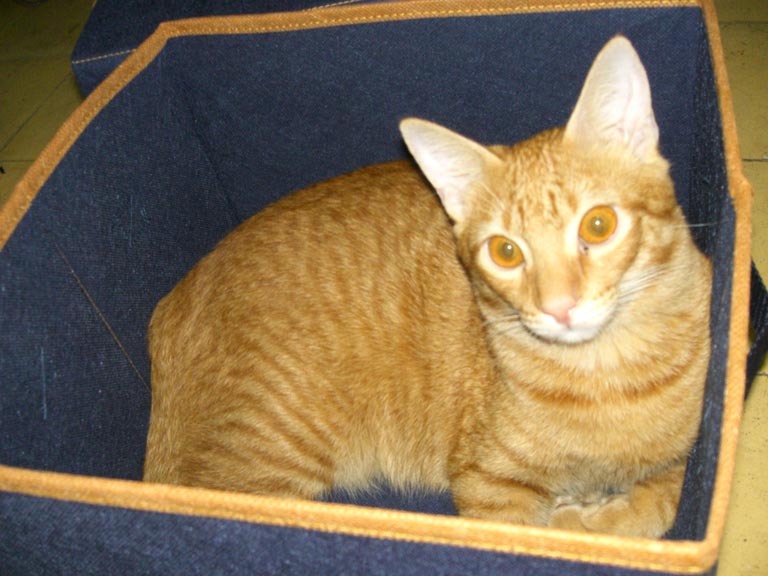
In memory of Tomas :)

I love cats. I like dogs, and animals in general, but I love cats most of all (shh, don’t tell my dog!).

Having raised two cats from birth (and feeding several other neighborhood strays), I find that cats are one of the smartest creatures (and yes, smarter than dogs, as I’ve raised more than my share of those too) on earth.

They’re clean, they’re naturally housebroken, and they’re low-maintenance. They won’t give their loyalty freely, but they make the most loyal and affectionate companions when they do.

And I love how easily they learn even without training. While I love our dog as much as my cats, my cats can open doors, climb onto bed with me and pull a blanket over themselves,  use their litterbox and keep it clean (our dog has a spraying problem), and get up and down the stairs faster than lightning (our dog forgets how to go up and down the stairs like every other hour).

Last year, my cat Tomas, an orange mackerel tabby that I raised since he was a kitten,  passed away due to kidney failure and subsequent cardiac arrest (I really suspect it was canned cat food tainted with melamine), and it was one of the hardest things I ever had to get through in my life.

I got a lot of cat books since then, including a beautiful copy of 99 Lives: Cats in History, Legend, and Literature, that was a present from fellow book lover Triccie. I still can’t get myself to finish reading that book (because I end up bawling), but I was able to find another cat book to cheer me up: Old Possum’s Book of Practical Cats by T.S. Eliot (book #112 for 2009).

Continue reading “One for Tomas (Old Possum’s Book of Practical Cats)”

Once upon a time, it was a dark and silly night… (Little Lit Roundup)

and I found myself with two great graphic anthologies!

The Little Lit series is a set of comic compilations for kids, edited by the great Art Spiegelman. I have two of them, because I lucked out on new copies at bargain prices — Folklore and Fairy Tale Funnies (from the NBS Book-sak sale, P200) and It Was a Dark and Silly Night (from the Book Sale warehouse, P170). I decided to read them for the 24-hour read-a-thon because they were easy to read and I wanted to get some variety in my read-a-thon books.

When I first saw the Little Lit books, I was literally agape at their visual impact — it’s a smorgasbord of creative juices from an amazing roster of top-caliber cartoonist and children’s book artists. Even now that I’ve had the books for some time now, I still thumb through the pages with reverence. It’s like holding an art gallery in your hands!

Revealing the actual stories would take away the fun from reading the Little Lit books, so let me just touch lightly on them, so you have an idea of what’s inside.

Folklore and Fairy Tale Funnies (book #61 for 2009) showcases a humorous collection of old and new story selections from different parts of the world, told through comics.

Aside from Spiegelman this book includes the works of Barbara McClintock, Chris Ware, Kaz, J. Otto Seibold, William Joyce, Bruce McCall, David Macaulay, and many more.

My favorites from this book include Barbara McClintock’s leonine version of the Princess and the Pea, the reprint of Walt Kelly’s (of Pogo Fame) 1943 comic The Gingerbread Man, Art Spiegelman’s hilarious Prince Rooster, Claude Ponti’s The Enchanted Pumpkin and Chris Ware’s interactive Fairy Tale Road Rage boardgame.


My second Little Lit Book is It Was a Dark and Silly Night… (book #62 for 2009), this time a showcase of imagination, with different comic stories that take off from the starting phrase “It was a dark and silly night… .”

This time, the masterminds are not only comic book artists and children’s book illustrators, but also novelists such as Neil Gaiman and Lemony Snicket.

My favorite selections from this book include Lemony Snicket and Richard Sala’s hilarious story about a girl and the Yeti, J.Otto Seibold and Vivian Walsh’s penguin treasure story, and Patrick MacDonnell’s moon story.


I still lack Strange Stories (my cousin Dianne has this one, though, I must borrow it sometime) and the Big Fat Little Lit collection. Hopefully I’ll get lucky and find bargain copies again for my Little Lit collection one day; they cost about P800 each at the bookstore.

*All book photos from the Little Lit website.

***
My copies: both hardcover

My rating: both 5/5 stars!

Scary stories: not so scary anymore

I remember how I loved scaring myself when I was a kid. I read all the Goosebumps and ghost story books I could get my hands on; I watched all the Halloween / All Souls’ Day horror specials on tv in between my fingers; and my classmates and I told ghost stories dared ourselves to go ghost-hunting whenever we had our annual camp-out on our school grounds (which, as all schools in this country are reported to be, was once a wartime burial ground, therefore it is haunted!)
In high school, I’d moved on to Christopher Pike and R.L. Stine’s Fear Street, and even the Spirit Quest Chronicles, but after that I don’t think I’ve ever went for any horror books. Yeah, I enjoy Gothic novels, or suspense thrillers, but I seem to have either a) lost the fascination for reading books for the intention of scaring myself silly (except for when I had to read The Historian again for a book discussion *shiver*); or b) less things have the power to scare me silly (okay, I am officially giving myself a headache thinking this through).

Anywaaaaay, the reason I brought this dilemma up is because I dug out this book from the bargain bin: Scary Stories 3: More Tales to Chill Your Bones, collected from folklore and retold by Alvin Schwartz, drawings by Stephen Gammell (Book #49 for 2009).

The book looked familiar; I think I must’ve read this (or one of the previous volumes) back in grade school. There are over 25 stories in the book: some ghost stories, some urban legends, some just strange tales.

If I were much younger, I’d probably have enjoyed this book and I’d have “chilled my bones” as the book earnestly promises.


On a positive note, what’s nice about this anthology is that there’s a whole section in the back devoted to references for the adaptations — whether it’s oral tradition, a news article, or a reported recollection. One of them, An Appointment in Samarra, even appears in the last book I read (The Eight by Katherine Neville).

I also like the pen and ink wash illustrations of Stephen Gammell (Caldecott Medal awardee for The Song and Dance Man by Karen Ackerman, and Caldecott Honor awardee for Where the Buffaloes Begin by Olaf Baker), I think they’re even more scary than the stories, and if I was the young reader perusing this volume, they’d have been set the right mood for bone-chilling. :)

***
My copy: a worn paperback, still good for many readings, now in my bookmooch inventory.

My rating: 3/5 stars

Soliloquies

I count Shakespeare as one of my rites of passage while I was growing up.

In the grade school I attended, the highlight of our 6th grade year was our theater season — a full quarter of our school year was devoted to putting up a play production of A Midsummer Night’s Dream. It’s been a tradition for the 6th graders for so long that the school has original arrangements for songs (e.g. Philomel) in the play, as well as a full wardrobe of medieval costumes — bloomers and all — for the annual production.Too bad I don’t have any photos that survived, but I played Snout the bellows-mender / The Wall of Pyramus and Thisbe. It was an awkward stage — I’d always wanted to get cast as Puck since the first time I watched the play onstage back in first grade, but I’d hit a growth spurt in fifth grade (if you can call it that; obviously it wasn’t much of a spurt), so I was taller than everyone else who was vying for the part. I also read for Hermia but I was probably snorting my way through the dialogue so they didn’t cast me there so I ended up as one of the mechanicals who were putting on a play for Theseus and Hippolyta’s wedding.

This trip down memory lane was prompted by book #47 for 2009 (also book #8 for the Diversity Challenge, European), To Be or Not to Be: Shakespeare’s Soliloquies edited by Michael Kerrigan.

I bought the book on a whim at Book Sale (where else can I afford to buy books on a whim?) for P40, because it was brand new and I liked the cover design.

The introduction provides great insight into the nature of the soliloquy:

“Although set back from the main dramatic narrative, Shakespeare’s soliloquies are generally anything but interludes. Nowhere do we come closer to the centre of things than in those moments in which characters speak when alone, or unaware of being overheard — in coversation, as it were, with themselves and with their audience…

…The great soliloquies may not make much noise but they are often show-stoppers in the more literal sense that they appear to suspend all normal narrative logic, reaching out instead for universalities that transcend any immediate dramatic setting.”

The book contains over 80 soliloquies from Shakespeare’s various plays, organized by play and indexed by first line.

I am disappointed that only one from AMND is included and it is Helena’s (How happy some o’er other some can be); I think there were many other notable ones from the play, from Oberon or even from Bottom. Oh well. I really need to get a good edition of that play.

Aside from AMND, the only other Shakespearean plays I’ve read in their entirety are Romeo and Juliet and The Merchant of Venice, so I liked how this book functions as a sampler of the more popular plays.

I liked this one by Orlando in “As You Like It”:

Hang there, my verse, in witness of my love,
And thou, thrice-crowned queen of night, survey
With thy chaste eye, from the pale sphere above,
Thy huntress’ name that my full life doth sway.
O Rosalind, these trees shall be my books,
And in their barks my thoughts I’ll character,
That every eye which in this forest looks
Shall see thy virtue witness’d every where.
Run, run, Orlando, carve on every tree
The fair, the chaste, and unexpressive she.

It’s sweet, how Orlando wants to carve Rosalind’s name in every tree in the forest :D

***
My copy: mass market paperback, P40 at Book Sale

My rating: 4/5 stars

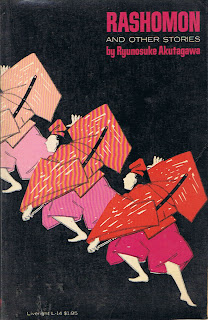
Rashomon and Other Stories by Ryunosuke Akutagawa

Book 6 of 2009
Asian book #1 of Diversity Challenge
My first encounter with Ryunosuke Akutagawa was back in freshman English, in my Intro to Fiction Class, when we read “In a Grove.”
I remember we had small group discussions about it, and I couldn’t concentrate because this guy I was crushing on was sitting next to me (tee hee hee) but I remember someone saying that the story was the same as the Japanese film Rashomon by Akira Kurosawa (The film was based largely on In a Grove, incorporating some elements from the short story Rashomon).
I still haven’t seen the movie, but I chanced upon this Akutagawa anthology at Book Sale and it was a 1970 edition (Liveright paperback) with some notes pencilled in the margins, but it was about P40, and I knew I wouldn’t come across it again. (I googled the name pencilled in the inside cover and apparently she’s an American minister of some religious congregation… Oh, in case you’re wondering, I started doing that sort of thing — googling the names inside old books– after watching Whisper of the Heart, hee hee hee).
Ryunosuke Akutagawa was a writer in the modern period (early 20th century) who was disturbed by Japan’s industrialization, and writing was his way of response, with over a hundred works to his name, before committing suicide at the age of 35.
The book contains six medieval Japanese short stories: In a Grove, Rashomon, Yam Gruel, The Martyr, Kesa and Morito, and The Dragon, a varied collection dealing with different aspects of societal values and human psychology. Authentic illustratiions (by M. Kuwata) are interspersed throughout the text.
In a Grove is easily the frontispiece to this collection — it is a tale of crime (rape, murder and suicide) told from five different perspectives. I like the story’s philosophical exploration into the nature of truth — how it is impossible to know the absolute truth, and how easy it is to blur the lines with memory, human desires and motivations, and personal biases.
The next story features the Rashomon, the largest gate marking entry into Japan’s ancient capital, Kyoto. The gate crumbled with the decline of Kyoto, and the Rashomon soon became a nest for thieves and criminals, as well as a place to dump unclaimed corpses. A recently laid off servant vwitnesses an old hag stealing hair from corpses to make a wig, and the encounter changes his life.
Yam Gruel features a bumbling protagonist whose greatest ambition was to eat his fill of this aristocratic delicacy. When he is presented with an opportunity to fulfill his ambition, however, things do not go the way he imagined.
The Martyr was a surprise because of its Christian (and Jesuit, at that) roots – apparently Akutagawa liked dramatizing existing texts and events, and this one was based on volume two of the book Legenda Aurea. This is the story I least enjoyed — probably because it was less subtle in the moralistic aspect.
Kesa and Morito, I read somewhere, was based on a real affair. Kesa and Morito are illicit lovers, and Morito is driven to kill Kesa’s husband. Here’s the quandary — he doesn’t hate the man and he doesn’t love Kesa but he feels Kesa is compelling him to do it. Kesa doesn’t love Morito either, but is fascinated because Morito mirrors the ugliness she sees in herself. Out of guilt, Kesa switches with her husband on the night Morito comes to kill him. It’s also fascinating how the story tests the very thin line between love and hate.
The Dragon is more of a folk tale, like something out of JK Rowling’s Tales of Beedle the Bard. It was also lighter and more humorous than the rest, dealing with a fellow with a big nose who got so tired of being teased about it that he pulls the prank of the century!
I do not read many anthologies because I like meaty novels I can sink my teeth into, but I enjoyed this book, because while the stories offer a moralistic viewpoint, they pose philosophical questions that encourage the reader to ponder the situations presented and reassess his or her own values.
***
my copy: Liveright paperbound edition, 1970
my rating: 5/5 stars

Photo courtesy of: http://www.redvicmoviehouse.com/images/poster/rashomon.jpg (poster)