Book Belt

In Harry Potter and the Prisoner of Azkaban, Hagrid sends Harry a peculiar birthday gift: the Monster Book of Monsters, a textbook that attempts to bite anyone who tries to open it. Harry binds it with a belt, and the other students keep it shut with Spellotape. This Harry Potter moment came to mind when I spotted a new book thingamajig at a Daiso store in Singapore: the book belt.

It’s actually a glorified piece of patterned garter sewn together with a felt band, and I bought it primarily because I’m a sucker for all sorts of book paraphernalia (as you well know), and I only got to try it recently. For 2 SGD (standard Daiso price), you get a pack of two book bands (I gave one to my FFP seezter Ajie) that can fit both mass market paperbacks and trade paperbacks.

Continue reading “Book Belt”

Chindogu Mania

chindogu

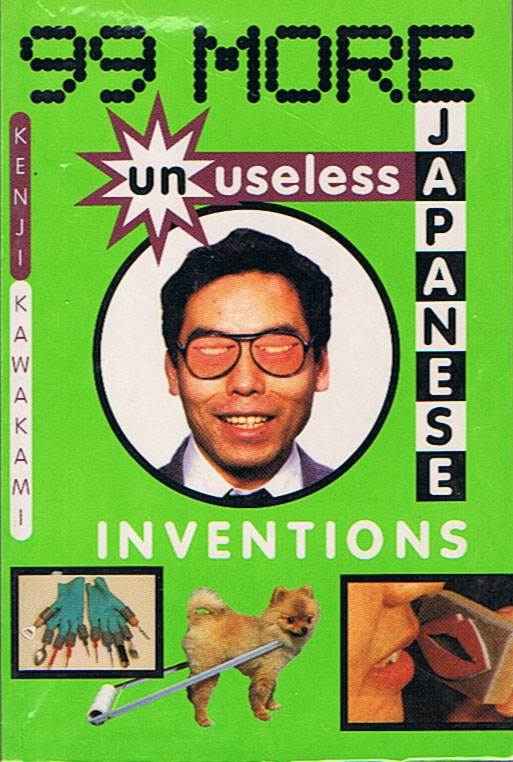
When I was in the hospital, my cousin Chickoy lent me his chindogu book, 99 More Unuseless Japanese Inventions by Kenji Kawakami (book #139 for 2009) to keep my mind off blood tests and platelet counts. And it worked, too, as the book kept me plenty entertained for a whole afternoon.

I’ve always been fascinated with Japanese ingenuity — I love going to the Japanese one price stores (here we have Saizen and Japan Home Center) to blow my money on all sorts of things, from plastic boxes with multiple compartments, gashapon display cases, nylon book cases, clip-on reading lamps, wrapping paper, pet toys, shoe racks, felt crafting materials, beanie pillows, bamboo mats, and all sorts of stuff I don’t really need but are fun to buy and convenient to have around!

Anyway, chindogu is the term for Japanese inventions for everyday gadgets to provide solutions for common problems. Chindogu has a distinctive characteristic, however, as the solution it presents causes even more problems, i.e. embarassment, unwieldiness, etc. They are not totally useless, just problematic, hence the term “unuseless.”

It’s more entertaining to look at the photos than listen to me going on and on about them, so here are some “ingenious” inventions from the book:

chindogu1
Portable armrests! Now your arms can relax even when you’re outdoors.

chindogu2
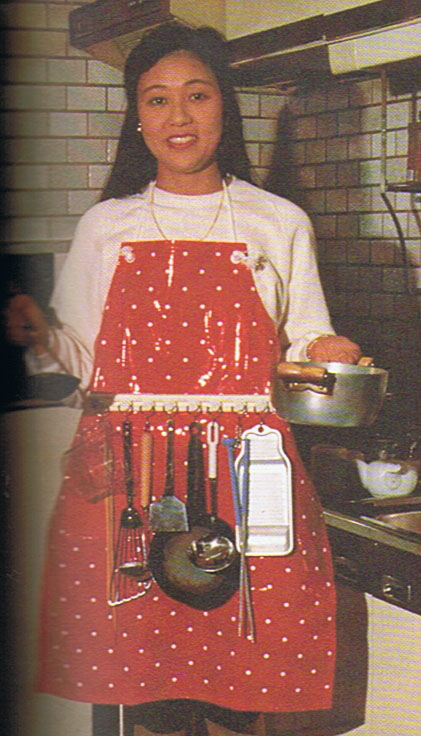
Carry-all apron. Have all your cooking implements within easy reach!

chindogu3
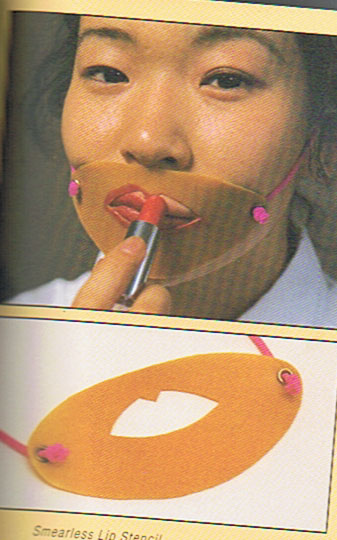
The lip stencil — perfect lips every time!

chindogu5
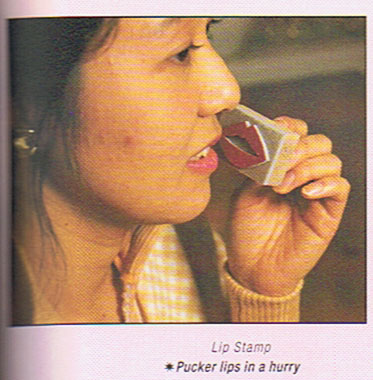
and if that lip stencil isn’t working for you, try the lip stamp!

chindogu4
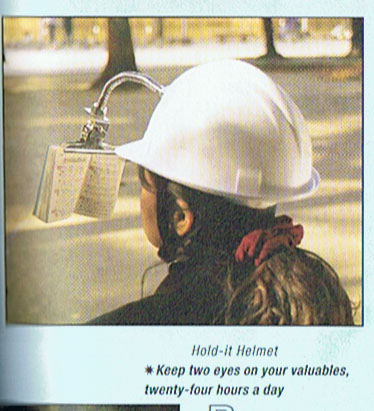
The hold-it helmet — for hands-free reading!

chindogu6
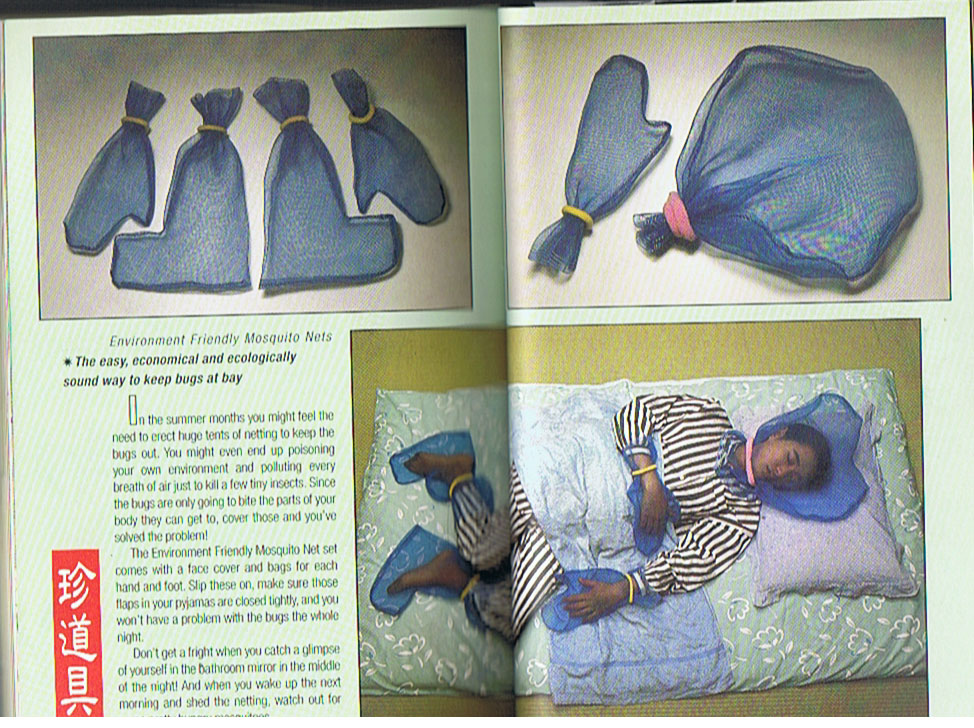
The solution to my fear of getting dengue fever again.

Now wasn’t that fun? My nurse was wondering why I was laughing so hard.

I have to return the book to Chickoy, so will definitely keep my eyes peeled for my own copy. There are other books in the series too, I’ll definitely want those as well.

***

My copy: trade paperback, borrowed from Chickoy

My rating: 5/5 stars for sheer entertainment value

Kare Kano Marathon

I like reading manga series when I can read them from the first volume. Luckily, I was able to mooch books 1, 2, and 4 of Kare Kano: His and Her Circumstances by Masami Tsuda from local moocher Cizi (books # 77-79 of 2009) and I’ve got book 3 on its way from the Netherlands.
Kare Kano is a romantic comedy featuring the seemingly perfect Yukino Miyazawa and her school rival Soichiro Arima. 

Yukino is the #1 student in her high school, and is admired for her beauty, talent, and intelligence. But beneath the perfect façade, Yukino is a control freak playing a part, as she is a brat and a slob at home, studying obsessively to keep up her grades.

When she enters high school, the new student Soichiro shows up and gives her a run for her money. The perfect façade cracks, and Yukino plots to take him down and regain the attention of her peers, but she didn’t plan on falling in love with him in the process.

Yukino has more in common with Soichiro than she thinks, because Soichiro is keeping up the perfect façade to prove to himself and his adoptive parents that he did not get his birth parents’ bad genes.

As Yukino and Soichiro get to know each other and their relationship blossoms, they both learn to loosen up and be true to themselves.

Kare Kano is a he said – she said story, with chapters alternating between Yukino and Soichiro. It is one of the first series released by Tokyopop, an English-language manga publishing company that is fast becoming a favorite of mine.It has also been adapted into an anime series, although I have yet to watch it.

I like the character of Yukino, specifically because she reminds me a lot of myself back in school. Back then, I was always in the honors class, and I understand her need to keep up appearances to live up to other people’s expectations.

I also like the character of Soichiro, because I am such a sucker for overachievers and I really don’t blame Yukino for falling for him.

The chemistry between them is good, and the story gets pretty funny, especially when new characters, like the hunky Hideaki (book 2) and little Tsubasa (book 4) are introduced. There are also nice little moments like Yukino working up the courage to tell Soichiro she loves him, the first time they hold hands, the first date, the first hug, the first kiss. It’s a bit nostalgic for me, because I remember one particular person in my life, but hehe, that’s another story.

I also like the little notes in the margins left behind by Masami Tsuda, as well as the Tsuda diary section at the back of the book because it gives great insight into her creative process, and gives a better understanding of the context of some cultural nuances, like Japanese school uniforms, or references to Japanese novels.

I can’t wait to read more of this series. Hopefully they’ll turn up on BookMooch.

***
My copy: Books 1, 2, and 4 in paperback, local mooch

My rating: Book 1, 2, and 4: 4/5 stars

Let’s play Kokology!

Quick, answer this little quiz for me before you read on, the first thing that comes to mind will do:

1. A book is lying in front of you. What type of story does it contain?

2. You begin to read and soon find that you yourself are a character in the story. What kind of role do you play?

3. You read further and come to a section where the pages have been damaged, making them nearly impossible to read. What part of the story is it?

4. You have just closed the cover after finishing the book. How was the ending?

The little quiz above is from the book Kokology: The Game of Self Discovery by Tadahiko Nagao and Isamu Saito, who define kokology (Japanese kokoro, mind, spirit, feelings + Greek logia, the study of) as “a series of psychological games designed to uncover emotional and behavioral traits of the players.”

I discovered Kokology in high school, when the first volume came out. I remember how we took turns checking the book out from the library and answered the quizzes in between classes, or when the teacher wasn’t looking.

Last year, I mooched a hardbound edition that compiles both volumes 1 and 2, and I’ve been answering random pages whenever the mood strikes.

It kills me that I forgot about this book for the Flips Flipping Pages Japanese book discussion a couple of weeks ago! *palm face*

I found out that before the book, Kokology was actually *drumroll please* a game show that ran in the early 90’s, where contestants answer the quiz questions and the interpretation turns out to be shocking or hilarious (e.g. what you shout when your roller coaster car plunges into pool = what you scream at orgasm).

In the hardbound compilation, there are over a hundred quizzes that delve into the subconscious, revealing how you truly feel about work, love, family, sex, and many more! Psych testing has never been this fun — I remember once when I was applying for a job, we had to undergo psychological profiling and it was a half-day’s worth of seemingly endless tests; I was getting paranoid about what I was revealing to a potential employer and I felt like my brain was getting picked. Kokology takes a more subtle, non-threatening approach.

Of course, like all pop psychology, Kokology interpretations range from spot-on to totally off the mark (depending on the person), and it’s up to you to take it or leave it. But it does provide great entertainment for small groups who are game for some good-natured ribbing.

So let’s see what your answers say about you.

According to Kokology, books and school are inextricably linked, and the answers you gave in response to this scenario likewise echo your own experiences during school.

1. The type of story you imagined reflects your general impression of your school years.

Does your answer suggest you lived through a comedy, a mystery, or a romance? Then again, who among us didn’t?

Or perhaps it was an erotic novel? Either you were a very precocious child or you had an overactive imagination.

A Shakespearean tragedy? The fact that you survived all five acts has added nobility to your character.

2. The role you saw yourself in is the image you have of yourself in your time as a student.

Were you the star of the tale? A sidekick? Comic relief? Or no more than a bit player with only a single dialogue on page 283? It may just be that your character was being developed for the sequel.

3. The scene described in the damaged pages mirrors a situation in which you were hurt during your youth. Broken hearts can hurt as much as an act of violence, and even seemingly minor traumas can take a lifetime to heal. Although at first there might not seem to be any immediate connection to your life, if you think back to your past, it’s more likely you’ll find some buried painful memory associated with the scene.

4. The ending of the story is an expression of your feelings of closure (or lack thereof) regarding your days spent at school.

Did you answer something like, “And they rode off into the sunset to live happily ever after”? A little cliched, perhaps, but you can’t argue with success.

Perhaps you envisioned a story in which your character dies in the end? It’s likely you greeted your graduation as a chance to be reborn into a new life.

Or was the ending a cliff-hanging “To be continued…”? In a way, that’s the most accurate response you could give. You’ll just have to wait and see how the next episode turns out.

***
My copy: hardbound, no dust jacket

My rating: 4/5 stars

What happens when you cross the line…


when you discover a taste for the unthinkable?

Could you be drawn into a murder?

For friendship?

For a way out of your dreary experience?

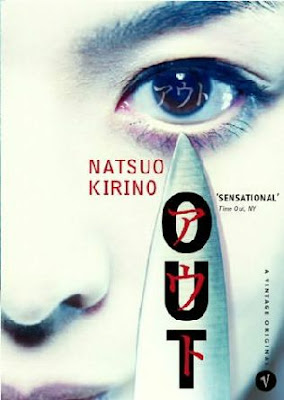
These are the haunting words on the back cover of the novel Out by female Japanese novelist Natsuo Kirino (Book #46 for 2009, Book 7 for diversity challenge – book discussion selection).

I had been mulling over my choices for this month’s FFP discussion, which will center around Japanese books. I have a bunch of Murakamis in my TBR, but I read Norwegian Wood last year and I don’t think I am ready for another one just yet. I also have Snow Flower, Secret Fan by Lisa Yee, but I also just recently read Memoirs of A Geisha and I wasn’t in the mood for another geisha novel so soon. I was considering reading a couple of manga books, when I took out the front stacks of my TBR shelf and found this book.

I’d been terribly busy the past week, so I was apprehensive that I wouldn’t be able to finish this book, at 520 pages, but I read a few odd chapters Wednesday night, polished off nearly half of it last night, and finally finished it off about an hour ago.

Researching on Natsuo Kirino for the weekend’s discussion, I found out that Out is actually an award winning novel: it received the Grand Prix for Crime Fiction, Japan’s top mystery award, and was a finalist (in English translation) for the 2004 Edgar Award. It is also Kirino’s first novel published in English, and the US film rights have been bought by New Line Cinema, to be directed by Nakata Hideo (of The Ring fame).

It was also interesting to find out that Natsuo Kirino is one of the most famous writers in the rise of Japanese women’s detective (misuterii) fiction that started in the 1990s, who have uniquely used the genre of detective fiction to depict and comment on present-day Japanese society and the Feminist situation.

Translated by Stephen Snyder, Out is a gritty crime novel about 4 women in contemporary, urban Japan: Yayoi, Masako, Yoshie, and Kuniko, who work on the night shift in the assembly line of a bento box factory. The foursome leads a troubled existence, each in their own way: Yayoi has a philandering and gambling husband; Masako is estranged from her husband and son right in her own home; Yoshie is a struggling widow with an ailing mother in law and a wayward daughter; and Kuniko is a shopaholic buried in debt.

One night Yayoi turns up at work dazed, and they find out her husband has beaten her, and she reveals that he has gambled away all their life savings. The next day, Masako gets a phone call from Yayoi asking for help — she has killed her Kenji in a fit of rage. Masako volunteers to dispose of the body, enlisting the help of Yoshie and Kuniko. The three dismember Kenji’s body and fill several trash bags, divided among themselves for disposal across the city.

The story gets more complicated after the body parts are discovered in a city park, and the police start investigating. But the women have more than the police to fear — a money-grubbing loan shark who figures out what they’re done, and a menacing nightclub owner who loses everything when he becomes the primary suspect in their crime and is now out to exact his revenge.

Out is definitely not for the weak of heart — it pushes the envelope on conventional views on sex, violence, feminism, and justice. I’m one of the less squeamish readers I know, but even I found this novel difficult to take in. It took me a while to remember why I actually mooched this book, and after racking my brains I remember why — I came across it in a recommendation list after I read Perfume by Patrick Suskind (which I have yet to review, but I’m looking forward to rereading it for an FFP discussion this year, so I’ll save it for then).

Out is similar to Perfume mostly because of the methodical procedures related to the murder (Grenouille’s approach to murder in Perfume and the carving of Kenji’s body parts in Out). Reading this book, I felt like I was watching episode after episode of Crime Night, and while uneasy, I was also reading in morbid fascination, much like I had read Perfume.

But the similarities end there. While I sympathized with Grenouille’s character in Perfume, I clearly knew he was psychotic and I can honestly say I would never go on a rampage like him. In Out, I could identify with the four women, as real as they come, who each dreamt of an escape from their lives, a way out. And it really got me thinking: would I do the same if I were in a similar bind?

I remember a text message I’d exchanged with some gal pals some years back; I don’t remember the exact words, but it went something like this: if I had killed a man, my friends would show up on the doorstep with a shovel, no questions asked.

Would I do it if a friend asked for my help?

What would it take to push me across the line?

The questions are haunting, but they do make you think.

As this is the first Japanese detective fiction I’ve read, I’m amazed that the Japanese culture has a long history of mystery writers, and is probably the only culture outside the Western world that has successfully assimilated this genre.

I’m also blown away that female Japanese writers were able to take this Western genre and make it their own (Japanese women’s detective fiction is a very popular genre, apparently), giving us an insight into the female situation. So many issues were successfully tackled in this book that were seamlessly incorporated into the story — domestic abuse, prostitution, poverty, climbing up the corporate ladder, beauty, weight, self-image — not easy, I imagine, but Natsuo Kirino does it quite well.

Now that I’ve discovered Japanese detective fiction, this opens a whole new world for me in mystery books — it’s a whole new genre to explore!

That’s it for now, must pack
for the weekend!

***
My copy: Vintage trade paperback, mooched from the US

My rating: 4/5 stars