V-day reading (Book 30! Woot!)

Love Story by Erich Segal
Book #30 for 2009
Book #4 for Diversity Challenge (Reading group requirement)

Reading Erich Segal’s Love Story was like running into an old friend I hadn’t seen in a long time.

It must be ten years since the first time I read this book, back in second year high school, a time when all we ever wanted to read were books about undying love, books that make us gush and sigh and cry and wish that someday we’d be able to experience the things we read about (oh, but that is another story…).

I was actually dreading reading this again, because I felt I’d outgrown it already, and if it were not for the Flips Flipping Pages discussion, I wouldn’t have read it again, because the mere sight of the book actually had me snorting in derision.

I didn’t have a copy of the book, and I’d seen dozens of copies of it at Book Sale in the past, but of course, as luck would have it, no copies were to be found now that I needed it. I’d once again proven the law of Book Sale: the amount of urgency applied in seeking out a specific title at book sale is directly proportional to the possibility that it (and multiple copies, too) will turn up when you no longer need it or already have a copy. I ended up mooching a hardcover copy (yes, of course, if I have to mooch internationally, I’d rather have a hardcover) from California, and got it just in the nick of time, the day before the discussion.

To my surprise, I got through the whole book without a single derisive snort! Rereading it was much better than I expected. Though I wasn’t reading it with the eyes of a thirteen-year old girl anymore, I actually still liked it.

It’s the simplicity of the story that has given this book its staying power: rich boy meets poor girl, they fight for their love, but the triumph is short-lived as the girl gets sick and dies tragically young (oops, is there anyone who doesn’t know how Love Story goes?). I agree with our discussion moderator, Czar, when he said that Erich Segal knew when to rein himself in, just short of the point of being mushy.

Like Jenny, I love Oliver Barrett III’s name and numeral (hahaha!) — who wouldn’t? He’s smart, rich, handsome, athletic, and even his rambunctiousness adds to his charm. Jenny Cavilleri, on the other hand, is exactly the girl who can whip his cute little tosh into submission, with her snooty demeanor, smart-ass mouth and artistic temperament. The highlight of the book for me was the playful banter between the two, and the fact that Jenny always got the final word.

Yesterday, we also watched the movie and I was surprised to find out that the screenplay actually came before the book, and Segal actually just wrote the book to promote the movie. The book was mostly faithful to the movie, except for the point of view, but I felt that the final scene was better in the book.

One of the points raised in the discussion was that the movie was actually more realistic, because relationships (in this case, Oliver and his dad’s relationship) don’t get fixed just because someone dies, and closure doesn’t come that easily. While I see their point and agree with it in essence, I don’t think that was what the book meant to say. In the book, as Oliver cries in his father’s arms, I didn’t see Jenny’s death as a cure-all for their relationship, but rather an opening to reach out to each other, and merely the start of Oliver’s coming to terms with Jenny’s death.

“Love means never having to say you’re sorry” (note: in the book it’s actually, not ever, not never) is probably one of the most trite expressions about love today, and while I am not in the position to debate its meaning, I guess it’s not the line’s fault that several generations of readers (and film viewers) all over the world have used it for almost 4 decades now.

I didn’t expect to say this, but I’m definitely keeping this book.
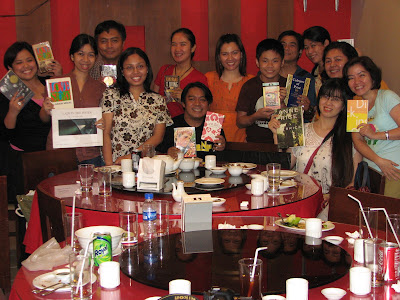
Flippers celebrate V-day with Love Story at Red Palace!

***
My copy: hardcover first edition with dustjacket
My rating: 4 out of 5 stars

Curiouser and curiouser…

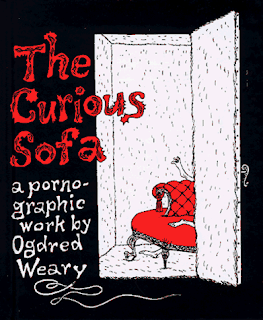
The Curious Sofa: A Pornographic Work by Ogdred Weary
Book #29 of 2009
I took a break from reading In the Company of the Courtesan first, as I dropped by Mall of Asia after work to hit Book Sale, and get my stash of “carmel”-cheddar popcorn from the Chicago Popcorn Shops (yum!) with my sister.
So I got home around 10 and stretched out on the padded divan with The Curious Sofa. When I picked it up at Book Sale, I actually recognized Edward Gorey’s illustration style instantly, so it was a cinch to figure out that Ogdred Weary was a pseudonym, an anagram of his name.
To those who don’t recognize him, Edward Gorey is an artist/writer known for his macabre pen and ink illustrations and over a hundred books, the type that blur the line between adult books and children’s books.

The Curious Sofa
instantly caught my attention due to the subtitle (a pornographic work), so of course I had to buy it, haha, I thank my lucky book-scavenging stars that it was only P25 (Squee!).
The book is about a young woman named Alice, who meets the well-endowed Herbert in the park, and they hop from place to place and are joined by more and more “well-endowed” people, and they all do, erm, “naughty” things together.

“Naughty” is in quotation marks because Gorey leaves it to the reader’s imagination. The picture book is actually as just as pornographic as you think it is, because while it makes a lot of suggestions, it doesn’t actually contain anything overtly pornographic, and the characters could all be twiddling their thumbs or having wild wild sex, depending on how much fun you want to have with the book.

Curiously (pun intended), the book reminds me of one other book on my shelf — Audrey Niffenegger’s The Three Incestuous Sisters, which is about six times the size of this book. I got my copy at the National Book Store cut price sale, for P299.

The Three Incestuous Sisters is in full color, albeit a muted palette and sepia undertones, painstakingly created using watercolor and a technique called aquatint, where a pattern is scratched through a layer of wax on a zinc plate. The plate is then submerged in an acid bath. The acid erodes the zinc where the pattern is scratched and creates grooves for the ink to fall into to create a print. No wonder it took Niffenegger 14 years to finish the book! The paintings are haunting, and bizarrely beautiful at the same time.

Niffenegger (author of The Time Traveler’s Wife), calls it a novel in pictures. It tells a twisted story of three sisters who lived by the sea: Ophile, the smart one; Clothilde, the talented one; and the youngest, Bettine, the pretty one. When Ophile and Bettine fall in love with the same man, the storyline goes off on a surreal tangent, as tragedy after tragedy strikes, and the sisters’ relationship is never the same again.
Both books employ the noir style and surrealism, although The Curious Sofa was some three decades ahead, copyrighted in 1961. They differ in tone, though, as Gorey’s work is cheeky and humorous while Niffenegger’s is evocative, and deep-seated in emotion.
I lean more towards Gorey though, as I felt really drained after reading The Three Incestuous Sisters, as if I’d absorbed all the emotions flying around in the book. And also because I’m not a big fan of the surreal; there’s just a point where it becomes hokey to me.

***
My copies: The Curious Sofa, hardbound; The Three Incestuous Sisters, hardbound

My rating: The Curious Sofa, 5/5 stars; The Three Incestuous Sisters, 4/5 stars

Sleuthing in the dark

From Charlie’s Point of View by Richard Scrimger

Book #28 for 2009

I had high hopes for this book because it had such an original premise: the Stocking Bandit has been on an ATM robbing rampage, and Charlie’s dad has been arrested because the police are convinced he is behind the crime.

As if that isn’t enough for a kid to deal with, Charlie happens to be blind. With the help of his friends, Charlie must find the real Stocking Bandit — and fast!– before it’s too late for his dad.

As YA books go, it’s a good blend of relevant themes, such as dealing with a disability, friendship, family, and bullying, but the multiplicity of themes also works against the book, as it draws the story away from the mystery. As a whodunit, it doesn’t quite take off because it tries to tackle so many themes that only bog down the book.

It takes forever to before the action and the actual sleuthing starts, and while the main premise of the book is a blind sleuth (which, to me is so cool), the actual sleuthing isn’t all done by Charlie. I understand that he needs his friends to act as his seeing guides, but they end up stealing a lot of the thunder. The book is entitled From Charlie’s Point of View, and yet the story’s point of view (the persona) shifts to his friends Bernadette and Lewis every few chapters and it annoyed me because I think it leaves the main character, Charlie, short-changed.

The book design is thoughtful; I think the braille patterns and the blank spreads signifying Charlie’s blindness were great details, but it takes more than that to hold a reader’s attention.

This is the second book I’ve read in Dutton’s Sleuth line — the first was Lulu Dark Can See Through Walls, which was average — and I’m getting quite disappointed. I think I’ll pass the next time I come across another title from this series.

***
My copy: hardcover with dust jacket, P50 from the Fully Booked sale table, now on my BookMooch inventory.

My rating: 2/5 stars

Before The 39 Clues…

… there was a little book entitled The Westing Game. And although they were written 20 years apart, The Westing Game still trumps The 39 Clues big-time.


(I wasn’t able to finish the book I am reading (From Charlie’s Point of View) because I was busy sorting books and squee-ing because of my latest book hoard, so let me share one of my favorite books instead.)

Winner of the 1979 Newbery Medal, Ellen Raskin’s The Westing Game is a book I’ve read more times than I can count — I remember a few times I actually read it twice in one day. I’ve also run through 4 different editions of the book — mass market, Puffin Modern Classic, trade paperback, and finally, a hardcover I found at Book Sale last year. It’s original, intelligent and entertaining, and a brilliant whodunit to boot!

Sixteen different people — of different ethnicities, and of no apparent relationship to one another except that all of them either live or work in the same apartment building — are summoned for the reading of Samuel W. Westing’s will.

All 16 of them are surprised to find out they are heirs to the Westing fortune — Sam Westing is the founder of Westingtown, Wisconsin, and owner of Westing Paper Products. The catch? The will is a contest: one of the heirs has murdered Sam Westing, and whoever finds the culprit will be the heir to strike it rich.

The heirs are a crazy and spirited bunch, among them:

James Shin Hoo, owner of a Chinese restaurant, also an inventor;
Madame Sun Lin Hoo, Shin Hoo’s wife, imported from China;
Doug Hoo, a track and field athlete;
Christos Theodorakis, a kid confined to his wheelchair and an avid birdwatcher;
Theo Theodorakis, Chris’ brother, a high school student, pal of Doug Hoo;
Dr. Jake Wexler, podiatrist;
Grace Windsor Wexler, Dr. Wexler’s idle wife;
Turtle Wexler, the Wexlers’ smart aleck younger daughter;
Angela Wexler, the Wexler family beauty, engaged to be married to
Dr. Denton Deere, an intern;
Flora Baumbach, a dressmaker;
Alexander McSouthers, the apartment’s doorman;
Josie-Jo Ford, a judge;
Berthe Crow, the cleaning lady;
Otis Amber, the messenger;
and Sydelle Pulaski, a secretary.
The characters are full of little quirks that make them all interesting and endearing, and they plod through blizzards, burglaries and bombings in deciphering the clues to get the family fortune. I also like that the female characters in the book are feisty and liberated (or gain liberation along the way). Turtle Wexler rocks!

What’s fun about this book is that it will keep you guessing, with a variety of imaginative puzzles you can solve together with and the characters… and then wham! Revelations throughout the book will make you doubt your original guess. And just when you’re ready to give your final answer… bam! Raskin turns everything around with a twisty plot!

I am getting worked up just talking about it, hahaha. I just love this book :)

***
My copy: hardcover with dust jacket, plus a trade paperback for lending and rereading

My rating: 5/5 stars

Persepolis

Was finally able to watch the Persepolis movie yesterday, and it comes as a relief that it’s not one of those annoying movie adaptations that fail to live up to the reader’s expectations.

If you’re not already familiar with the 2-part graphic novel (although there is already a complete edition with both parts in one book), Persepolis by Marjane (mar-zhan) Satrapi is a coming-of-age memoir in comic strips, narrating her life growing up in Iran during the Islamic revolution, studying in Austria, and then returning to her home country.
The comics, done in pen and ink, swing between irreverent and hilarious to poignant and insightful. I liked the first book, which is focused on Satrapi’s childhood, better than the second, which deals with her schooling abroad onwards. The perspective changes in the second book, naturally — the humor gets drier as she grows older and deals with more issues, but it is still worth reading to get the whole story.To parents who are wondering if the comics are suitable for young readers, the first book is okay for younger teens (6th grade to junior high, but be prepared to answer questions and explain certain concepts), but reserve the second book for later, as it deals with more mature issues.

The Persepolis movie, which debuted at the 2007 Cannes, is as highly acclaimed as the book. The animation is a bit more polished than the comics, but resembles it closely enough that you wouldn’t really notice. Some episodes from the first book are not in the film, especially those that don’t really propel the story forward, but the film is in essence faithful to the book.

The film also manages to make some episodes even funnier and some even more poignant, even though I’d read them already, and an adaptation that can do that is worth lauding. I cried a bit when uncle Anoush gave Marji the bread swans, and when the”Eye of the Tiger” sequence was rolling, I was doubled over laughing!

Film adaptations, when executed properly, add another dimension of enjoyment to the experience of reading a book, and the Persepolis movie does just that. It’s one of the very few movie adaptations that I’ve enjoyed recently, so bravo to that!

***
My copies: Persepolis 1, trade paperback, from NBS Book-sak Presyo Sale (a steal at P75); Persepolis 2, trade paperback, mooched from abroad

My rating: Persepolis I, 5/5 stars; Persepolis II, 4/5 stars
Persepolis movie, 5/5 stars