One heck of a sleeping pill…

The Dream Merchant by Isabel Hoving

Book #26 of 2009

I can’t believe I actually finished this book, because I fell asleep thrice while reading it, and had some very strange dreams too.

I saw this book at National Bookstore and was attracted by the handsome cover — deep red with a gilt pattern, with red jewels embedded in front. I searched it on BookMooch and found a copy of the exact edition and mooched it, and was excited to read it as soon as it got here.

I tried starting it a few times last year but I couldn’t spark a connection with the book. Finally, because I stayed home all weekend, I decided to stick it out, and for a six-hundred page book in fairly small font, with lots of vague mumbo-jumbo, I really am surprised I managed to finish it.

The Amazon reviews are high, all either 5 star or 4 star, but considering there are only 8 reviews in total, I shouldn’t have been too confident (haha, I really shouldn’t believe Amazon reviews).

The story is weird — 12 year old Josh Cope is hired by Gippart, a trading company that operates in dreamworlds called umaya. Due to a complication created by some overzealous Gippart employees in one of their operations, Josh and his team are trapped in the umaya and they must travel backwards in time.

It sounds hokey, I know. The ideas were there, but they weren’t sufficiently expressed , and it frustrated me. I hate it when fantasy books introduce strange concepts but don’t give you substantial information or context and expect you to automatically accept and understand its strangeness. Up to the last page of the book, I still couldn’t understand the point of the book and half the things they were saying!

Reading the amazon info, I found out the book was translated from Dutch. Perhaps its real merit was lost in translation.

I want to give this book away because my frustration with it irritates me, but it’s so pretty I still want it on my shelf.

***
My copy: hardcover

My rating: 2/5 stars

Picture book roundup #2

Got myself some great picture books for my collection this week:

Jumanji written and illustrated by Chris Van Allsburg (#23 for 2009)
Monster! written by Angela McAllister, illustrated by Charlotte Middleton (#24 for 2009)
Tuesday written and illustrated by David Wiesner (#25 for 2009)

and I’m throwing in one other book from my “for shelving” pile (just finished covering, hehe): To Market, to Market written by Anne Miranda, illustrated by Janet Stevens

I was covering them in plastic this afternoon, so I decided I might as well read and review them so I can shelve them already.

To Market, to Market is a hilarious retake of the famous Mother Goose rhyme:

“To market, to market, to buy a fat pig,
Home again, home again, jiggity-jig!”

In this story, the old woman goes to the market and buys a fat pig… and also a hen, a trout, a goose, a lamb, a duck, and a goat.

Chaos ensues when she brings home the animals one by one and they start to escape and make a mess around the house, and the old woman gets crankier and crankier.

Finally, the old woman goes back to the market together with all the animals and buys a bunch of vegetables. Then they go home, and the old woman makes a rich, hot soup that she shares with all the animals, and they all collapse into a happy pile on the kitchen floor.

I actually let out a sigh of relief at the end of the book because I was afraid she was going to cook all the animals to get rid of the racket they were making.

I also liked the illustrations in the book — an interesting combination of photocopied pictures (black and white, for the backgrounds) and watercolor (full color, for the animals and the old lady), as they captured the humor of the story perfectly.

Check it out here.

I actually haven’t read the original Jumanji until today, but the movie (as well as the movie novelization) was a childhood favorite.

The storybook is actually a simpler version, without the Robin Williams plotline, but most of the elements from the game are there.

Jumanji is a Caldecott awardee, and Chris van Allsburg’s illustrations, are as always, superb. Monochromatic pencil drawings, clean lines, and masterful use of the play of light and shadow — his art never fails to awe me.

Check the book out here.

Next in the lineup is Monster! a story that deals with the responsibility of keeping a pet, an issue that is close to my heart. I agree that kids need to learn this, because they often think pets are toys, and even as grown-ups some people do not take pet-keeping seriously.

The story is quite effective in driving the message across. It’s about a kid named Jackson who wants a pet so badly, so his dad gets him a hamster, which he immediately names “Monster.” The hamster is a novelty, and after a week he forgets to clean Monster’s cage, and forgets to feed the hamster altogether (tsk, tsk, tsk…).

One day, Monster escapes from the cage, gets into the sack of hamster feed, and grows into a real monster, and things take on a surreal reversal of roles. Jackson becomes the pet and he finds out for himself how it feels to be neglected.

Thankfully, it is all a bad dream, and when he wakes up, he finds his hamster, renames him “Fluffy” and resolves to take better care of him.

The illustrations in this book are interesting too, as upon closer examination, I discovered they’re actually a collage of paper cutouts outlined in dark pencil.

The last book in this lineup is the Caldecott awardee Tuesday by David Wiesner, which I got, hardbound for *drumroll, please* P15! All right, so it’s a library discard and a little beat up, but I don’t really care, it’s nothing a fresh plastic cover and invisible taped won’t fix. I actually mooched a copy from Israel, but it’s been some months now and I think it might have gotten lost in the mail, so this will have to do for now.

It’s a book with very few words, about some very strange happenings one Tuesday night, when hundreds of frogs (what do you call them in collective anyway? Ooh, google says it’s “army”) fly into the night sky on lilypads, running into lines of laundry, inside windows, down fireplaces, past trees and dogs.

The lilypads lose their flight as soon as the sun rises, and the next morning, to the townsfolk’s puzzlement, the street is littered with lilypads and some people swear they saw things zooming across the sky the night before.

The story ends with a funny twist: next Tuesday, and this time, it’s the pigs that are flying.

I am not fond of frogs so I was actually queasy at the sight of so many throughout the book, but it’s fascinating how each frog’s pattern is painstakingly different from the others. The visual narrative is awesome too — Wiesner is a master of wordless picture books.

Check out the book here!

Sigh. Book Sale is a tre
asure trove for picture book collectors.

***
My copies: To Market, to Market, paperback (P30, from Pick-a-Book warehouse); Jumanji, hardbound but missing dust jacket (P55 from Book Sale); Monster!, paperback (P15 from Book Sale); Tuesday, hardcover with dust jacket (P15 from Book Sale)

My rating: To Market, to Market, 4/5 stars; Jumanji, 5/5 stars; Monster!, 4/5 stars; Tuesday, 5/5 stars

Geisha

Memoirs of a Geisha by Arthur Golden

Book # 22 of 2009

Back in college, everyone was reading Memoirs of a Geisha, naturally sending me running in the opposite direction, especially when the movie came out.

Then when I discovered BookMooch, I decicded to go and get myself a copy, only it turned out to be a mass market paperback (I am admittedly a mass market paperback snob) so I was reluctant to pick it up and I packed it on my RORO trip but a few pages ended up getting squashed inside my luggage (bus compartments and all)… Then I got a trade paperback copy from an FFP book swap, although I still didn’t read it. Finally, I was able to mooch a hardcover copy from Triccie early this year and I’ve pretty much run out of excuses already.

Like The Kite Runner, this book needs no introduction. I read it on and off for a couple of days, and it was interesting enough to keep me reading until the end, but not so compelling that I could not put it down.

My bone to pick with the book is that while it is well-written (style-wise) and gives an insight into the geisha culture, the voice is startlingly Western, as if I was watching an anime character that has been dubbed over by an American accent. Aside from Golden giving the story a “fairy tale” (in Sayuri’s mind) ending, Sayuri’s cluttered train of thought was so distractingly un-Japanese, and I found myself looking for the quiet subtlety I’ve come to admire in Japanese writers.

I actually want to talk about another geisha book, one we read for Great Books class back in college, and was really memorable to me: Snow Country by Yasunari Kawabata.

Kawabata is the first Japanese author to win a Nobel Prize for Literature, and Snow Country is his first full-length novel.

Snow Country, often touted as the convergence of haiku and a novel, is a tragic love story set in a geisha district in snowy Western Japan.

I love the juxtaposition of beauty and sadness (a specialty of Kawabata’s — he has another novel entitled Beauty and Sadness) in Snow Country, the breathtaking but bleak snow-capped mountains providing the perfect backdrop for this theme.

“In the depths of the mirror the evening landscape moved by, the mirror and the reflected figures like motion pictures superimposed one on the other. The figures and the background were unrelated, and yet the figures, transparent and intangible, and the background, dim in the gathering darkness, melted into a sort of symbolic world not of this world. Particularly when a light out in the mountains shone in the center of the girl’s face, Shimamura felt his chest rise at the inexpressible beauty of it.”

The tragic love affair is between the wealthy Shimamura and the hot-spring (provincial) geisha Komako. Shimamura trifles with feelings while Komako’s whole being revolves around them. Komako devotes all of herself to Shimamura, with full knowledge that the more they love each other, the farther apart they’ll become.

As plots go, nothing much happens in this book, but the moving emotion of Kawabata’s writing makes it a masterpiece.

I especially like this passage on journalling books:

“But even more than her diary, Shimamura was surprised at her statement that she had carefully cataloged every novel and short story she had read since she was fifteen or sixteen. The record already filled ten notebooks.

“You write down your criticisms, do you?”

“I could never do anything like that. I just write down the author and the characters and how they are related to each other. That is about all.”

“But what good does it do?”

“None at all.”

“A waste of effort.”

“A complete waste of effort,” she answered brightly, as though the admission meant little to her. She gazed solemnly at Shimamura, however.

A complete waste of effort. For some reason Shimamura wanted to stress the point. But, drawn to her at that moment, he felt a quiet like the voice of the rain flow over him. He knew well enough that for her it was in fact no waste of effort, but somehow the final determination that it was had the effect of distilling and purifying the woman’s existence.”

With all these books about geisha, wired_lain, a BookMooch friend in Japan, tells me that the geisha are getting sick of so much attention from tourists, who bug them to take photos. I can just imagine how irritating that is.

***
My copy: Memoirs of A Geisha, hardcover; Snow Country, trade paperback

My rating: Memoirs of A Geisha, 3/5 stars; Snow Country, 5/5 stars

Charmed.

(This post is rather lengthy, I know — I’ve just wanted to write about this book for so long!)
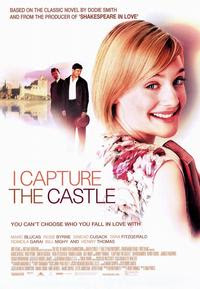
There was one book I forgot to list down among my top picks for 2008, one of the buzzer beaters, which I finished on the 28th of December: I Capture the Castle by Dodie Smith.

Dodie Smith’s more famous work is the children’s story The 101 Dalmatians, but before that, she wrote a novel entitled I Capture the Castle in 1948.

I only learned about I Capture the Castle because J.K. Rowling named it as one of her favorite books — I love the books she recommends; my cousin and I discovered the Cirque du Freak series also because JKR raved about them.

I found a fairly new copy at Book Sale (the best! I swear!) last year, but it took a few more months before I finally found an opportunity to read it without interruptions — on my holiday trip after Christmas, where I indulged in a lot of fresh air and four days of reading bliss.

Meet the Mortmains

I Capture the Castle is the journal of 17-year old Cassandra Mortmain, who lives with her eccentric family in a crumbling English castle in the countryside in the 1930s.

The Mortmains are dirt-poor but such characters! Cassandra’s father (she calls him Mortmain) is something of a one-hit wonder writer. His first book, “Jacob Wrestling” was a big hit in the past decade, prompting him to move his family to the countryside for inspiration, although it never came — he has a ten-year old case of writer’s block. The Mortmains have a 40-year lease on the castle, but over the years, they have had to sell off all the good furniture just so they can buy food.

Cassandra’s mother has passed away early on, so her father remarries the young Topaz, who is well-meaning but flighty. She is a model who poses nude for artists, and habitually “communes with nature” (er, frolics in the meadow) in nothing but hipboots.

Cassandra’s elder sister, Rose, is the family beauty (golden haired and rosy-cheeked) who despairs of being poor and wants to hook a rich husband (her main fantasy is to live in a Jane Austen novel). Their younger brother, Thomas, is often away at school on a scholarship courtesy of the local vicar, and although he doesn’t appear often, he is quite endearing as well.

The family also includes Stephen Colly, the son of one of their old servants, who continues to help out around the house even though they have nothing to pay him and he ends up getting a job outside to contribute towards the family budget. Stephen also happens to be in love with Cassandra, but unfortunately, Cassandra loves him like a brother.

Finally, there is the snowy-white bull terrier Heloise, who rounds out the family picture.

Things change for the family one fateful night, in a rather comical episode. Rose is overcome with despair about being poor, and attempts to do a Faust by hauling herself up on a pulley to wish upon the gargoyle mounted high on their kitchen fireplace. That same night, they meet the Cottons — the rich family who are now the landlords to the castle, including their two bachelor sons, Neil and Simon.

I will have to stop there before I reveal any more of the story, but more amusing episodes follow, and even as I’m writing this, I can’t help but laugh at the memory — the bathtub confrontation, the fur incident, the two wireless radios, the lockup in the tower… Equally plentiful are the sigh-inducing moments that make the book a throwback to 19th century English novels like Pride and Prejudice, Wuthering Heights, and Jane Eyre.

Cassandra and Rose also remind me of the March girls in Little Women, especially when they had to dress up for dinner at the Cottons’. Rose reminds me of Meg and Jo, when they had to go to a party and had to make do with shabby gowns. The sisters also keep an old dress form in their room, christened as “Miss Blossom,” whom they pour their hearts out to whenever they’re troubled.

A heroine like no other

I Capture the Castle is one of this century’s most beloved novels, and now I know why — Cassandra Mortmain can charm the socks off a stone monument!

“I write this sitting in the kitchen sink. That is, my feet are in it; the rest of me is on the draining-board, which I have padded with our dog’s blanket and the tea-cosy.”

This is how the novel begins, and it sets the tone for the rest of the story. It’s Cassandra’s voice that is the cornerstone of this book, and it reveals a guileless, intelligent, and feisty teenage girl, one of the most fascinating characters I’ve ever had the pleasure of reading about.

She says the most original things, and outside of EM Forster’s A Room with a View, I don’t think I’ve ever read so many lines that spoke to me all in one book! Most of the lines that struck a chord with me in this book were Cassandra’s random thoughts — some plain amusing, some thought-provoking, and others just overflowing with emotion. Her uncanny wit and sharp perception make the book such a delightful read.

Here are some of my favorite lines from the book:

On life:

“Noble deeds and hot baths are the best cures for depression.”

“Time takes the ugliness and horror out of death and turns it into beauty.”

“I wonder if there isn’t a catch about having plenty of money? Does it eventually take the pleasure out of things?”

“I should rather like to tear these last pages out of the book. Shall I? No-a journal ought not to cheat.”

On contemplation:

“Contemplation seems to be about the only luxury that costs nothing.”

“I have found that sitting in a place where you have never sat before can be inspiring.”

“I was wandering around as usual, in my unpleasantly populated sub-conscious…”

“I have noticed that when things happen in one’s imaginings, they never happen in one’s life.”


On family:

“The family, that dear octopus from whose tentacles we never quite escape, nor in our innermost hearts never quite wish to.”

On writing:

“I only want to write. And there’s no college for that except life.”

“Only half a page left now. Shall I fill it with ‘I love you, I love you’– like father’s page of cats on the mat? No. Even a broken heart doesn’t warrant a waste of good paper.”

I hope these beautiful lines tempt you to read the book, because I don’t know anyone else who has read it, and I’d love to talk about the book with someone :)

There is a 2003 movie on the book, but I’m afraid to watch it because it might ruin the book for me. If anyone has watched it, please let me know how you found it, especially if you’ve read the book too.

***
My copy: trade paperback, bought at Book Sale for P170 (yes, I shelled out P170 at Book Sale for this — so much worth it!)

My rating: 5/5 stars
Oh, the drama!

It took me over a year to go and read Khaled Hosseini’s The Kite Runner (also avoiding the movie like the plague) because I have a built-in aversion to books that are overly hyped or foisted on me by other people.

I dragged my feet for about six more months, then I decided to bring it along on a trip after Christmas. That’s another book-related habit of mine: whenever I go on trips, I always take books I have trouble starting, or books I have been hedging on for a long time, just so I’ll be forced to read them.

I’m not going to summarize it anymore, as most people have probably read it, and if not, it’s easy enough to look up on the internet. But despite the fact that I have never met anyone who’s read the book and not raved about it, I would have to say that it wasn’t particularly groundbreaking for me.
While the writing was fluid, I felt like I was reading something out of Chicken Soup for the Soul. The book seemed to be engineered to tug at the reader’s heartstrings. How can it not, with the cast of characters that are designed for the perfect tragedy? The flawed Amir who is weak and prone to doing things you just know he’ll regret, the meek and devoted Hassan, the gruff Baba who turns out to be a sad man with a lot of secrets, the equally meek and devoted Ali, the father-substitute Rahim who serves as his moral compass, and the tyrannical Assef who seems to come straight out of a B movie!
Each plot device read like a cue for the waterworks to start, and I, who can cry at the drop of a hat, was tear-free for most of the book. I’m all for catharsis, and I love books that give me a good cry, but The Kite Runner was a shade too melodramatic for me.

It wasn’t a bad read, in total, but I could have passed on the book and I wouldn’t have felt the difference. In no hurry to read A Thousand Splendid Suns.

***

My copy: trade paperback, mooched from Cheche

My rating: 3/5 stars