After
rereading the Noli a couple of months ago, I waited a while before starting on its sequel
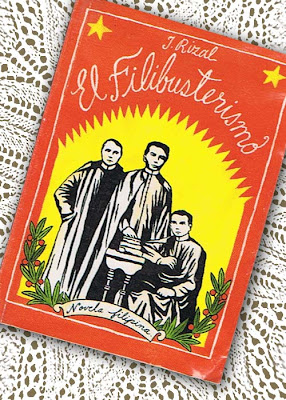
El Filibusterismo (book #80 of 2009), because I wanted to gather up the courage to read it again. Like everyone else who’s read both novels, I’ve always found El Fili more challenging than the Noli, and I wanted sufficient time to focus on the novel so I could better understand it. I ended up taking it along on a couple of trips out of town this summer.
The review is also a challenge to write — it’s not easy to comment about a book that has been read and reread by generations of Filipinos, written by a man revered as national hero for more than a century now.
Again, to my non-Filipino readers, a bit of an explanation: Noli Me Tangere and El Filibusterismo are two novels written by the Philippine national hero, Jose Rizal. Originally written in Spanish, and a catalyst for the change in political thinking in the 19th and 20th century Philippines, both novels are required reading for high school students in the country. It’s a bit difficult to summarize — you can read about it on Wikipedia.
As with the Noli, I read the Ma. Soledad Lacson-Locsin edition of El Fili (English title: Subversion) highly recommended by Flipper friend Czar (who now has his own blog!) for its rich language that tries to preserve the form and context of Rizal’s original Spanish. Now that Czar has named the two books as the common reading requirement in the FFP Diversity Challenge, I’m glad I read the books before half the year set in, but I will have to regroup my challenge entries.
Identity change
Though as prodigiously written as the Noli, El Fili stands in contrast to the Noli as it goes deeper into the ideas that the first book touched upon, and gets darker and darker until the fiery end. Crisostomo Ibarra, the protagonist from the Noli, returns in El Fili and sheds his preppy, pretty-boy image in favor of a new identity: the mysterious jeweler Simoun.
“The jeweler was a lean, tall, sinewy man , deeply tanned, dressed in the English fashion, and wearing a helmet of tinsin. What called attention to him was his long hair — completely white in contrast to the black beard, which was sparse, denoting mestizo origin. To avoid the light of the sun, he always wore a pair of enormous, blue tinted glasses which completely covered his eyes and part of his cheeks, giving him the aspectof a blind man or one of defective eyesight. He stood with legs apart, as if to maintain his balance, hands thrust into the pockets of his jacket.”
In El Fili Ibarra (as Simoun) returns to avenge all that he lost, driven to the brink of madness by all that he has experienced. The disguise is so conspicuous I’m surprised nobody figured him out for a fake sooner. But they figured Simoun was an American, he had strong ties with the Capitan-General and the assets to prove he was a jeweler. Nobody had reason to associate him with Ibarra, whom people thought to be dead, so he got away with it.
I find Ibarra’s lot in life heartbreaking. A gently bred and educated son of a wealthy family and engaged to his childhood sweetheart, Ibarra had his whole life to look forward to when he returned from his studies abroad to his hometown. But alas, he inherits his father’s enemies, and he is forced into a fate he did not want.
But it is not only Ibarra who has been transformed; time has not been kind to the other characters from the Noli, either: Basilio, the young boy hunted by the guardia civil, now a young man pursuing medicine; Maria Clara, beautiful and full of life, now wasting away at the Sta. Clara convent; Kapitan Tiago, dignified and jolly, now in a permanent opium-induced stupor. Such a tragedy!
The fire of revolution
It is difficult to discuss El Fili without touching on the revolution that Simoun incited in the novel. Simoun uses his ties with the Capitan-General and the upper class to influence them to abuse their position, to commit deeds that will stir the anger of the masses. While Ibarra would have sought diplomatic means to challenge the authorities, Simoun goes all out to set off a bloodbath, a violent revolution meant to eradicate a corrupted society.
Simoun gains the support of various aggrieved parties: Cabesang Tales, decrying the injustice his family suffered at the hands of the friars; the university students, who are proposing to establish a Spanish language academy but are meeting opposition from the Dominicans; Quiroga, a Chinese merchant aspiring for an important position in society; and eventually, Basilio, initially reluctant but pushed over the edge by the death of his sweetheart Juli.
At the biggest society event of their time — the wedding of Paulita Gomez and Juanito Pelaez, Simoun plots to wipe out the prime movers of society by planting a lamp filled with nitroglycerine in the living room, set to explode when the wick is turned up.
Simoun’s plan is foiled by Paulita’s ex-boyfriend Isagani, and he meets his death at the remote seaside home of Padre Florentino, but I imagine that to the very end, he believes it was not all in in vain, as he once told Basilio:
“Patriotism can only be a crime in the oppressor nations, because then it will be rapacity baptized with a beautiful name, but no matter how perfect humanity may become, patriotism will always be a virtue among the oppressed peoples because it will signify for all time love of justice, freedom and self-dignity… The greatness of man lies not in being ahead of his times… but in divining his wants, responding to his needs and guiding himself to march forward.”
One of the passages in the final chapter though, a piece by Padre Florentino, seems to cement Rizal’s personal stand on waiting for the right time for revolution:
“In the meantime, while the Filipino people may not have sufficient energy to proclaim, with head high and chest bared, their rights to social life, and to guarantee it with their sacrifice, with their own blood; while we see our own countrymen in private life feeling shame within themselves, to hear roaring the voice of conscience which rebels and protests, in public life keep silent, to make a chorus with him who abuses to mock the abused; while we see them enclosed in their own selfishness, praising the most iniquitous deeds with forced smiles, begging with their eyes for a portion of the booty, why give them freedom? With Spain and without doubt, because he who loves tyranny submits to it. Señor Simoun, while our people may not be prepared, while they may go to battle beguiled or forced, without a clear understanding of what they have to do, the wisest attmpts will fail and it is better that they fail, because why commit the wife to the husband if he does not sufficiently love her, if he is not ready to die for her?”

Words that come to life
Politics isn’t really something I enjoy reading, but as the novel isn’t entirely political, I found a lot of other parts to like.
I really like Rizal’s lavishly descriptive prose, as it takes you right to the heart of the scene, as if you were witnessing it before your very eyes.
For instance, this is how Rizal describes the steamship Tabo:
“Bathed by the morning sun, which makes the ripples of the river throb and the wind sing through the swaying reeds flourishing on both banks, there goes her white silhouette, waving a black plume of smoke; they say the Ship of State smokes much, too! Her whistle wails at every moment, raucous and imposing like a tyrant that seeks to rule by shouting; so much so that no one aboard understands himself. She threatens everything in her way, now seeming about to crush the salambaw, scraggy fishing contraptions which in their movements are not unlike skeletons saluting an antediluvian turtle; now running straight against the bamboo brushes or gainst the floating eating places or karihan, which, among gumamelas and already in water but still undecided on plunging in. Sometimes, following a certain bearing marked on the river with bamboo poles, the steamship moves very surely, but suddenly a shock jolts the travelers, making them lose their balance; she has struck low-lying mud which nobody suspected.”
I actually took this book along an interisland trip that involved around eight ferry rides across the country, and so this particular passage was very vivid to me. All the while I could imagine traveling down the Pasig river in the steamship Tabo, surrounded by the hustle-bustle of the ship crew and passengers.
And then there’s Simoun’s casket of jewelry:
“Simoun opened the casket and lifted the raw cotton which protected it, uncovering a compartment full of rings, lockets, crucifixes, pins, and so forth. Diamonds combined with stones of different color sparkled, stirred among golden flowers of different hues with veins of enamel, with fanciful designs and rare arabesques.
Simoun lifted the tray and displayed another full of fantastic jewels which could have overwhelmed the imagination of seven young women on the eve of seven balls in their honor. such fantastic designs, combination of precious stones and pearls, imitating insects with bluish backs and transparent wings; the sapphire, the emerald, the ruby, the turquoise, the diamond were arranged together, to create dragonflies, butterflies, wasps, bees, scarabs, serpents, lizards, fish, flowers, clusters, and others…
Nobody had ever seen such wealth before. In that box lined with dark blue velvet, divided dinto sections, could be realized the dreams of a Thousand and One Nights, the dreams of Oriental fantasies. Diamonds as large as chickpeas were scintillating, spewing sparks of fascinating hues as if they were melting or burning perfectly in the colors of the spectrum; emeralds from Peru in all shapes and cuts; rubies from India, red like drops of blood; sapphires from Ceylon, blue and white; turquoises from Persia; Oriental mother-of-pearl; some rosy, gray and black. Those who have seen in the night a giant rocket exploding against the dark blue sky into thousands of sparks of all colors, so brilliant that the eternal stars pale beside them, can imagine the aura that compartment radiated.
This is actually one of my favorite passages in this book, even back when I first read it in high school. What a spread that must have been, and I’m not surprised all the ladies nearly swooned when Simoun brought out his wares. The casket ends up at the bottom of the sea at the end of the book, and it resurfaces in another novel written decades later, in Ang Mga Ibong Mandaragit by Amado V. Hernandez.
And sadder still
The part that affected me most in the book is that defining scene when Basilio reveals to Simoun that Maria Clara has passed away. More than revenge, Simoun is actually inciting a revolution so he can storm the gates of the cloister and rescue Maria Clara, so they can pick up where they left off and get a chance to live the life they were deprived of.
But alas, after thirteen years in the cloister, Maria Clara was taken ill and subsequently died after a few days. Simoun is devastated by the news, and I couldn’t help crying at this part:
“Dead!” he murmured in a voice so low it was as if a ghost were speaking, “dead! dead without having seen her, dead without knowing that I was living for hear, dead suffering…”
And feeling that a horrible storm, a tempest of whirlwinds and thunder without a drop of rain, sobs without tears, cries without words, roaored in his breast and was going to overflow like incandescent lava long ago suppressed, he hurridly fled the room. Basilio heard him rush down the stairs with erratic steps, tumbling; he heard a silent cry, a cry that seemed to herald the coming of death, deep, unbridled, mournful…
And Basilio thinks of the fate of Ibarra and Maria Clara:
“He, young, rich, lettered, free, master of his destiny, with a brilliant future ahead of him, and she, beautiful like a dream, pure, full of faith and innocence, cradled among loves and smiles, destined for a happy life, to be adored int eh family and respected in the world, and yet, nevertheless, those two beings, full of love, of dreams and hopes; by a fatal destiny, he wandered around the world, dragged without respite by a whirlpool of blood and tears, sowing bad instead of doing good, dismantling virtue and fomenting vice, while she was dying in the mysterious shadows of the cloister where she had sought peace and may perhaps have encountered sufferings, where she had entered pure and without stain and expired like a crushed flower!”
That’s just the saddest thing ever. It makes me want to create an alternate universe for Ibarra and Maria Clara, where they can live happily ever after, but I think the power of the Noli and the El Fili, is in establishing how the forces at work in their society have affected their lives, just as historically, countless lives of Filipinos were changed by our experience as a colony.
And on an ending note…
It’s a strange feeling, to read the books that have been read by millions of Filipinos over the last century, the books that have had the power to set the wheels of Philippine history in motion. While I can’t say I carry the same fervor the first readers of the books must have had, I am gratified that the books are still alive today to serve as a link to them.
I still like Noli Me Tangere over El Filibusterismo, but I’m glad I took on the challenge of reading both books and writing a bit about them. I meant to read them for leisure, but the books have moved me more than I expected they would, and I appreciate them better now than I did back in high school.
I really love the Lacson-Locsin translations, and my next target is to upgrade my paperbacks into the nice hardcovers, hopefully at the next Manila International Book Fair.
***
My copy: El Filibusterismo, Lacson-Locsin translation, paperback.
My rating: 4/5 stars (out of personal preference on the themes of the novel, not on literary merit, which is obviously stellar)



 History was the topic of the May book discussion for Flips Flipping Pages, and because I’d been reading the novels
  of stress, who stamped his feet and almost cried in grief and frustration when he could not prevent Lola Pia (Olimpia) from dying in childbirth, who was always quick to show gratitude especially to Lola Neneng (Saturnina) and Lola Sisa who could deny him nothing. Here is the solicitous big brother to younger sisters Panggoy and Trining (Trinidad), whom he taught French and English, and to whose wise counsel they listened with respectful attention and who alternately pampered and tenderly chided baby sister Choleng (Soledad).