


I was fourteen when I first read Amy Tan’s Joy Luck Club, which was required reading for our Afro-Asian Literature class in sophomore year in high school . I remember reading the book, watching the film in class, and then writing a paper analyzing the tenets of Confucianism and Taoism as applied to the stories in the book.
I had to dig out my yellowed copy of Joy Luck Club last month, because our book club was scheduled to read it in time for a discussion that was synced with Repertory Philippines’ staging of the theatrical adaptation.
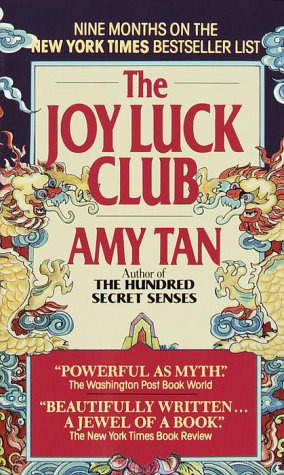 I don’t think it needs any introduction, but on the off chance that you’re not familiar with it, the novel features sixteen interlocking stories of mothers and daughters bound by the Joy Luck Club, a group of Chinese immigrant women who met regularly to play mah jong (and eat Chinese food), and support one another as they began their new lives in America.
The novel’s main thread is the story of Jing-Mei “June” Woo, daughter of the late Suyuan Woo, who founded the original Joy Luck Club back in wartime China and restarted it upon coming to America. June is hesitant about taking her mother’s place in the Joy Luck Club, as she feels she hardly knew her mother.
June tells her mother’s story: when the Japanese invade China in World War II, Suyuan flees to escape capture, and she is forced to abandon her twin baby daughters on the roadside. Suyuan tracks them down many years later, but she passes away before she has a chance to meet them.
The point of view shifts, and the stories of the other members of the Joy Luck Club and their daughters are alternately revealed, like players taking their turn in mah jong.
The mothers (An-Mei Hsu, Lindo Jong, and Ying-Ying St. Clair) tell stories about their life in China, their own relationships with their mothers, and their passage to America while the daughters (Rose Hsu, Waverly Jong, and Lena St. Clair) talk about growing up in America with their Chinese mothers and their own adult lives. As the daughters sort out their problems (marriage, career, etc), they find themselves turning to their mothers for guidance, and the mothers draw on their experiences to support their daughters.
The novel comes to a close as the Joy Luck Club sends June to China to meet her long-lost sisters, bridging the gap between the past and the present, and coming to terms with her Chinese identity.
The stories are rich in culture (the moms’ stories), and the experience of growing up in two cultures (the daughters’ stories) and emotion, but I enjoyed rereading this book particularly for the nostalgia it brought back. “The Red Candle,” which tells of Lindo Jong’s clever escape from her arranged marriage in China, was my favorite story back then (the one I chose to write about in my paper) and I was happy to find it is still my favorite story in the book.
Also, my family is big on mah jong (somewhere down the line I’ve got some Chinese blood on both sides of the family, though the percentage is blurry), so this novel tugs a bit on some guilt — mah jong playing stops at our generation. Somehow, even though we’ve all watched our parents and grandparents play (and they still do whenever they get together) all our lives, my cousins and I (with the exception of one, I think) have never been interested in mah jong, and rereading Joy Luck Club seriously makes me think I should at least learn to play.
The Joy Luck Club was one of the two books discussed this month by Flips Flipping Pages, and I missed the discussion (rats!) because I had to go out of town for my uncle’s wedding. But from the looks of it, the gang had fun, watching the play and getting to meet the cast (jealous!!!).
 (photo courtesy of Rhett de Jesus)
I did watch the play the day after, though (great idea purchasing those season tickets!), and it was okay for me — I particularly enjoyed the adaptation of “The Red Candle” and “The Rules of the Game” (which is about Waverly’s childhood career as a chess champion), and “Best Quality” (with June & Suyuan), but I was bored at some points (I found Rose and Lena’s portrayals lacking). But of course, I thoroughly enjoyed Rep’s “Little Women” last December and I think I used that as my benchmark.
I was happy I had the chance to read Joy Luck Club again, though, and I remember now why that book has stayed on my shelf all this time.
***
Joy Luck Club, mass market paperback, 3.5/5 stars
Book #14 for 2011
*mah jong photo courtesy of sxc.hu
[amazonify]::omakase::300:250[/amazonify]
I love The Joy Luck Club, but I don’t think I can get through reading it now. Not yet, at least.
Aww, I understand perfectly.
*hug*
I read this book in college and loved it. We compared it to the book, “How the Garcia Girls Lost their accents” by Julia Alvarez. I also read Amy Tan’s 2nd book, but I can’t remember the title, guess is was less impressionable. Anyway, great review, thanks.
Hmm, interesting. I think I’ll hunt down “How the Garcia Girls Lost their Accents”. I saw it the other day at the bargain book store, I hope it’s still there when I get back.
I’ve read both of them and think Tan’s book was far better than Alvarez’s.
In what way, Jennifer? I’d still like to read Alvarez’ book just for comparison, though :)
It’s a good book, so reading it is a good idea.
You would think as a Hispanic, I would have identified more with Alvarez’s book, but I didn’t. And it was completely forgettable for me. I read Alvarez’s a year ago and Tan’s about five, and I still remember Tan’s with better clarity.
What I would like to read by Alvarez is Something to Declare.
oh, interesting viewpoint. Filipino culture has strong Hispanic and Chinese influences, so I’m really curious to see how I’d react to it.
Hi Blooey,
I read The Joy Luck Club when I was 14 too. It was nice taking a walk down memory lane with you. My parents are into mah jong, but I’ve never been too keen on it either. I’m more into poker and black jack. Hmm, I may just dust off my copy of the Joy Luck Club and give it another whirl.
Bridge is my favorite card game :D
@Johanna, Amy Tan’s 2nd book was really forgettable – The Kitchen God’s Wife – in case you want to be reminded.
@ Blooey,
Good to know that you read The Joy Luck Club in high school; I included it in our required readings for the sophomore level two years ago, so thanks for the affirmation. At any rate, The Loy Luck Club is one of the best ever!
Cheers to teachers that get their students to read!