The Sisters Grimm

sisters grimmAs soon as I saw the Sisters Grimm series on the bookstore shelf, I knew I wanted to read the books. Of course, as I rarely buy books full price (I have to really really really want a book with that can’t-eat-can’t-sleep-reach-for-the-stars-over-the-fence-world-series kind of feeling to buy it full price), I passed them up and ended up adding them to my BookMooch wishlist.

A few months later I was able to mooch the first two books of the series from a friend I’d made on BookMooch, wired_lain, a Filipina based in Japan, who’s been sending me a lot of great stuff, from Japanese Harry Potters for my collection to Studio Ghibli books to little Japanese snacks (sweet potato flavored Kitkat!) and other odds and ends (including a talking calculator!)

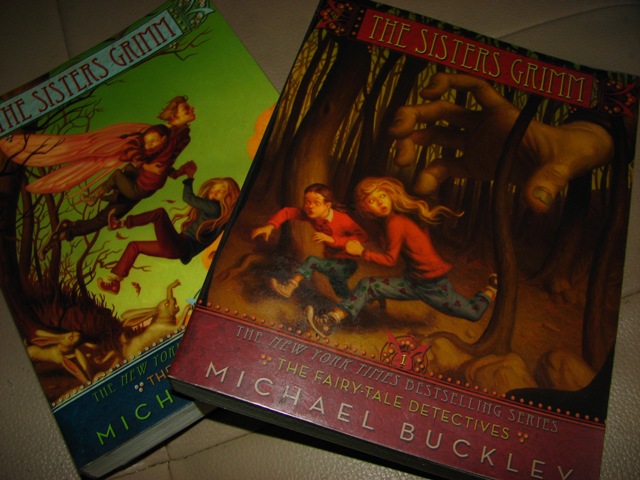
So approximately one year later, I finally got around to reading the books: Michael Buckley’s The Sisters Grimm: The Fairy-tale Detectives (Book 1) and The Unusual Supects (Book 2) – Books #82-83 of 2009.

The Sisters Grimm series is about Sabrina and Daphne Grimm, whose parents have mysteriously disappeared. They are sent off to live with their grandmother Relda (whom they believed to be dead) in the town of Ferryport.

But things are not what they seem. The girls find out that Ferrytown – originally Fairytown – is home to the Everafters, or characters out of storybooks. Puck is their housemate, the mayor is Prince Charming, Sheriff Hamstead is one of the pigs in Three Little Pigs, their Grandmother’s friend Mr. Canis is the Big Bad Wolf, Snow White is a schoolteacher, and the Pied Piper is their principal. And the girls are actually descendants of the thread-spinners themselves, Jakob and Wilhelm Grimm.

To keep the Everafters from wreaking havoc in the world, the Brothers Grimm enlisted the help of the witch Baba Yaga ang created a magical boundary that keeps the Everafters in Ferryport as long as there is a surviving member of the Grimm family living in town.

Together with their grandmother and their dog Elvis, the Grimm Sisters solve fairy tale mysteries involving Everafters and get closer to the key to their parents’ disappearance.

Here is a trailer of the series, from The Sisters Grimm website:

The books remind me of The Spiderwick Chronicles by Holly Black and Tony DiTerlizzi because of the sibling action, except that the Grace siblings dealt with actual faeries rather than fairy tale characters. There is also a similar plotline about giants in A Giant Problem (Beyond the Spiderwick Chronicles series) and The Sisters Grimm: The Fairy Tale Detectives. Both series also have lovely illustrations — Di Terlizzi in The Spiderwick Chronicles, Peter Ferguson in The Sisters Grimm — that establish the atmosphere of the stop.

Storywise, the Sisters Grimm books are fast-paced and the Shrek-like premise is engaging enough, but I’m not completely sold on the series.

First, I didn’t find the Sisters Grimm very likeable. Sabrina, 12, is too angsty for her age. Sure, they’ve been volleyed around in foster homes. Sure, their parents have been missing for 18 months. Sure they’re taken in by a crazy old woman that they’ve never seen in their lives. But she has so much anger inside her than is actually believable for a pre-teen girl that she was kind of annoying. In Book 2, I find out that the intensity of Sabrina’s emotions had a significance to the plot, but that made it even more contrived for me. I think that if her character was a bit older, she would have been more credible.

Daphne, 7, on the other hand, I find to be too cute, as in Bubbles in The Powerpuff Girls. She is overly enthusiastic about their detective duties (and life in general), says things you can only describe as “precious,” and is nice to everyone except occasionally to her sister. Perhaps this is to provide a foil to Sabrina’s personality, but she’s entirely too twee for my taste.

This makes me wonder if their personalities evolve in the future.
Another thing I don’t like about the book is the vocabulary lessons sprinkled throughout the book, like when a character uses a word Daphne doesn’t understand, she has to ask what it means and it is explained to her. I find this extremely annoying because they weren’t particularly difficult words (e.g. alliance).

This “vocabulary lesson” seems to be common in children’s books these days, I also noticed this in Lemony Snicket’s A Series of Unfortunate Events (which I didn’t read past the first book) and I don’t like it because it talks down to the reader and assumes the reader doesn’t know what it means. And anyway, even if the reader doesn’t know what a word means, I think that makes it too easy for them, robbing them of a more important lesson: context clues. I think with the proper context, and some creativity from the author, meaning can be more effectively (and less blatantly) established.

(And heck, when I was a kid, I would read books with a dictionary on hand to look up meanings of words I don’t understand — I distinctly remember looking up “vouchsafe” when I came across it reading the unabridged Heidi when I was seven!)

On the whole, I think the series has promise — I looked it up and there are now 7 books out in the 9-book series and it looks like more exciting things are about to happen in the next books. I do hope the characters are developed more throughout the series. While I’m not compelled to buy the books one after the other (hopefully I can mooch them), I do want to know what happens next in this series.

***
M y copy: trade paperbacks, mooched from Japan

My rating: The Sisters Grimm: Fairy Tale Detectives 3/5 stars; The Sisters Grimm: The Unusual Suspects, 3/5 stars

Every Filipino’s Lolo Jose

History was the topic of the May book discussion for Flips Flipping Pages, and because I’d been reading the novels Noli Me Tangere and El Filibusterismo, I chose to read a book about their author, national hero Jose Rizal. Luckily I had a copy of Lolo Jose by Rizal’s own grandniece Asuncion Lopez Bantug.

Lolo Jose (book #81 of 2009) is an “intimate and illustrated portrait of Jose Rizal,” is a one of a kind biography of Rizal, culled from the Rizal family lore and personal anecdotes. “Lolo” is the Filipino word for grandfather, and the book is entitled as such because it paints a different picture of Rizal, reminding us that Rizal was not born a legendary hero, that before he became that figure mounted in a glorious pedestal in a park now named after him, he was a son, a brother, a friend, a scholar, and a leader.

lolo_jose_book_coverHistory was the topic of the May book discussion for Flips Flipping Pages, and because I’d been reading the novels Noli Me Tangere and El Filibusterismo, I chose to read a book about their author, national hero Jose Rizal. Luckily I had a copy of Lolo Jose by Rizal’s own grandniece Asuncion Lopez Bantug.

Lolo Jose (book #81 of 2009) is an “intimate and illustrated portrait of Jose Rizal,” is a one of a kind biography of Rizal, culled from the Rizal family lore and personal anecdotes. “Lolo” is the Filipino word for grandfather, and the book is entitled as such because it paints a different picture of Rizal, reminding us that Rizal was not born a legendary hero, that before he became that figure mounted in a glorious pedestal in a park now named after him, he was a son, a brother, a friend, a scholar, and a leader.

Bantug states in her introduction:

“Here is the Jose Rizal I met and learned to love from all the anecdotes told to me since childhood. Here is the Jose whom the older brother he called ‘Nor Paciano led and guided with unflagging and perceptive devotion, the “little brother” whom my Lola Sisa (Narcisa) loved with passonate unquestioning loyalty, the little playmate who was teased and ordered about on errands by Lola Biyang (Maria) and who played practical jokes on her and Panggoy (Josefa), the fond brother who shed his first tears over the death of little sister Concha. Here is the brother, now grown into manhood, on whose unfailing support Lola Lucia could turn to in times rizalof stress, who stamped his feet and almost cried in grief and frustration when he could not prevent Lola Pia (Olimpia) from dying in childbirth, who was always quick to show gratitude especially to Lola Neneng (Saturnina) and Lola Sisa who could deny him nothing. Here is the solicitous big brother to younger sisters Panggoy and Trining (Trinidad), whom he taught French and English, and to whose wise counsel they listened with respectful attention and who alternately pampered and tenderly chided baby sister Choleng (Soledad).

Here is a son, brother, uncle, mentor, friend, leader — aye, even a young, susceptible swain, always a lover of beauty in all its forms.

I want the young to know that no man is born a hero…I hope that after reading about the young Jose, their inquisitive nature roused, they will want to know about Rizal the Man and Patriot. And I hope that once their interest is stimulated, they will yearn to know more about the hero and martyr. Then they can pursue their reading to include all the well-known biographies written by our eminent scholars who present Rizal in all his different aspects. “

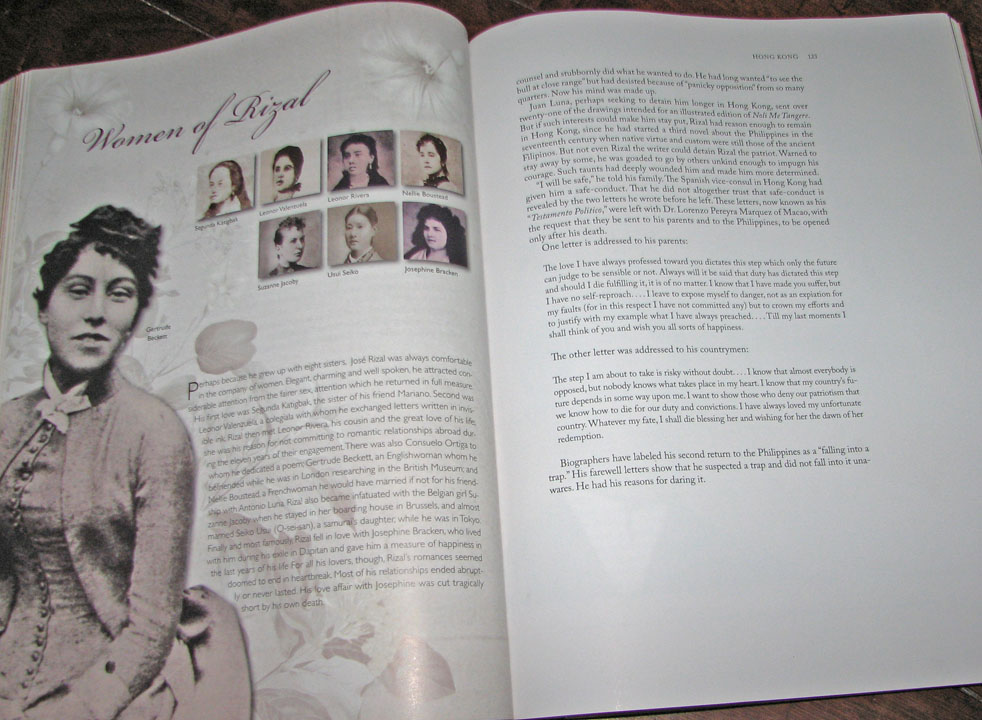
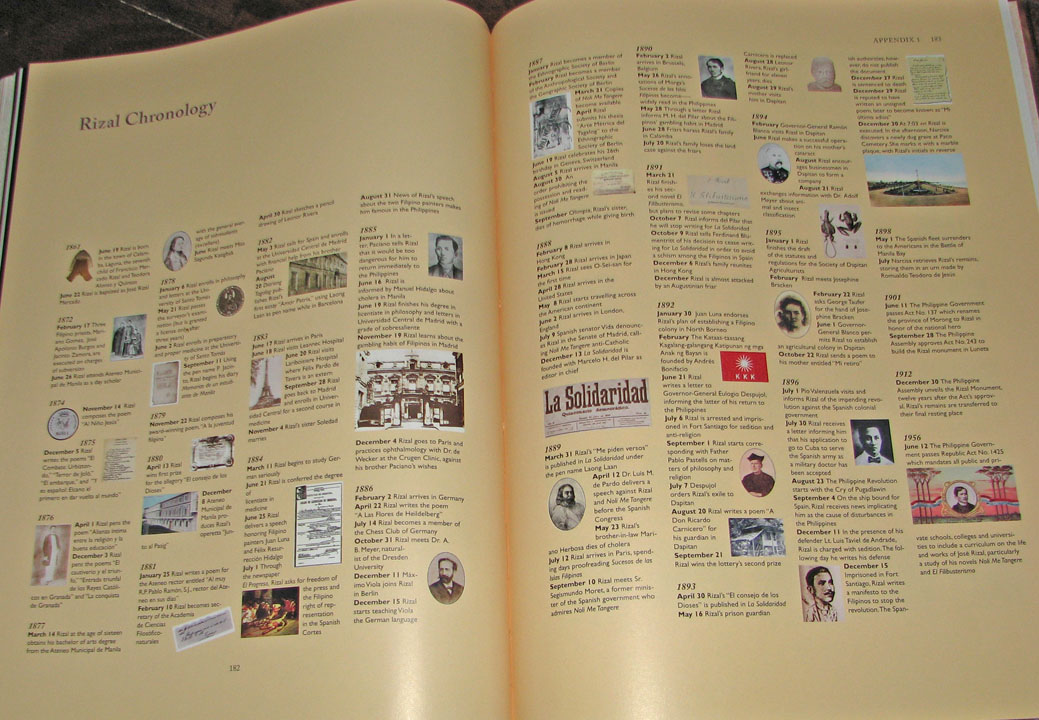
The book was actually first published in the ’80s by the Intramuros administration, but what makes this 2nd edition special is the visual showcase: over three hundred historical photos and reproductions. The appendices are also chock-full of important information: a timeline covering Rizal’s life (1861-1896)and beyond — when he was proclaimed national hero (1901), the Rizal Monument was unveiled (1912), and Rizal was made part of school curricula (1956); a catalog of Rizal’s artworks; important letters; a comprehensive bibliography of Rizal’s written works; a list of readings on Jose Rizal; and the Rizal family genealogical charts.

lolo-jose1

lolojose2

lolojose3

lolojose4

I love this book not only because it is beautifully produced by Vibal Foundation (the first book in their Filipiniana Clasica series, which aims to uphold the continuity of the Filipino reading canon), but because it provides great insight into Rizal and reveals stories and information about Rizal that do not appear in any other Rizaliana books and writings.

Earlier, before the discussion, a few Flipper friends — Marie, Cecille, MayD, Oel, and Didi  (who is a real live princess from the Sultanate of Sulu, no kidding!) went walking around Intramuros (a walled district of Manila which used to hold the seat of power in the Spanish regime) and went to Fort Santiago, where Rizal spent his last days before he was executed.

cell
Rizal’s detention cell

I felt a sense of reverence tracing his footsteps (and there are actual brass footprints that mark the path), and as we went around the detention cell that has been converted into a museum about him, I was able to share with my friends some bits of knowledge I got from the book.

footprints
Rizal’s final walk

The discussion that followed in the afternoon was one of the best our book club has ever had, which is fitting, I think, as this marks our second year into our monthly book discussions. We all read different history books on a variety of subjects and time periods, and it was a lively discussion, held in a place steeped in history.

This is the last stop in my Rizaliana phase this year (I think), and it has been very rewarding. I’ve always loved Rizal — and not because he’s the most familiar hero to me because he’s a part of every Filipino’s education, although that helps — but because I really admire him for being a Rennaissance man (and I’m a sucker for overachievers), and I loved getting to know him more through his works and his family stories this year.

And, as cheesy as it sounds, he makes me proud to be Filipino. Rizal’s legacy lives on.

***
my copy: paperback (although I am drooling for the hardcover edition, which comes with the Codex Rizal, a cd-rom containing a photo gallery, the full text of Rizal’s novels and some of his works, and important writings on Rizal).

my rating: 5/5 stars

*cover photo from Vibal Foundation

Flippers discuss history!

Rereading El Fili

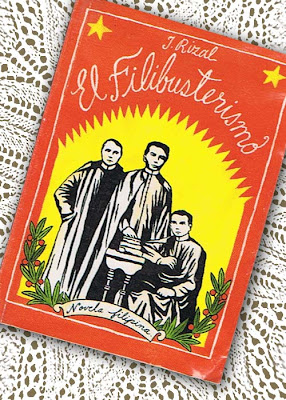
After rereading the Noli a couple of months ago, I waited a while before starting on its sequel El Filibusterismo (book #80 of 2009), because I wanted to gather up the courage to read it again. Like everyone else who’s read both novels, I’ve always found El Fili more challenging than the Noli, and I wanted sufficient time to focus on the novel so I could better understand it. I ended up taking it along on a couple of trips out of town this summer.
The review is also a challenge to write — it’s not easy to comment about a book that has been read and reread by generations of Filipinos, written by a man revered as national hero for more than a century now.        

Again, to my non-Filipino readers, a bit of an explanation: Noli Me Tangere and El Filibusterismo are two novels written by the Philippine national hero, Jose Rizal. Originally written in Spanish, and a catalyst for the change in political thinking in the 19th and 20th century Philippines, both novels are required reading for high school students in the country. It’s a bit difficult to summarize — you can read about it on Wikipedia.

As with the Noli, I read the Ma. Soledad Lacson-Locsin edition of El Fili (English title: Subversion) highly recommended by Flipper friend Czar (who now has his own blog!) for its rich language that tries to preserve the form and context of Rizal’s original Spanish. Now that Czar has named the two books as the common reading requirement in the FFP Diversity Challenge, I’m glad I read the books before half the year set in, but I will have to regroup my challenge entries.  

Identity change
Though as prodigiously written as the Noli, El Fili stands in contrast to the Noli as it goes deeper into the ideas that the first book touched upon, and gets darker and darker until the fiery end.    Crisostomo Ibarra, the protagonist from the Noli, returns in El Fili and sheds his preppy, pretty-boy image in favor of a new identity: the mysterious jeweler Simoun.
“The jeweler was a lean, tall, sinewy man , deeply tanned, dressed in the English fashion, and wearing a helmet of tinsin. What called attention to him was his long hair — completely white in contrast to the black beard, which was sparse, denoting mestizo origin. To avoid the light of the sun, he always wore a pair of enormous, blue tinted glasses which completely covered his eyes and part of his cheeks, giving him the aspectof a blind man or one of defective eyesight. He stood with legs apart, as if to maintain his balance, hands thrust into the pockets of his jacket.”

In El Fili Ibarra (as Simoun) returns to avenge all that he lost, driven to the brink of madness by all that he has experienced. The disguise is so conspicuous I’m surprised nobody figured him out for a fake sooner. But they figured Simoun was an American, he had strong ties with the Capitan-General and the assets to prove he was a jeweler. Nobody had reason to associate him with Ibarra, whom people thought to be dead, so he got away with it.   

I find Ibarra’s lot in life heartbreaking. A gently bred and educated son of a wealthy family and engaged to his childhood sweetheart, Ibarra had his whole life to look forward to when he returned from his studies abroad to his hometown. But alas, he inherits his father’s enemies, and he is forced into a fate he did not want.

But it is not only Ibarra who has been transformed; time has not been kind to the other characters from the Noli, either: Basilio, the young boy hunted by the guardia civil, now a young man pursuing medicine; Maria Clara, beautiful and full of life, now wasting away at the Sta. Clara convent; Kapitan Tiago, dignified and jolly, now in a permanent opium-induced stupor. Such a tragedy!


The fire of revolution
It is difficult to discuss El Fili without touching on the revolution that Simoun incited in the novel. Simoun uses his ties with the Capitan-General and the upper class to influence them to abuse their position, to commit deeds that will stir the anger of the masses. While Ibarra would have sought diplomatic means to challenge the authorities, Simoun goes all out to set off a bloodbath, a violent revolution meant to eradicate a corrupted society.

Simoun gains the support of various aggrieved parties: Cabesang Tales, decrying the injustice his family suffered at the hands of the friars; the university students, who are proposing to establish a Spanish language academy but are meeting opposition from the Dominicans; Quiroga, a Chinese merchant aspiring for an important position in society; and eventually, Basilio, initially reluctant but pushed over the edge by the death of his sweetheart Juli.   

At the biggest society event of their time — the wedding of Paulita Gomez and Juanito Pelaez, Simoun plots to wipe out the prime movers of society by planting a lamp filled with nitroglycerine in the living room, set to explode when the wick is turned up.

Simoun’s plan is foiled by Paulita’s ex-boyfriend Isagani, and he meets his death at the remote seaside home of Padre Florentino, but I imagine that to the very end, he believes it was not all in in vain, as he once told Basilio:

“Patriotism can only be a crime in the oppressor nations, because then it will be rapacity baptized with a beautiful name, but no matter how perfect humanity may become, patriotism will always be a virtue among the oppressed peoples because it will signify for all time love of justice, freedom and self-dignity… The greatness of man lies not in being ahead of his times… but in divining his wants, responding to his needs and guiding himself to march forward.”

One of the passages in the final chapter though, a piece by Padre Florentino, seems to cement Rizal’s personal stand on waiting for the right time for revolution:

“In the meantime, while the Filipino people may not have sufficient energy to proclaim, with head high and chest bared, their rights to social life, and to guarantee it with their sacrifice, with their own blood; while we see our own countrymen in private life feeling shame within themselves, to hear roaring the voice of conscience which rebels and protests, in public life keep silent, to make a chorus with him who abuses to mock the abused; while we see them enclosed in their own selfishness, praising the most iniquitous deeds with forced smiles, begging with their eyes for a portion of the booty, why give them freedom? With Spain and without doubt, because he who loves tyranny submits to it. Señor Simoun, while our people may not be prepared, while they may go to battle beguiled or forced, without a clear understanding of what they have to do, the wisest attmpts will fail and it is better that they fail, because why commit the wife to the husband if he does not sufficiently love her, if he is not ready to die for her?”


Words that come to life
Politics isn’t really something I enjoy reading, but as the novel isn’t entirely political, I found a lot of other parts to like.

I really like Rizal’s lavishly descriptive prose, as it takes you right to the heart of the scene, as if you were witnessing it before your very eyes.

For instance, this is how Rizal describes the steamship Tabo:

“Bathed by the morning sun, which makes the ripples of the river throb and the wind sing through the swaying reeds flourishing on both banks, there goes her white silhouette, waving a black plume of smoke; they say the Ship of State smokes much, too! Her whistle wails at every moment, raucous and imposing like a tyrant that seeks to rule by shouting; so much so that no one aboard understands himself. She threatens everything in her way, now seeming about to crush the salambaw, scraggy fishing contraptions which in their movements are not unlike skeletons saluting an antediluvian turtle; now running straight against the bamboo brushes or gainst the floating eating places or karihan, which, among gumamelas and already in water but still undecided on plunging in. Sometimes, following a certain bearing marked on the river with bamboo poles, the steamship moves very surely, but suddenly a shock jolts the travelers, making them lose their balance; she has struck low-lying mud which nobody suspected.”

I actually took this book along an interisland trip that involved around eight ferry rides across the country, and so this particular passage was very vivid to me. All the while I could imagine traveling down the Pasig river in the steamship Tabo, surrounded by the hustle-bustle of the ship crew and passengers.

And then there’s Simoun’s casket of jewelry:

“Simoun opened the casket and lifted the raw cotton which protected it, uncovering a compartment full of rings, lockets, crucifixes, pins, and so forth. Diamonds combined with stones of different color sparkled, stirred among golden flowers of different hues with veins of enamel, with fanciful designs and rare arabesques. 

Simoun lifted the tray and displayed another full of fantastic jewels which could have overwhelmed the imagination of seven young women on the eve of seven balls in their honor. such fantastic designs, combination of precious stones and pearls, imitating insects with bluish backs and transparent wings; the sapphire, the emerald, the ruby, the turquoise, the diamond were arranged together, to create dragonflies, butterflies, wasps, bees, scarabs, serpents, lizards, fish, flowers, clusters, and others…

Nobody had ever seen such wealth before. In that box lined with dark blue velvet, divided dinto sections, could be realized the dreams of a Thousand and One Nights, the dreams of Oriental fantasies. Diamonds as large as chickpeas were scintillating, spewing sparks of fascinating hues as if they were melting or burning perfectly in the colors of the spectrum; emeralds from Peru in all shapes and cuts; rubies from India, red like drops of blood; sapphires from Ceylon, blue and white; turquoises from Persia; Oriental mother-of-pearl; some rosy, gray and black. Those who have seen in the night a giant rocket exploding against the dark blue sky into thousands of sparks of all colors, so brilliant that the eternal stars pale beside them, can imagine the aura that compartment radiated.

This is actually one of my favorite passages in this book, even back when I first read it in high school. What a spread that must have been, and I’m not surprised all the ladies nearly swooned when Simoun brought out his wares. The casket ends up at the bottom of the sea at the end of the book, and it resurfaces in another novel written decades later, in Ang Mga Ibong Mandaragit by Amado V. Hernandez.

And sadder still
The part that affected me most in the book is that defining scene when Basilio reveals to Simoun that Maria Clara has passed away. More than revenge, Simoun is actually inciting a revolution so he can storm the gates of the cloister and rescue Maria Clara, so they can pick up where they left off and get a chance to live the life they were deprived of.

But alas, after thirteen years in the cloister, Maria Clara was taken ill and subsequently died after a few days.    Simoun is devastated by the news, and I couldn’t help crying at this part:   

“Dead!” he murmured in a voice so low it was as if a ghost were speaking, “dead! dead without having seen her, dead without knowing that I was living for hear, dead suffering…” 

And feeling that a horrible storm, a tempest of whirlwinds and thunder without a drop of rain, sobs without tears, cries without words, roaored in his breast and was going to overflow like incandescent lava long ago suppressed, he hurridly fled the room. Basilio heard him rush down the stairs with erratic steps, tumbling; he heard a silent cry, a cry that seemed to herald the coming of death, deep, unbridled, mournful…

And Basilio thinks of the fate of Ibarra and Maria Clara:

“He, young, rich, lettered, free, master of his destiny, with a brilliant future ahead of him, and she, beautiful like a dream, pure, full of faith and innocence, cradled among loves and smiles, destined for a happy life, to be adored int eh family and respected in the world, and yet, nevertheless, those two beings, full of love, of dreams and hopes; by a fatal destiny, he wandered around the world, dragged without respite by a whirlpool of blood and tears, sowing bad instead of doing good, dismantling virtue and fomenting vice, while she was dying in the mysterious shadows of the cloister where she had sought peace and may perhaps have encountered sufferings, where she had entered pure and without stain and expired like a crushed flower!”

That’s just the saddest thing ever. It makes me want to create an alternate universe for Ibarra and Maria Clara, where they can live happily ever after, but I think the power of the Noli and the El Fili, is in establishing how the forces at work in their society have affected their lives, just as historically, countless lives of Filipinos were changed by our experience as a colony.

And on an ending note…
It’s a strange feeling, to read the books that have been read by millions of Filipinos over the last century, the books that have had the power to set the wheels of Philippine history in motion. While I can’t say I carry the same fervor the first readers of the books must have had, I am gratified that the books are still alive today to serve as a link to them.

I still like Noli Me Tangere over El Filibusterismo, but I’m glad I took on the challenge of reading both books and writing a bit about them. I meant to read them for leisure, but the books have moved me more than I expected they would, and I appreciate them better now than I did back in high school.

I really love the Lacson-Locsin translations, and my next target is to upgrade my paperbacks into the nice hardcovers, hopefully at the next Manila International Book Fair.

***
My copy: El Filibusterismo, Lacson-Locsin translation, paperback.

My rating: 4/5 stars (out of personal preference on the themes of the novel, not on literary merit, which is obviously stellar)

 

No rants this time (Angels and Demons movie)


I enjoy reading Dan Brown, especially the Robert Langdon novels, because while you need to suspend your disbelief while reading the books, Brown knows how to build up a good chase.I’m also a sucker for art thrillers, and I love the interesting artsy details that are incorporated into the novels, traversing artistic hotspots such as the Louvre and Vatican City, and dissecting the works of Leonardo Da Vinci, Galileo, and Bernini. 

Other than that I love scholarly protagonists (e.g. Paul in The Historian, Sherlock Holmes) and Robert Langdon hits the mark on that aspect.

I distinctly remember the first time I read Angels and Demons: in ebook format beamed to my phone from my computer, because I was in my last semester in college and I couldn’t afford to buy brand-new books then. Angels and Demons is one of the scariest books I’ve ever read, and I remember getting even more scared a couple of months later, when Pope John Paul II died and I was imagining an Angels and Demons scenario playing out. Of course, that was just in my head, and the conclave proceeded without any events that resembled the Dan Brown plot.

By the end of the year I bought a hardbound Robert Langdon omnibus at Fully Booked at 40% off, so it was less than P400. I also have fond memories of this book, as it was one of my cat Tomas’ (he died of kidney failure and cardiac arrest in November 2008) favorite perches when he was still a kitten.
Tomas

Now I really didn’t like the Da Vinci Code movie, because it was so boring and I felt it copped out at the end so I didn’t have high expectations for Angels and Demons. I was out of town covering a race on opening week, so I decided to watch it as soon as I returned, never mind that everyone else I knew already saw it and I had to watch alone.

I normally have a problem with film adaptations, but I actually liked the Angels and Demons movie, which is surprising because the book is my favorite Dan Brown novel.Not that they didn’t deviate from the novel — they eliminated Maximilian Kohler, Father Silvano became Vittoria’s research partner, Camerlengo Carlo Ventresca turned into the Irish Patrick McKenna (hotness aside, I really had a hard time picturing Ewan McGregor in the role), Cardinal Baggia survived among the preferiti and became Pope (as opposed to Cardinal Strauss), and Langdon’s famous parachute escape was glaringly missing, among other things — but the pace was good and I didn’t nod off at any point in the movie like I did at Da Vinci Code. 

It’s not a movie for critical acclaim, but at least, unlike its predecessor, it stands up well enough alone that even those who haven’t read the book are able to follow the action.

I read at Dan Brown’s site that the third Langdon novel, The Lost Symbol, is coming out this September. I’ll definitely be reading that one.

***
My copy: Robert Langdon Omnibus, hardcover

My rating: Angels and Demons book 4/5 stars, Angels and Demons movie 3.5/5 stars

Kare Kano Marathon

I like reading manga series when I can read them from the first volume. Luckily, I was able to mooch books 1, 2, and 4 of Kare Kano: His and Her Circumstances by Masami Tsuda from local moocher Cizi (books # 77-79 of 2009) and I’ve got book 3 on its way from the Netherlands.
Kare Kano is a romantic comedy featuring the seemingly perfect Yukino Miyazawa and her school rival Soichiro Arima. 

Yukino is the #1 student in her high school, and is admired for her beauty, talent, and intelligence. But beneath the perfect façade, Yukino is a control freak playing a part, as she is a brat and a slob at home, studying obsessively to keep up her grades.

When she enters high school, the new student Soichiro shows up and gives her a run for her money. The perfect façade cracks, and Yukino plots to take him down and regain the attention of her peers, but she didn’t plan on falling in love with him in the process.

Yukino has more in common with Soichiro than she thinks, because Soichiro is keeping up the perfect façade to prove to himself and his adoptive parents that he did not get his birth parents’ bad genes.

As Yukino and Soichiro get to know each other and their relationship blossoms, they both learn to loosen up and be true to themselves.

Kare Kano is a he said – she said story, with chapters alternating between Yukino and Soichiro. It is one of the first series released by Tokyopop, an English-language manga publishing company that is fast becoming a favorite of mine.It has also been adapted into an anime series, although I have yet to watch it.

I like the character of Yukino, specifically because she reminds me a lot of myself back in school. Back then, I was always in the honors class, and I understand her need to keep up appearances to live up to other people’s expectations.

I also like the character of Soichiro, because I am such a sucker for overachievers and I really don’t blame Yukino for falling for him.

The chemistry between them is good, and the story gets pretty funny, especially when new characters, like the hunky Hideaki (book 2) and little Tsubasa (book 4) are introduced. There are also nice little moments like Yukino working up the courage to tell Soichiro she loves him, the first time they hold hands, the first date, the first hug, the first kiss. It’s a bit nostalgic for me, because I remember one particular person in my life, but hehe, that’s another story.

I also like the little notes in the margins left behind by Masami Tsuda, as well as the Tsuda diary section at the back of the book because it gives great insight into her creative process, and gives a better understanding of the context of some cultural nuances, like Japanese school uniforms, or references to Japanese novels.

I can’t wait to read more of this series. Hopefully they’ll turn up on BookMooch.

***
My copy: Books 1, 2, and 4 in paperback, local mooch

My rating: Book 1, 2, and 4: 4/5 stars