Dahl’s Chickens!

I’ve been a fan of Roald Dahl ever since I discovered he was the brains behind Willy Wonka and the Chocolate Factory (I saw the Gene Wilder movie dozens of times before I found the book in the library in fifth grade) and my favorite Willy Wonka candies that I bought at the school canteen — Gobstoppers, Pixy Sticks (the jumbo ones!), Runts (I loved the bananas!), Nerds, Dweebs (chewy Nerds), Tart & Tinys, Fun Dips, and SweeTarts — which led me to believe that Willy Wonka was a real person and that he had a chocolate factory somewhere. In fact, I was devastated (Santa Claus part II) when I eventually found out Nestle was making the candies!
UPDATE: My Roald Dahl Collection

After Charlie and the Chocolate Factory and Charlie and the Great Glass Elevator, I was fascinated with The Witches and Matilda, both of which I’ve read dozens of times.

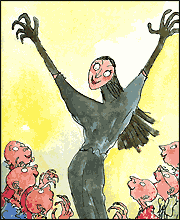
I know a lot of people who were terrified as kids when they watched Angelica Huston’s portrayal of the Grand High Witch in the movie, but I didn’t get to see the movie until it was aired on Disney Channel several years ago, so I never had that problem. Like Roald Dahl himself, I was disappointed that they changed the ending in the movie.

I also liked Matilda, because our school’s parents association sponsored the film premiere when I was in sixth grade and I begged and begged my mom to get me a copy of the book after we saw the movie.

Matilda is one of my favorite characters because I could totally relate to her when I was younger– I was the kid who was always at the library until closing time, and I was always happy to be holed up alone in a room with a book. Hahaha, when I was younger I would set up a pencil on a dresser and try to levitate it like Matilda did, attempting to use my eyes to move the pencil and mouthing “Move!” fiercely. Today, I use Matilda as my BookMooch avatar.

To this day, the Grand High Witch and Miss Trunchbull are still in my list of the best book villains.

Other favorites include the BFG (which I only read recently, and I wanted to burst into applause after), George’s Marvelous Medicine, The Vicar of Nibbleswicke (hilarious!), The Twits (also hilarious!), Revolting Recipes and Even More Revolting Recipes.

Having grown up on Roald Dahl books, Quentin Blake also became one of my all-time favorite illustrators. I love how you can look at his work and know without doubt that it’s his. Very simple, yet enormous comic appeal!
In college, I started reading Roald Dahl’s short story collections, and I found a whole new – but equally engrossing – way to enjoy his works. The stories are dark and humorous, highly imaginative and original, and always with a surprise twist in the end. It was surprising to find out he could write outside of children’s books, and he is excellent at both writing for kids and for adults.

This isn’t actually a review of Roald Dahl’s books (although it’s starting to veer in that direction), but a review of D is for Dahl (Book 60 for 2009), an A-Z book about one of Britain’s most celebrated children’s authors.

The book is not very thick, but still filled with a lot of interesting factoids I never knew about one of my favorite authors.

I read this book to “cleanse the palate” after reading Silverlock during the read-a-thon, and I was laughing from start to end.

Am sharing my favorite entries:

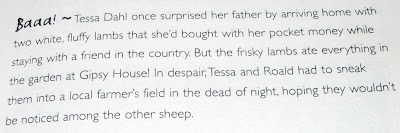
The lamb debacle

Come to think of it, they don’t have names!

Heeheehee.

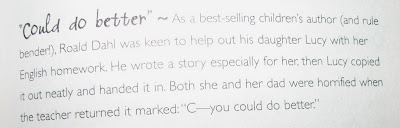
The cutest story ever!

Who would’ve thought?

***
My copy: trade paperback, mooched from Triccie

My rating: 5/5 stars

Up, Up, and Away

(blogging about another old favorite, as I’m still in the middle of reading Silverlock and am majorly swamped, hay…)

When I was in 4th grade, my dad usually picked me up after work so I had a few hours to kill while waiting. I usually read books if I didn’t have any homework to work on, or if I didn’t feel like doing it, which was more often the case.

Now in those days, we decorated the room with special corners for each subject — Christian Doctrine, Science, Math, Social Studies, etc. Of course, my favorite corner was the Reading Corner, where everyone brought a book or two to share with the class and we would have a mini-library to escape to in between classes or during DEAR (Drop Everything And Read) time, so we wouldn’t get listed down as “noisy girls”. Haha, magically by the end of the school year the books would have dwindled to a couple mo.tley ones; I lost a lot of books to the Reading Corner, although I gained some other kids’ books too, wink, wink.

One of the books I discovered in our 4th grade reading corner is the 1947 Newbery Award winner The Twenty-One Balloons by William Pene du Bois, which I first read while waiting to get picked up from school one rainy afternoon at Gate 1.

The Twenty-One Balloons one of the best escapist stories I have ever had the pleasure of reading, and I’ve lost count of how many times I’ve read it and how many copies I’ve worn out and lost (e.g. loaned and never returned to me! grr).

I really love the premise: Professor William Waterman Sherman decides to retire from teaching arithmetic to grubby kids, and decides to fly off on a grand vacation — drifting aimlessly on a hot-air balloon! I loved the detailed description of how The Globe (Prof. Sherman’s hot air balloon) was constructed — a small wicker house with an observation deck, and everything made from the lightest materials — even a small library of paper-bound books in tiny print!

Professor Sherman left San Francisco intending to fly across the Pacific Ocean, and three weeks later, he mysteriously turns up floating in the Atlantic Ocean, in a wooden wreckage with 21 balloons!

Where exactly has he been? On the island of Krakatoa (he flies over the Philippines!), which turns out to be an extremely wealthy island-nation of eccentric citizens!

The Diamond Mines

I love the idea of Krakatoa in The Twenty-One Balloons, and this book has made me daydream about living there, and given the choice, I’d drop everything and go. The island has an expansive diamond mine right under the volcano Krakatoa. According to Krakatoan history (as narrated by Mr. F), a sailor got shipwrecked on the island and discovered its treasures. As soon as he was able to return to America, he handpicked 20 families of diverse talents and interests. Each family was renamed with a letter of the alphabet, e.g. Mr. A, Mr. B, A-1, and A-2 and so on until the Ts, and the small nation lives a leisurely life financed by discreetly selling a small load of diamonds each year.

The Coat of Arms of Krakatoa: “Not New Things, but New Ways”

What’s most interesting about Krakatoa is its “Gourmet Government.” Each day of their 20-day calendar (A through T) is assigned to a specific family, who is tasked to serve meals at their house, which functions as a restaurant specializing in a particular cuisine — A for American, B for British, C for Chinese, D for Dutch, etc. It’s a lot of fun, as each house resembles the architecture of the country too — from an Egyptian pyramid to a Russian tea house to an Italian Bistro and a miniature Versailles! — and the families are very competitive in coming up with great dining experiences for one another, and they have theme months too, like “Month of Lamb,” depending on their surplus stock. I imagine every day to be a gastronomic adventure!

There are also a lot of imaginative Krakatoan inventions in the book, including a bed that automatically changes sheets, a collapsible dining room, living room bumpcars, sky beds, and flying merry-go-rounds. William Pene du Bois is not only a gifted writer, he illustrated the book as well, and the illustrations are great fuel for the imagination.

M-1 and M-2’s Sky beds

Of course, you will have to read the book to find out how Professor Sherman ends up in the wrong ocean with 21 balloons. It’s a great book for all ages; kids and adults alike will appreciate the rich experience that Pene du Bois lays out for the reader.

Interesting factoid: the story came out around the same time as F. Scott Fitzgerald’s “A Diamond as Big as the Ritz” in 1947, which has a similar plot although very different ideas. William Pene du Bois writes a horrified note as an introduction and quips,”The fact that F. Scott Fitzgerald and I apparently would spend our billions in like ways right down to being dumped from bed into a bathtub is altogether, quite frankly, beyond my explanation.”

***
My copy: trade paperback. Looking for a hardcover copy!

My rating: 5/5 stars

At long last… The Eight!

I don’t normally pick up a book that people are raving about, but I have to admit that I was really curious about The Eight (book #48 for 2009), especially when fellow Flipper MayD named it her best book of 2008.
I finally got around to reading it last week, which went by in a flurry of activity, leaving medetermined to make some headway on a bunch of books this week to keep my reading rate up.

I don’t want to give away any major plot details, so I’ll try to keep the summary short: The Eight by Katherine Neville is a complex mystery involving Charlemagne’s legendary chess service, a gift from the Moors, that is said to unlock the secret of civilization. Told in alternating timelines by two spirited women, The Eight traces an age-old quest to recover the pieces of the legendary service and yield the secret it conceals, encapsulated in a seemingly endless, real-life chess game involving those who want to protect the service, and those who want it for their own gain.

The Eight started out quite interesting for me, then I got bogged down by the middle chapters, and it picked up again during the latter half of the book.

This novel is longer than your average mystery, but then again, The Eight is far from average. The writing style is not particularly refined or lyrical, but given the intricacies of a two-tiered plot involving multiple sets of characters, anything that’s beyond succinct would probably have been overkill.

There are so many layers to this novel — the chess component, the historical aspect involving many colorful personalities, the mystery-thriller plot, and the cryptic word puzzles, that it tends to get unwieldy if you’re not fully invested in the book; it does take some patience and concentration before the pieces to all fall into place. The faithful reader is then rewarded as the layers come together and reveal their links, and history, romance and mystery are entwined in an intelligent and highly memorable novel that mystery buffs would love to sink their teeth into.

(That said, I wish I’d read it on a long weekend or a vacation when I could have read it from cover to cover without any interruptions. It took me all week to make my way through the first half of the novel, and when I finally got my respite on Sunday, I settled down to read the latter half, and it was then when I started to fully appreciate the book.)

For me, though, the backbone of the book lies in the strong women characters in the novel. As in a chess game, it is the queen that wields true power, and using the chess metaphor, the novel’s central characters — the spirited Mireille from the 1790s, and the feisty Cat from the 1970s, and even the key characters in the story — Catherine Grand, Lily Rad, and the fortune teller — are all female. The males, for the most part, are supplemental and hover in the periphery, and often only function to supply information or provide assistance to the central characters (although I must say the hunky Alexander Solarin is a guy after my own heart! hee hee), and at some point even the dog Carioca had a bigger part than any of the males (and the dog was more than once used as a convenient diversion tactic, may I point out).

While I like the characters in the book — Cat and Lily more than Mireille and Valentine — I think that for a book that’s almost 600 pages long, Neville could have strengthened the characterization, especially for Cat, who is the ultimate key to the mystery. While we know she is smart and sassy, we really do not know who she is aside from her recent work history; I just found it strange that we know nothing about her family or her childhood, or even her life before she got to New York.

It was also kind of annoying for me that in the chapters pertaining to Cat, the author kept preempting future events repetitively, I remember reading so many passages that ended with phrases like (not verbatim) “little did she know how the books would create an impact on her life” and “not knowing that this would turn her into a major player in the game.” For me, it was like neon lights flashing “this is a significant event, take note!” and took away some of the thrill of the mystery.

While it’s not the best mystery I’ve ever read, I still enjoyed reading the book, and I look forward to reading its sequel, The Fire.


The Eight reminds me uncannily of three other books I’ve read that might be of interest to those who’ve read this book: The Virgin Blue by Tracy Chevalier, Labyrinth by Kate Mosse, and The Flanders Panel by Arturo Perez Reverte.

The Virgin Blue and Labyrinth both use a similar style – two different women in two different times, although in these two books the two women are reincarnations of each other. In The Virgin Blue, the character from the future solves a mystery of the past through dream apparitions of her ancestor. Labyrinth is more eerily similar to The Eight, as the events from the past recreate themselves in the future and it is up to the contemporary character to stop the cycle from happening again. There are also a major plot elements that both books share, but I can’t reveal them without spoiling the book.

The Flanders Panel is also similar to The Eight in the use of chess as a metaphor for the story, and movements across the chessboard as a mirroring of the plot, although the novel is based on a Flemish painting (Van Huys’ The Game of Chess), and not Charlegmagne’s service.

***
My copy: trade paperback, mooched from the US

My rating: 4/5 stars

V-day reading (Book 30! Woot!)

Love Story by Erich Segal
Book #30 for 2009
Book #4 for Diversity Challenge (Reading group requirement)

Reading Erich Segal’s Love Story was like running into an old friend I hadn’t seen in a long time.

It must be ten years since the first time I read this book, back in second year high school, a time when all we ever wanted to read were books about undying love, books that make us gush and sigh and cry and wish that someday we’d be able to experience the things we read about (oh, but that is another story…).

I was actually dreading reading this again, because I felt I’d outgrown it already, and if it were not for the Flips Flipping Pages discussion, I wouldn’t have read it again, because the mere sight of the book actually had me snorting in derision.

I didn’t have a copy of the book, and I’d seen dozens of copies of it at Book Sale in the past, but of course, as luck would have it, no copies were to be found now that I needed it. I’d once again proven the law of Book Sale: the amount of urgency applied in seeking out a specific title at book sale is directly proportional to the possibility that it (and multiple copies, too) will turn up when you no longer need it or already have a copy. I ended up mooching a hardcover copy (yes, of course, if I have to mooch internationally, I’d rather have a hardcover) from California, and got it just in the nick of time, the day before the discussion.

To my surprise, I got through the whole book without a single derisive snort! Rereading it was much better than I expected. Though I wasn’t reading it with the eyes of a thirteen-year old girl anymore, I actually still liked it.

It’s the simplicity of the story that has given this book its staying power: rich boy meets poor girl, they fight for their love, but the triumph is short-lived as the girl gets sick and dies tragically young (oops, is there anyone who doesn’t know how Love Story goes?). I agree with our discussion moderator, Czar, when he said that Erich Segal knew when to rein himself in, just short of the point of being mushy.

Like Jenny, I love Oliver Barrett III’s name and numeral (hahaha!) — who wouldn’t? He’s smart, rich, handsome, athletic, and even his rambunctiousness adds to his charm. Jenny Cavilleri, on the other hand, is exactly the girl who can whip his cute little tosh into submission, with her snooty demeanor, smart-ass mouth and artistic temperament. The highlight of the book for me was the playful banter between the two, and the fact that Jenny always got the final word.

Yesterday, we also watched the movie and I was surprised to find out that the screenplay actually came before the book, and Segal actually just wrote the book to promote the movie. The book was mostly faithful to the movie, except for the point of view, but I felt that the final scene was better in the book.

One of the points raised in the discussion was that the movie was actually more realistic, because relationships (in this case, Oliver and his dad’s relationship) don’t get fixed just because someone dies, and closure doesn’t come that easily. While I see their point and agree with it in essence, I don’t think that was what the book meant to say. In the book, as Oliver cries in his father’s arms, I didn’t see Jenny’s death as a cure-all for their relationship, but rather an opening to reach out to each other, and merely the start of Oliver’s coming to terms with Jenny’s death.

“Love means never having to say you’re sorry” (note: in the book it’s actually, not ever, not never) is probably one of the most trite expressions about love today, and while I am not in the position to debate its meaning, I guess it’s not the line’s fault that several generations of readers (and film viewers) all over the world have used it for almost 4 decades now.

I didn’t expect to say this, but I’m definitely keeping this book.

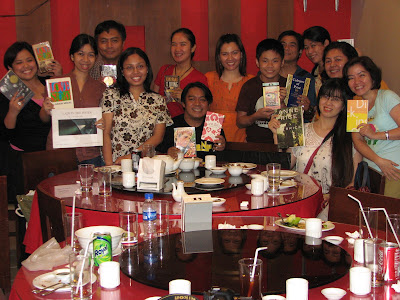
Flippers celebrate V-day with Love Story at Red Palace!

***
My copy: hardcover first edition with dustjacket
My rating: 4 out of 5 stars

Charmed.

(This post is rather lengthy, I know — I’ve just wanted to write about this book for so long!)
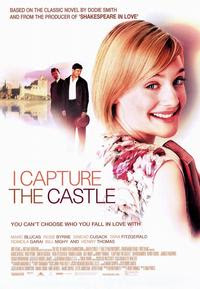
There was one book I forgot to list down among my top picks for 2008, one of the buzzer beaters, which I finished on the 28th of December: I Capture the Castle by Dodie Smith.

Dodie Smith’s more famous work is the children’s story The 101 Dalmatians, but before that, she wrote a novel entitled I Capture the Castle in 1948.

I only learned about I Capture the Castle because J.K. Rowling named it as one of her favorite books — I love the books she recommends; my cousin and I discovered the Cirque du Freak series also because JKR raved about them.

I found a fairly new copy at Book Sale (the best! I swear!) last year, but it took a few more months before I finally found an opportunity to read it without interruptions — on my holiday trip after Christmas, where I indulged in a lot of fresh air and four days of reading bliss.

Meet the Mortmains

I Capture the Castle is the journal of 17-year old Cassandra Mortmain, who lives with her eccentric family in a crumbling English castle in the countryside in the 1930s.

The Mortmains are dirt-poor but such characters! Cassandra’s father (she calls him Mortmain) is something of a one-hit wonder writer. His first book, “Jacob Wrestling” was a big hit in the past decade, prompting him to move his family to the countryside for inspiration, although it never came — he has a ten-year old case of writer’s block. The Mortmains have a 40-year lease on the castle, but over the years, they have had to sell off all the good furniture just so they can buy food.

Cassandra’s mother has passed away early on, so her father remarries the young Topaz, who is well-meaning but flighty. She is a model who poses nude for artists, and habitually “communes with nature” (er, frolics in the meadow) in nothing but hipboots.

Cassandra’s elder sister, Rose, is the family beauty (golden haired and rosy-cheeked) who despairs of being poor and wants to hook a rich husband (her main fantasy is to live in a Jane Austen novel). Their younger brother, Thomas, is often away at school on a scholarship courtesy of the local vicar, and although he doesn’t appear often, he is quite endearing as well.

The family also includes Stephen Colly, the son of one of their old servants, who continues to help out around the house even though they have nothing to pay him and he ends up getting a job outside to contribute towards the family budget. Stephen also happens to be in love with Cassandra, but unfortunately, Cassandra loves him like a brother.

Finally, there is the snowy-white bull terrier Heloise, who rounds out the family picture.

Things change for the family one fateful night, in a rather comical episode. Rose is overcome with despair about being poor, and attempts to do a Faust by hauling herself up on a pulley to wish upon the gargoyle mounted high on their kitchen fireplace. That same night, they meet the Cottons — the rich family who are now the landlords to the castle, including their two bachelor sons, Neil and Simon.

I will have to stop there before I reveal any more of the story, but more amusing episodes follow, and even as I’m writing this, I can’t help but laugh at the memory — the bathtub confrontation, the fur incident, the two wireless radios, the lockup in the tower… Equally plentiful are the sigh-inducing moments that make the book a throwback to 19th century English novels like Pride and Prejudice, Wuthering Heights, and Jane Eyre.

Cassandra and Rose also remind me of the March girls in Little Women, especially when they had to dress up for dinner at the Cottons’. Rose reminds me of Meg and Jo, when they had to go to a party and had to make do with shabby gowns. The sisters also keep an old dress form in their room, christened as “Miss Blossom,” whom they pour their hearts out to whenever they’re troubled.

A heroine like no other

I Capture the Castle is one of this century’s most beloved novels, and now I know why — Cassandra Mortmain can charm the socks off a stone monument!

“I write this sitting in the kitchen sink. That is, my feet are in it; the rest of me is on the draining-board, which I have padded with our dog’s blanket and the tea-cosy.”

This is how the novel begins, and it sets the tone for the rest of the story. It’s Cassandra’s voice that is the cornerstone of this book, and it reveals a guileless, intelligent, and feisty teenage girl, one of the most fascinating characters I’ve ever had the pleasure of reading about.

She says the most original things, and outside of EM Forster’s A Room with a View, I don’t think I’ve ever read so many lines that spoke to me all in one book! Most of the lines that struck a chord with me in this book were Cassandra’s random thoughts — some plain amusing, some thought-provoking, and others just overflowing with emotion. Her uncanny wit and sharp perception make the book such a delightful read.

Here are some of my favorite lines from the book:

On life:

“Noble deeds and hot baths are the best cures for depression.”

“Time takes the ugliness and horror out of death and turns it into beauty.”

“I wonder if there isn’t a catch about having plenty of money? Does it eventually take the pleasure out of things?”

“I should rather like to tear these last pages out of the book. Shall I? No-a journal ought not to cheat.”

On contemplation:

“Contemplation seems to be about the only luxury that costs nothing.”

“I have found that sitting in a place where you have never sat before can be inspiring.”

“I was wandering around as usual, in my unpleasantly populated sub-conscious…”

“I have noticed that when things happen in one’s imaginings, they never happen in one’s life.”


On family:

“The family, that dear octopus from whose tentacles we never quite escape, nor in our innermost hearts never quite wish to.”

On writing:

“I only want to write. And there’s no college for that except life.”

“Only half a page left now. Shall I fill it with ‘I love you, I love you’– like father’s page of cats on the mat? No. Even a broken heart doesn’t warrant a waste of good paper.”

I hope these beautiful lines tempt you to read the book, because I don’t know anyone else who has read it, and I’d love to talk about the book with someone :)

There is a 2003 movie on the book, but I’m afraid to watch it because it might ruin the book for me. If anyone has watched it, please let me know how you found it, especially if you’ve read the book too.

***
My copy: trade paperback, bought at Book Sale for P170 (yes, I shelled out P170 at Book Sale for this — so much worth it!)

My rating: 5/5 stars