My rating:
Shopaholic hits the big screen
My rating:
Reading something old, something new, something borrowed, and something blue
“It was like everyone else was in a play and I was the audience. I couldn’t see myself, but maybe everyone feels this way. You never see yourself (unless you look in the mirror). You only see everyone else. I still feel that way.”
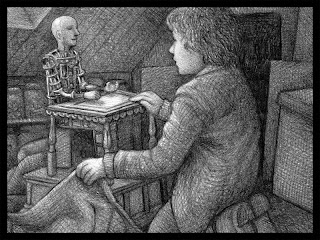
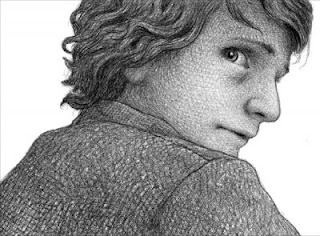
The Invention of Hugo Cabret was awarded the 2008 Caldecott Medal, and was the first non-picture book (in the traditional sense) to win this honor. The story is told in over 500 pages of pictures and words, with 284 pages of Selznick’s trademark monochromatic pencil sketches framed in black.

I am sad, though, that I read this book after The Arrival, because had I read Hugo Cabret first, I would have enjoyed the book more . Since the book is hugely plot-driven, I felt it was a bit lacking in depth and character development; a bit more introspection from Hugo’s character would have placed the two books on a more even plane.

Despite that small sentiment on my part, I still give full marks for the book for breaking new ground in books for young readers, especially in illustrated novels. Selznick is definitely in the hall of fame in my bookshelf, and I look forward to collecting more of his works.
***
My copy: hardcover
My rating 5/5
In the Company of the Courtesan by Sarah DunantI love reading historical fiction, especially those that deal with Renaissance painters and their art.
Sarah Dunant’s The Birth of Venus was one of the first novels I read in this genre, and was one of the reasons I got hooked — I loved the tapestry of themes Dunant weaves: romance, art, religion, and politics, set in the vibrant backdrop of the Renaissance.
I’ve had In the Company of the Courtesan for over a year now, and I figured it was time to finally read it.
This time, Dunant chooses Venice as the setting for her story and I have no complaints — I love stories set in Venice, with its colorful people, flurry of activity, and air of romance.
In the Company of the Courtesan revolves around an unlikely duo — the beautiful courtesan named Fiammetta Bianchini and her right-hand man, a dwarf named Bucino Teodoldi.
The story unfolds as the pair flees from the sack of Rome in Renaissance Italy, escaping into Venice to rebuild their life from scatch.
The dwarf and his mistress struggle to get back on their feet, and eventually manage to enter Venetian society and reestablish Fiammetta as an in-demand courtesan, but troubles continue to brew, as Venice’s cast of characters pose threats to their partnership, from an overzealous lover who opens Fiammetta’s eyes to real romance and passion; an enterprising Turk who is eager to add Bucino to his Sultan’s menagerie; and the blind and crippled healer La Draga, who breaks the peace pf the household and leaves them to face seriouse consequences.
Sarah Dunant is a master at recreating history and fleshing out nameless faces of the past.
In the Company of the Courtesan was a bit more challenging to read than The Birth of Venus, probably because it is written from the point of view of Bucino, who is not as companionable as Alessandra at first, but grows on you as the story progeresses.
Bucino makes an interesting, if outlandish persona, as he is an outcast that has gained the grudging respect of society because of his ties to the great Fiammetta.
The novel also features another artist — Titian, this time — for whom Fiammetta serves as a muse.

In true Dunant fashion, In the Company of the Courtesan is another page-turner, offering a glimpse into the role of courtesans in Renaissance society, seamlessly incorporating themes of loyalty, friendship, and religion in a portrait of 16th century Venice.
Sarah Dunant’s other novels seem to be all contemporary after this, I do hope they are as well-written as her historical novels.
***
My copy: hardcover with dustjacket (upgraded from trade paperback)
My rating: 4/5 stars
Reading Erich Segal’s Love Story was like running into an old friend I hadn’t seen in a long time.
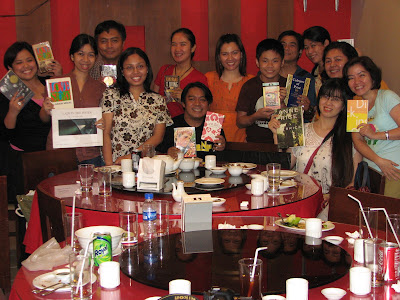
I was actually dreading reading this again, because I felt I’d outgrown it already, and if it were not for the Flips Flipping Pages discussion, I wouldn’t have read it again, because the mere sight of the book actually had me snorting in derision.
I didn’t have a copy of the book, and I’d seen dozens of copies of it at Book Sale in the past, but of course, as luck would have it, no copies were to be found now that I needed it. I’d once again proven the law of Book Sale: the amount of urgency applied in seeking out a specific title at book sale is directly proportional to the possibility that it (and multiple copies, too) will turn up when you no longer need it or already have a copy. I ended up mooching a hardcover copy (yes, of course, if I have to mooch internationally, I’d rather have a hardcover) from California, and got it just in the nick of time, the day before the discussion.
It’s the simplicity of the story that has given this book its staying power: rich boy meets poor girl, they fight for their love, but the triumph is short-lived as the girl gets sick and dies tragically young (oops, is there anyone who doesn’t know how Love Story goes?). I agree with our discussion moderator, Czar, when he said that Erich Segal knew when to rein himself in, just short of the point of being mushy.
Like Jenny, I love Oliver Barrett III’s name and numeral (hahaha!) — who wouldn’t? He’s smart, rich, handsome, athletic, and even his rambunctiousness adds to his charm. Jenny Cavilleri, on the other hand, is exactly the girl who can whip his cute little tosh into submission, with her snooty demeanor, smart-ass mouth and artistic temperament. The highlight of the book for me was the playful banter between the two, and the fact that Jenny always got the final word.
Yesterday, we also watched the movie and I was surprised to find out that the screenplay actually came before the book, and Segal actually just wrote the book to promote the movie. The book was mostly faithful to the movie, except for the point of view, but I felt that the final scene was better in the book.
One of the points raised in the discussion was that the movie was actually more realistic, because relationships (in this case, Oliver and his dad’s relationship) don’t get fixed just because someone dies, and closure doesn’t come that easily. While I see their point and agree with it in essence, I don’t think that was what the book meant to say. In the book, as Oliver cries in his father’s arms, I didn’t see Jenny’s death as a cure-all for their relationship, but rather an opening to reach out to each other, and merely the start of Oliver’s coming to terms with Jenny’s death.
I didn’t expect to say this, but I’m definitely keeping this book.