The Three Little Pigs go Po-Mo

I know I just did a picture book roundup, but I’m really excited to share two picture books I got this weekend, both a deconstruction of the story of the Three Little Pigs: The True Story of the Three Little Pigs by A. Wolf as told to Jon Scieszka, illustrated by Lane Smith; and The Three Pigs (book #54 for 2009), written and illustrated by David Wiesner.

I have had a fascination for postmodern picture books since I was in college, and I have a growing collection of them. It totally revolutionizes picture books as we know them, and it’s great genius on the part of the writers and especially the illustrators.

Postmodern picture books are often characterized by:

  • Nontraditional ways of using plot, character, and setting, which challenge reader expectations and require different ways of reading and viewing;
  • Unusual uses of the narrator’s voice to position the reader to read the book in particular ways and through a particular characters’ eyes (this can be achieved by the written or visual text);
  • Indeterminacy in written or illustrative text, plot, character, or setting, which requires the reader to construct some of the text and meanings;
  • A pastiche of illustrative styles, which require the reader to employ a range of knowledge and grammars to read;
  • New and unusual design and layout, which challenge the reader’s perception of how to read a book;
  • Contesting discourses (between illustrative and written text), which require the reader to consider alternate readings and meaning; intertextuality, which requires the reader to use background knowledge in order to access the available meanings; and
  • The availability of multiple readings and meanings for a variety of audiences.
(Anstey, M. (2002). “It’s not all black and white”: Postmodern picture books and new literacies. Journal of Adolescent & Adult Literacy)

Now, I’ve long been a fan of Lane Smith, especially when he’s teamed up with John Scieszka, because they just make me laugh out loud! I have a growing collection of their picture books, starting with The True Story of the Three Little Pigs, The Stinky Cheese Man and Other Stories, Squids will be Squids, Cowboy and Octopus, Pinocchio, and Math Curse. I think I’m just missing a few – Science Curse, the Abe Lincoln book, and Seen Art?.

I’ve had a paperback copy of The True Story of the Three Little Pigs for around 4 years now, but when I saw the hardcover, 10 year anniversary edition of the book at Book Sale for only P120, I just had to have it (never mind that I bought the paperback full price, for more than twice the amount.

The True Story of the Three Little Pigs, with Totoro :)
The True Story of the Three Little Pigs is told from the wolf’s point of view, and he cries out, “I was framed!”

He pleads not guilty, stating, “Hey, it’s not my fault wolves eat cute little animals like bunnies and sheep and pigs. That’s just the way we are. If cheeseburgers were cute, folks would probably think you were Big and Bad too.”

cheeseburger: wolf version
A. Wolf, or Alexander T. Wolf, shares his side of the story, the real story, he says, which is about a sneeze and a cup of sugar.

Apparently, he was making a birthday cake for his granny when he ran out of sugar, so he went over to the pigs’ house to borrow a cup of sugar. The problem is, he had a bad cold, and when he sneezed, the first two houses – the one made of straw and the one made of sticks – collapsed on top of the their owners, and the wolf thought it would be a shame to let some perfectly good ham go to waste.

The third house was brick, though, and the wolf had a nasty exchange of words with the third pig, who wouldn’t lend him a cup of sugar for his dear granny’s birthday cake. So he huffed, and he puffed… and that’s how the cops found him.

He says that the cup of sugar story wasn’t exactly breaking news, so the police jazzed up the story and he became famous as the Big Bad Wolf.

breaking news!
Lane Smith’s rich, textured illustrations make the story doubly funny, adding little (sometimes morbid) jokes into the illustrations. The 10 year anniversary edition, which I now have, throws in a few more laughs: there is a letter from A. Wolf complaining his ten-year imprisonment and decrying the testimony made by a certain girl in a red riding hood. The back of the book has also been vandalized with different opinions on the case.
wall graffiti
Now that I’ve “done a Blooey” on this book, i.e. upgraded yet another paperback into hardcover (in Flippers/Moochers terms), I now have a spare copy of the book (in pristine condition), but I think I already have someone in mind for the book. I’ll have to find out if that person has this already, or else it’ll go into my BookMooch inventory.

By the way, I’m really loving how hardcover picture books from the US have “reinforced binding” that make them good for lots and lots of readings. Hopefully my (future + hypothetical) kids get to appreciate my growing collection of picture books, which ran out of shelves, like, several dozen books ago. I wish they’d devise the same type of binding for other types of books.

My second book for today is The Three Pigs by David Wiesner, who has fast become another one of my favorites, ever since I found a battered copy of Tuesday in a bargain bin (I think the one I mooched got lost in the mail).

According to the jacket, “Ever since the pigs took to the air at the end of Tuesday, he [Wiesner] has wanted to give them a book of their own” – hence The Three Pigs, which received the 2001 Caldecott Medal. It amazes me how this guy just racks up the Caldecotts.

Before reading this book, I’d have thought The True Story of the Three Little Pigs would be a tough act to beat, but Wiesner does a great job with this book. Aside from deconstructing the story, The Three Pigs deconstructs the actual structure of the book, with a touch of metafiction, as the characters become aware that they are characters in a book.

It starts out as the regular Three Little Pigs story, but the wolf huffs and puffs so hard that he blows the first pig right out of the story. Confused, the wolf moves on to the next house, but as he huffs and puffs, the first pig coaxes the second one out of the story and the wolf is even more confused when he finds the second house empty.

When the two pigs reach the third house, the third pig is surprised because they haven’t been eaten up. They knock away some pages of the book, fold it up, make a paper plane and have the time of their lives, until the plane crashes into a crumpled heap.

folding the pages
My favorite scene — the paper plane ride
The three pigs find another story and they enter it – it’s Hey Diddle Diddle. They get out of the story and the cat with the fiddle follows them out. They enter another story, this time with a dragon, and they save the dragon from getting slain by taking him out of his story.

The pigs finally go home to their story, and piece it back together so that the wolf gets to the brick house, and when he huffs and puffs and is unable to blow down the house, the dragon pokes his head out and the letters from the text get scattered. The pigs decide they’ve had quite enough and leave the wolf outside while they (pigs + cat + dragon) all head inside to have some soup.

Dragon’s head butts into the text, scattering the letters
I love how smart David Wiesner’s books are, and this one reminds me of one of my favorite book series, Jasper Fforde’s Thursday Next series. I like how the pigs defy the structure of the book, jumping from one story into another, ultimately taking charge of their fate.

I also love how Wiesner uses different styles to establish the jump from story to story, and the pigs adapt to the illustration style wherever they are situated— from the vintage style of The Three Little Pigs, the realistic style of the “space” outside the books, the simplistic style of the nursery rhyme book, and the coloring book style of the dragon story. When the pigs are halfway out the story, they’re also illustrated in half-and-half styles. Wiesner is such a genius!

The pigs jumping into the coloring book-style dragon story
The Three Little Pigs is a great children’s classic, but it’s even better when it goes po-mo! :)

***
My copy: The True Story of the Three Little Pigs, hardcover 10 year anniversary edition (upgraded from Scholastic paperback); The Three Pigs, hardcover — both P120 at Book Sale

My rating: The True Story of the Three Little Pigs, 5/5 stars; The Three Pigs 5/5 stars

A Pig, A Panda, and a Tiger (Picture book roundup #4)

Another picture book roundup for lazy Sunday, so I can catch up on my reading (cramming a few more books into what’s left of March). Today’s roundup includes three award-winning books: Olivia, written and illustrated by William Falconer (Book #51 for 2009), Zen Shorts written and illustrated by John J. Muth (Book #52 for 2009), and A Visit to William Blake’s Inn by Nancy Willard, illustrated by Alice and Martin Provensen (Book #53 for 2009).

I’ve wanted an Olivia book for so long, but I rarely buy picture books for more than P100 at Book Sale so I had to wait until I came across this great P65 board book. Olivia is the latest addition to the list of my character-based collections – Madeline, Babar, Curious George, and Eloise.

Olivia (Caldecott Honor Book 2001) is the story of that now-familiar scribbly pig who likes fashion, art, ballet, and books — a very cultured pig indeed. This picture book has few words, and as the story is character-based, there is not much of a plot. It’s mostly an introduction to Olivia as a character, and the rest of the Olivia books tell the stories.

The illustrations, of course, make the book special (hence the Caldecott). Olivia’s peculiar appearance gives her instant recall — a top heavy pig with little spindly arms and legs, rendered in charcoal and gouache, looking like she’s been scrawled onto the page. Olivia is mostly grayscale (except when she gets sunburnt at the beach), with the occasional spot color (usually clothes), and the simplicity emphasizes her comic appeal — she’ll have you in stitches with the visual humor that appeals to all ages.

There’s something very French and chic about Olivia (and not just the name) that delights me, because it’s unexpected from a pig character. The book is great for a budding fashionista — Olivia, and her family dress up in decidedly French styles – maillot swimsuits, striped shirts, turtlenecks, opera gowns, sailor dresses and dark shades. Her cultural tastes are also French, from Degas (there’s a Pollock too, though) to ballet, and Callas.

Next on the lineup is Zen Shorts (Caldecott Honor 2006), which I actually read a couple weeks ago for the Flippers’ Japanese book discussion. I found my paperback copy at Book Sale for P60, and as soon as I spotted it, I knew I had to buy it.

Zen Shorts features a panda named Stillwater, who befriends siblings Michael, Karl, and Addy. Enclosed within this story are three Zen “shorts” – short stories from Zen Buddhist literature that challenge the reader to reexamine his or her habits, desires, concepts and fears. In the same way, Stillwater uses the Zen “shorts” (“Uncle Ry and the Moon,” “A Heavy Load,” and “Farmer’s Luck”) as gentle teaching tools for the three kids.


There are two illustration styles used in this book, a full-color watercolor wash for the main story, and a heavier pen and ink style for the Zen Shorts, a great juxtaposition of Western and Oriental techniques that mirror the realistic Western story framing three stories of Oriental philosophy. I like how this all ties together in introducing abstract philosophical concepts to kids, with Stillwater as the very huggable sensei, not to mention that it makes for a very engaging picture book.

The last book, A Visit to William Blake’s Inn: Poems for the Innocent and Experienced Travelers caught my eye because it had both the gold and silver badges (Newbery Medal 1982 and Caldecott Honor 1982), and it was only P65 at Book Sale.

The book is about a fictitious inn owned by William Blake, which houses his fantastic creations, such as the Rabbit, the Rat, the Wise Cow, the King of Cats, the Tiger, and the Man in the Marmalade Hat. William Blake is also one of the characters in this collection of poetry that pays homage to Blake’s work.

Gouache paintings bring the poetry and all its vivid characters to life, with intricate architectural details. I love the tigers and the cats in particular, who remind me of my beloved Tabby, Tomas :) A beautiful book showcasing beautiful poetry, this is a great addition to my picture book collection!

***
My copies: Olivia, board book; Zen Shorts and A Visit to William Blake’s Inn, paperback

My rating: Olivia 5/5 stars; Zen Shorts 5/5 stars; A Visit to William Blake’s Inn 5/5 stars

Blast from the Past (Picture book roundup #3)

There are some books that stand out in my childhood memories, and I am on a crusade to find them all again to add to my collection. It hasn’t been easy, as some of them have been out of print for a while now, so I scour Book Sale and BookMooch for copies.
Recently I was able to find some of them, and I thought I’d share them here (Books 41-43 for 2009).First up is Tubby and the Lantern by Al Perkins, illustrated by Rowland Wilson. For a long time I couldn’t remember the title of this book, I just knew we read it in Think & Try (my pre-school) days, during story time and it was shown on Batibot, and that there was a Chinese boy and an elephant.
I mooched a copy from the US, and had it sent to my my mom when she was in the States as the user wasn’t sending international. Finally it came in one of the balikbayan boxes my mom sent home.

Tubby and the Lantern is about the friendship of a Chinese boy named Ah Mee and a small elephant named Tubby. It’s set in a Chinese, lantern-making town, where Ah Mee’s parents are the best lantern makers. On Ah Mee’s birthday, Tubby decides to surprise Ah Mee by making him a giant lantern, which proves disastrous as he is carried into the air and Ah Mee has to save him.

I remember back in pre-school, we had a lantern-making session after reading the book, just like Ah Mee and Tubby made them. Except the candles, of course!

Even more than 20 years later, I still love the story and the cheery illustrations. The illustrator, Rowland B. Wilson, used to work for Playboy, and also worked on animated films like Disney’s Hercules, Hunchback of Notre Dame, Little Mermaid, and Tarzan, as well as Don Bluth’s Thumbelina. He also worked on the series Schoolhouse Rock.

(Tubby and the Lantern photo by Glenn Mullaly)

The next book is also a throwback to my kindergarten days — Little Black Sambo by Helen Bannerman (illus. by Eulalie). I still don’t have a copy of this book, but I found a modernized version by Little Golden Books, entitled The Boy and the Tigers (by Helen Bannerman, illus. by Valeria Petrone).

Little Black Sambo is the bizarre story of a boy who walks into a jungle (haha, a leisurely stroll, with an umbrella to boot!) and runs into a pack of tigers, who make him give up his clothes, shoes, and even his umbrella in exchange for his life. The tigers end up fighting over Little Black Sambo’s belongings and they spin round and round chasing each other until they melt into a puddle of butter and Little Black Sambo’s father uses the butter to make pancakes for the family! Fascinating stuff, really!

I remember reading this over and over with morbid interest when I was a kid; I even remember dressing up in my raincoat and umbrella so I could role-play Little Black Sambo and fend off the fierce tigers. So I was so disappointed with the new edition, because it was sanitized and cutesy-fied so it’s less offensive and more lovable. The original book was criticized for being racist, but I grew up reading the book and I was oblivious to the racism, I think it was more anti-tiger than anything else, hehe.

In the new edition, Little Black Sambo becomes a hindu boy named Rajani and the tigers are so cute they’re not even scary. The illustrations are great, but they obviously chose the style to bowdlerize the new edition.

Arrgh!!! I still want a copy of Little Black Sambo.

Finally, my last book for the roundup is Many Moons by James Thurber, illustrated by Louis Slobodkin. It won a Caldecott Medal in 1943.
I actually have two copies of this book, a new paperback edition that I found at the Book Sale Warehouse and an old hardbound library discount that I found at the Book Sale in Cagayan de Oro (P35!), but in case you’re wondering, I’m not letting either one go.

I remember this was the final story in our CRL workbook in Grade 3 (i think…) and it’s about Princess Lenore, the princess who asks for the moon, and the court jester (who outwits the Lord Chamberlain, the palace wizard, and the mathematician) who gets the moon for her.

It’s a great fairy tale, and Louis Slobodkin’s swirly illustrations are the perfect touch.

I am still looking for a copy of Tikki Tikki Tembo, Robert the Rose Horse, and Are You My Mother? I hope I can find them soon :)

***

My copies: Tubby and the Lantern, hardcover; The Boy and the Tigers, hardcover; Many Moons, paperback / hardcover

My rating: Tubby and the Lantern, 5/5 stars; The Boy and the Tigers, 2/5 stars; Many Moons, paperback / hardcover 5/5 stars

V-day reading (Book 30! Woot!)

Love Story by Erich Segal
Book #30 for 2009
Book #4 for Diversity Challenge (Reading group requirement)

Reading Erich Segal’s Love Story was like running into an old friend I hadn’t seen in a long time.

It must be ten years since the first time I read this book, back in second year high school, a time when all we ever wanted to read were books about undying love, books that make us gush and sigh and cry and wish that someday we’d be able to experience the things we read about (oh, but that is another story…).

I was actually dreading reading this again, because I felt I’d outgrown it already, and if it were not for the Flips Flipping Pages discussion, I wouldn’t have read it again, because the mere sight of the book actually had me snorting in derision.

I didn’t have a copy of the book, and I’d seen dozens of copies of it at Book Sale in the past, but of course, as luck would have it, no copies were to be found now that I needed it. I’d once again proven the law of Book Sale: the amount of urgency applied in seeking out a specific title at book sale is directly proportional to the possibility that it (and multiple copies, too) will turn up when you no longer need it or already have a copy. I ended up mooching a hardcover copy (yes, of course, if I have to mooch internationally, I’d rather have a hardcover) from California, and got it just in the nick of time, the day before the discussion.

To my surprise, I got through the whole book without a single derisive snort! Rereading it was much better than I expected. Though I wasn’t reading it with the eyes of a thirteen-year old girl anymore, I actually still liked it.

It’s the simplicity of the story that has given this book its staying power: rich boy meets poor girl, they fight for their love, but the triumph is short-lived as the girl gets sick and dies tragically young (oops, is there anyone who doesn’t know how Love Story goes?). I agree with our discussion moderator, Czar, when he said that Erich Segal knew when to rein himself in, just short of the point of being mushy.

Like Jenny, I love Oliver Barrett III’s name and numeral (hahaha!) — who wouldn’t? He’s smart, rich, handsome, athletic, and even his rambunctiousness adds to his charm. Jenny Cavilleri, on the other hand, is exactly the girl who can whip his cute little tosh into submission, with her snooty demeanor, smart-ass mouth and artistic temperament. The highlight of the book for me was the playful banter between the two, and the fact that Jenny always got the final word.

Yesterday, we also watched the movie and I was surprised to find out that the screenplay actually came before the book, and Segal actually just wrote the book to promote the movie. The book was mostly faithful to the movie, except for the point of view, but I felt that the final scene was better in the book.

One of the points raised in the discussion was that the movie was actually more realistic, because relationships (in this case, Oliver and his dad’s relationship) don’t get fixed just because someone dies, and closure doesn’t come that easily. While I see their point and agree with it in essence, I don’t think that was what the book meant to say. In the book, as Oliver cries in his father’s arms, I didn’t see Jenny’s death as a cure-all for their relationship, but rather an opening to reach out to each other, and merely the start of Oliver’s coming to terms with Jenny’s death.

“Love means never having to say you’re sorry” (note: in the book it’s actually, not ever, not never) is probably one of the most trite expressions about love today, and while I am not in the position to debate its meaning, I guess it’s not the line’s fault that several generations of readers (and film viewers) all over the world have used it for almost 4 decades now.

I didn’t expect to say this, but I’m definitely keeping this book.

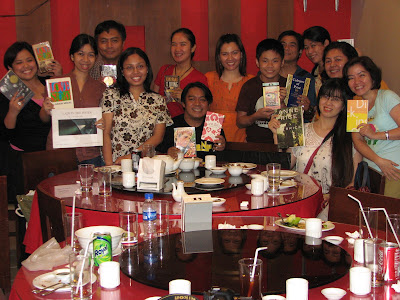
Flippers celebrate V-day with Love Story at Red Palace!

***
My copy: hardcover first edition with dustjacket
My rating: 4 out of 5 stars

Picture book roundup #2

Got myself some great picture books for my collection this week:

Jumanji written and illustrated by Chris Van Allsburg (#23 for 2009)
Monster! written by Angela McAllister, illustrated by Charlotte Middleton (#24 for 2009)
Tuesday written and illustrated by David Wiesner (#25 for 2009)

and I’m throwing in one other book from my “for shelving” pile (just finished covering, hehe): To Market, to Market written by Anne Miranda, illustrated by Janet Stevens

I was covering them in plastic this afternoon, so I decided I might as well read and review them so I can shelve them already.

To Market, to Market is a hilarious retake of the famous Mother Goose rhyme:

“To market, to market, to buy a fat pig,
Home again, home again, jiggity-jig!”

In this story, the old woman goes to the market and buys a fat pig… and also a hen, a trout, a goose, a lamb, a duck, and a goat.

Chaos ensues when she brings home the animals one by one and they start to escape and make a mess around the house, and the old woman gets crankier and crankier.

Finally, the old woman goes back to the market together with all the animals and buys a bunch of vegetables. Then they go home, and the old woman makes a rich, hot soup that she shares with all the animals, and they all collapse into a happy pile on the kitchen floor.

I actually let out a sigh of relief at the end of the book because I was afraid she was going to cook all the animals to get rid of the racket they were making.

I also liked the illustrations in the book — an interesting combination of photocopied pictures (black and white, for the backgrounds) and watercolor (full color, for the animals and the old lady), as they captured the humor of the story perfectly.

Check it out here.

I actually haven’t read the original Jumanji until today, but the movie (as well as the movie novelization) was a childhood favorite.

The storybook is actually a simpler version, without the Robin Williams plotline, but most of the elements from the game are there.

Jumanji is a Caldecott awardee, and Chris van Allsburg’s illustrations, are as always, superb. Monochromatic pencil drawings, clean lines, and masterful use of the play of light and shadow — his art never fails to awe me.

Check the book out here.

Next in the lineup is Monster! a story that deals with the responsibility of keeping a pet, an issue that is close to my heart. I agree that kids need to learn this, because they often think pets are toys, and even as grown-ups some people do not take pet-keeping seriously.

The story is quite effective in driving the message across. It’s about a kid named Jackson who wants a pet so badly, so his dad gets him a hamster, which he immediately names “Monster.” The hamster is a novelty, and after a week he forgets to clean Monster’s cage, and forgets to feed the hamster altogether (tsk, tsk, tsk…).

One day, Monster escapes from the cage, gets into the sack of hamster feed, and grows into a real monster, and things take on a surreal reversal of roles. Jackson becomes the pet and he finds out for himself how it feels to be neglected.

Thankfully, it is all a bad dream, and when he wakes up, he finds his hamster, renames him “Fluffy” and resolves to take better care of him.

The illustrations in this book are interesting too, as upon closer examination, I discovered they’re actually a collage of paper cutouts outlined in dark pencil.

The last book in this lineup is the Caldecott awardee Tuesday by David Wiesner, which I got, hardbound for *drumroll, please* P15! All right, so it’s a library discard and a little beat up, but I don’t really care, it’s nothing a fresh plastic cover and invisible taped won’t fix. I actually mooched a copy from Israel, but it’s been some months now and I think it might have gotten lost in the mail, so this will have to do for now.

It’s a book with very few words, about some very strange happenings one Tuesday night, when hundreds of frogs (what do you call them in collective anyway? Ooh, google says it’s “army”) fly into the night sky on lilypads, running into lines of laundry, inside windows, down fireplaces, past trees and dogs.

The lilypads lose their flight as soon as the sun rises, and the next morning, to the townsfolk’s puzzlement, the street is littered with lilypads and some people swear they saw things zooming across the sky the night before.

The story ends with a funny twist: next Tuesday, and this time, it’s the pigs that are flying.

I am not fond of frogs so I was actually queasy at the sight of so many throughout the book, but it’s fascinating how each frog’s pattern is painstakingly different from the others. The visual narrative is awesome too — Wiesner is a master of wordless picture books.

Check out the book here!

Sigh. Book Sale is a tre
asure trove for picture book collectors.

***
My copies: To Market, to Market, paperback (P30, from Pick-a-Book warehouse); Jumanji, hardbound but missing dust jacket (P55 from Book Sale); Monster!, paperback (P15 from Book Sale); Tuesday, hardcover with dust jacket (P15 from Book Sale)

My rating: To Market, to Market, 4/5 stars; Jumanji, 5/5 stars; Monster!, 4/5 stars; Tuesday, 5/5 stars