Growing up, one of the most read books on my shelves was a well-thumbed copy of Johann Wyss’ Swiss Family Robinson. It was one of those cheap, watered down illustrated classic editions, but it provided me many long hours of entertainment as I fantasized about what I would do if I were shipwrecked on an exotic island.
That old book has long been missing — I think it was donated to a book drive, and I sorely missed it, so I’d been looking for a nice replacement for the longest time.
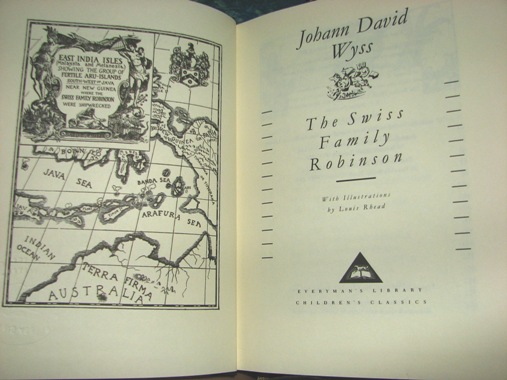
Last year, at one of my bargain book haunts (the Book Sale branch in Mall of Asia) I was able to unearth an exquisite Everyman’s Library Classic edition, with a cloth bound, gilded cover, a gold bookmark ribbon, vintage endpapers, and lovely illustrations by Louis Rhead! The best part? It was only P90 (less than $2)!
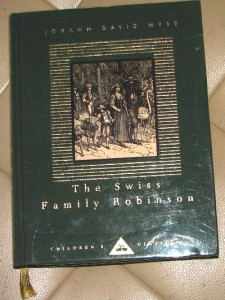 Swiss Family Robinson (#129 for 2009) is a classic adventure story published in 1812. Johann Wyss was a Swiss pastor who wrote the book to impart good values to his sons.
Swiss Family Robinson tells the story of a family (Robinson isn’t their surname, but it’s in the title because they were comparable to Robinson Crusoe) abandoned on a sinking ship. The father is the unnamed narrator, joined by his wife (also unnamed, but in my old book she was Elizabeth), and kids: 16 year-old Ernest, 14 year-old Fritz, 8 year-old Jack, and 6 year-old Franz (in my old book, his name was Francis, and Fritz was older than Ernest).
The wreckage floats near an island, so the narrator decides to take refuge there with his family, and they establish a new life in the island, which they christen as “New Switzerland.”
I knew the version I read when I was younger was abridged, but I was really surpised at how different the story was this time around.
Some of the details didn’t match — the kids’ names and ages, the dogs’ names, the names of the places on the island — and there was a major disparity in the events that transpired in the two books.
That was difficult to get past, and I was in a surly mood, fuming at unscrupulous publishers that took entirely too much liberty with classic texts, without concern for literary preservation or the thousands of impressionable minds that would read their books. It’s one thing to abridge a classic, but it’s another thing to make up events that aren’t in the original text.
And then I looked it up and found out that The Swiss Family Robinson has been translated and rewritten so many times, with episodes added, changed, or deleted that no complete edition of Wyss’ manuscript exists. I find that really sad, because it’s his work, and all those who worked with it should have given it the respect that it deserves.
Anyway, as soon as I got past the indignation, I realized that I could enjoy this one even more than my “first” reading of The Swiss Family Robinson, and soon grew amazed at the new world that was opened up to me.
Some things I loved about The Swiss Family Robinson, thankfully, were still in this book, like the tub boat made of casks sawn in half, placed side by side and nailed to a plank; the animals swimming to shore in life preservers; the house in the tree; and the dwelling in the cave.
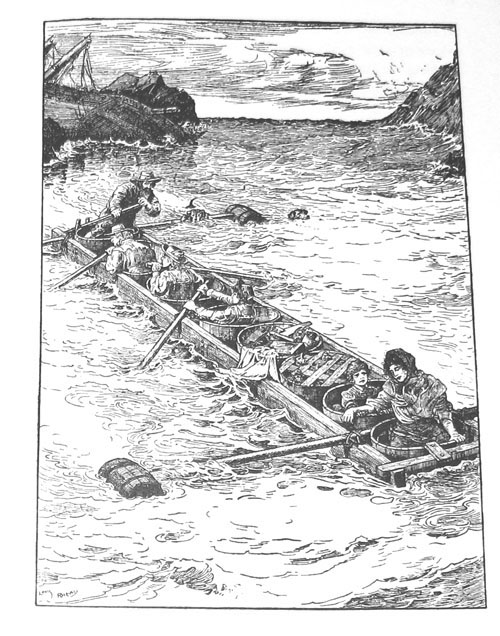
But I also found more to enjoy in this book, as it’s four times longer than my old copy of The Swiss Family Robinson.
It’s amusing because the island is supposed to be in the “East Indies” (they were en route to Australia), meaning it’s in Southeast Asia, and could easily have been set in one of the islands in the Philippines, but the biodiversity is scientifically impossible, even in the 19th century. The menagerie is worthy of a zoo — sperm whales, porcupines, monkeys, lions, tigers, bears, onagras, wild boars, buffaloes, kangaroos, hyenas, jackals, sea turtles, hippos, moose, and a wide variety of birds — to exist in the same ecosystem. The plant life is impossible too: rubber plant, flax, coconut palms, sago palms, cassava, figs, wild berries and cotton — all in one island?!?
Obviously it was written naively, but the imagination in the text is well-appreciated, and when I was a kid, I didn’t think about how impossible it all was.
I marveled at the family’s (specifically the father’s) “knowledge” of the natural world (again, impossible, I know), and their survival instincts — they built houses from scratch, made flour from cassava, tapped rubber from the trees, made candles from berry wax, harvested honey from wild beehives, spun thread from flax and wove cloth from the flax thread. They also tamed animals and cultivated plants from various parts of the island. No matter how fantastic the author made the family, I have no doubt they’re better equipped to survive in the wilderness than a 21st century family.
But then, I also cringed at all the animal cruelty that went on, and not only when their survival was at stake, and I couldn’t help thinking a lot of beautiful animals were senselessly killed. I didn’t think about this when I was younger, but it’s an issue I’ve learned to feel strongly about, and I was really disturbed by the animal cruelty in the book.
They pelted monkeys with stones sow the would throw down coconuts from the trees, they used their pet monkey to taste food so they would know it was safe to eat, they hunted down a kangaroo for no particular reason, they harpooned a sea turtle to tow their boat faster to the shore, and they butchered a beached spermwhale! With that kind of human thinking, no wonder the world’s biodiversity is suffering.

This book was missing some episodes that were in my old book, most jarringly the indian bird-taming techniques, the island tournament between the brothers, and the shipwrecked sailor that turned out to be a girl, but this book also had episodes that weren’t in the old one — the hippo, the “savages”, the rubber, the cassava, the candles and a lot more (and I’ve skimmed through the edition on Project Gutenberg, and it appears to be another different version too).
While I’m indebted to my old copy of the book for introducing me to the classic and endearing it to me, I’m glad I read another version of the book, although I really would like to read a version that is as close to how Wyss originally wrote it.
And while this book is more detailed and a lot different from the old copy I enjoyed, it still carried the spirit of The Swiss Family Robinson that I’ve always loved, the classic family adventure that has enjoyed immense popularity all over the world for over a century now.
***
My copy: hardcover, Everyman’s Library Classic edition
My rating: 4/5 stars
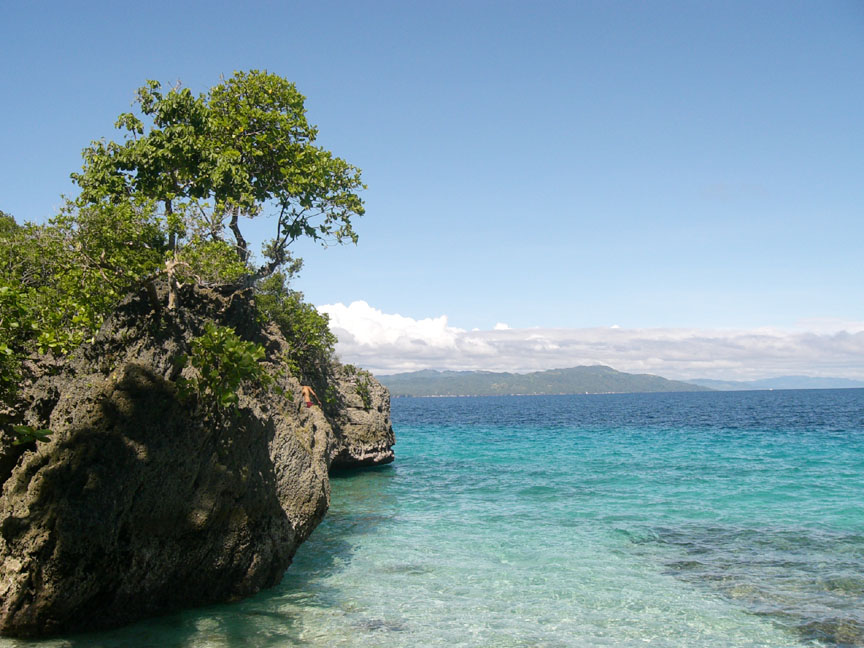
*cover photo taken in Bituon beach, Limasawa Island
I recently had the pleasure of reading a decades old copy of The Swiss Family Robinson. Not having read the book as a child I was amazed at how much I enjoyed it. I expected antiquated language and a dull, by todays standards, story line but found I was wrong on both counts. The Swiss Family Robinson, truly is a wonderful classic.
Maureen Hume http://www.thepizzagang.com
Gosh, impaling a sea turtle just so it would tow the boat faster? Evil!
This is definitely one of those classics everyone should at least know about!
Tony Peters
Kids on a Case: The Case of The Ten Grand Kidnapping
http://authortonypeters.blogspot.com/
Hi Blooey! Spending a few minutes (even hours) at BookSale really pays off!
@Maureen – I thought I would have outgrown it, but I still enjoyed this classic! :)
@Kathlyn – :s I know, I cringed the most at that part…
@Tony – Agree with you there!
@Peter – Hahaha, I spend a fair part of my free time at Book Sale… Nothing beats the feeling of being able to unearth a gem of a book!
One of my favorites!
Hi Jeannie– one of mine too!
Awww.. I remember reading this book as a kid, lots of adventures, definitely a must read! :D
Hi Betty Boop – and it’s great for both boys and girls too! :)