Sucker-punched.

A Heart of Stone by Renate Dorrenstein
Book #27 for 2009
Book #4 for Diversity Challenge (American)

After reading The Dream Merchant, I felt a little loopy so I grabbed the first book off my TBR pile just so I could clear my mind, and I didn’t read the back cover (now that I read the summary, I am thinking it wouldn’t have helped) nor did I have any idea what the book was about, as I got it from the book swap at the last BMP party.

I wasn’t planning on reading it, but Tracy Chevalier’s recommendation on the cover (“moving, chilling, powerful”) caught my eye. It started out innocently enough, as a coming-of-age novel high on Americana and it was a compelling read. The protagonist, Ellen, is quite likeable, and I found myself smiling at the quaint family portrait she painted.

A few chapters into the book though, it becomes clear that there is something sinister lurking beneath the surface of the picture-perfect family, and the goosebumps started breaking out. There is a dark mystery at the heart of the book, something that happens after Ellen’s twelfth birthday that continues to haunt her twenty-five years later.

The passages alternate between homey and gruesome, in a disturbing medley. And as the dark family secret was starting to unravel, I couldn’t stop reading, although I was getting increasingly queasy and was stuffing my fist into my mouth to keep myself from screaming and/or getting sick. In a vile sort of way, the book is so engrossing it makes you read through all the trauma, until you feel like you’ve experienced it all as well.

I don’t think I’ll read it again because the first time was traumatizing enough, but it was a very good read that was gripping from start to finish.

***
my copy: trade paperback, now on my BookMooch inventory

my rating: 4/5 stars

Persepolis

Was finally able to watch the Persepolis movie yesterday, and it comes as a relief that it’s not one of those annoying movie adaptations that fail to live up to the reader’s expectations.

If you’re not already familiar with the 2-part graphic novel (although there is already a complete edition with both parts in one book), Persepolis by Marjane (mar-zhan) Satrapi is a coming-of-age memoir in comic strips, narrating her life growing up in Iran during the Islamic revolution, studying in Austria, and then returning to her home country.
The comics, done in pen and ink, swing between irreverent and hilarious to poignant and insightful. I liked the first book, which is focused on Satrapi’s childhood, better than the second, which deals with her schooling abroad onwards. The perspective changes in the second book, naturally — the humor gets drier as she grows older and deals with more issues, but it is still worth reading to get the whole story.To parents who are wondering if the comics are suitable for young readers, the first book is okay for younger teens (6th grade to junior high, but be prepared to answer questions and explain certain concepts), but reserve the second book for later, as it deals with more mature issues.

The Persepolis movie, which debuted at the 2007 Cannes, is as highly acclaimed as the book. The animation is a bit more polished than the comics, but resembles it closely enough that you wouldn’t really notice. Some episodes from the first book are not in the film, especially those that don’t really propel the story forward, but the film is in essence faithful to the book.

The film also manages to make some episodes even funnier and some even more poignant, even though I’d read them already, and an adaptation that can do that is worth lauding. I cried a bit when uncle Anoush gave Marji the bread swans, and when the”Eye of the Tiger” sequence was rolling, I was doubled over laughing!

Film adaptations, when executed properly, add another dimension of enjoyment to the experience of reading a book, and the Persepolis movie does just that. It’s one of the very few movie adaptations that I’ve enjoyed recently, so bravo to that!

***
My copies: Persepolis 1, trade paperback, from NBS Book-sak Presyo Sale (a steal at P75); Persepolis 2, trade paperback, mooched from abroad

My rating: Persepolis I, 5/5 stars; Persepolis II, 4/5 stars
Persepolis movie, 5/5 stars

One heck of a sleeping pill…

The Dream Merchant by Isabel Hoving

Book #26 of 2009

I can’t believe I actually finished this book, because I fell asleep thrice while reading it, and had some very strange dreams too.

I saw this book at National Bookstore and was attracted by the handsome cover — deep red with a gilt pattern, with red jewels embedded in front. I searched it on BookMooch and found a copy of the exact edition and mooched it, and was excited to read it as soon as it got here.

I tried starting it a few times last year but I couldn’t spark a connection with the book. Finally, because I stayed home all weekend, I decided to stick it out, and for a six-hundred page book in fairly small font, with lots of vague mumbo-jumbo, I really am surprised I managed to finish it.

The Amazon reviews are high, all either 5 star or 4 star, but considering there are only 8 reviews in total, I shouldn’t have been too confident (haha, I really shouldn’t believe Amazon reviews).

The story is weird — 12 year old Josh Cope is hired by Gippart, a trading company that operates in dreamworlds called umaya. Due to a complication created by some overzealous Gippart employees in one of their operations, Josh and his team are trapped in the umaya and they must travel backwards in time.

It sounds hokey, I know. The ideas were there, but they weren’t sufficiently expressed , and it frustrated me. I hate it when fantasy books introduce strange concepts but don’t give you substantial information or context and expect you to automatically accept and understand its strangeness. Up to the last page of the book, I still couldn’t understand the point of the book and half the things they were saying!

Reading the amazon info, I found out the book was translated from Dutch. Perhaps its real merit was lost in translation.

I want to give this book away because my frustration with it irritates me, but it’s so pretty I still want it on my shelf.

***
My copy: hardcover

My rating: 2/5 stars

Picture book roundup #2

Got myself some great picture books for my collection this week:

Jumanji written and illustrated by Chris Van Allsburg (#23 for 2009)
Monster! written by Angela McAllister, illustrated by Charlotte Middleton (#24 for 2009)
Tuesday written and illustrated by David Wiesner (#25 for 2009)

and I’m throwing in one other book from my “for shelving” pile (just finished covering, hehe): To Market, to Market written by Anne Miranda, illustrated by Janet Stevens

I was covering them in plastic this afternoon, so I decided I might as well read and review them so I can shelve them already.
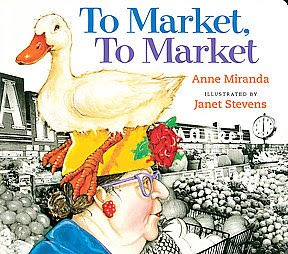
To Market, to Market is a hilarious retake of the famous Mother Goose rhyme:

“To market, to market, to buy a fat pig,
Home again, home again, jiggity-jig!”

In this story, the old woman goes to the market and buys a fat pig… and also a hen, a trout, a goose, a lamb, a duck, and a goat.

Chaos ensues when she brings home the animals one by one and they start to escape and make a mess around the house, and the old woman gets crankier and crankier.

Finally, the old woman goes back to the market together with all the animals and buys a bunch of vegetables. Then they go home, and the old woman makes a rich, hot soup that she shares with all the animals, and they all collapse into a happy pile on the kitchen floor.

I actually let out a sigh of relief at the end of the book because I was afraid she was going to cook all the animals to get rid of the racket they were making.

I also liked the illustrations in the book — an interesting combination of photocopied pictures (black and white, for the backgrounds) and watercolor (full color, for the animals and the old lady), as they captured the humor of the story perfectly.

Check it out here.
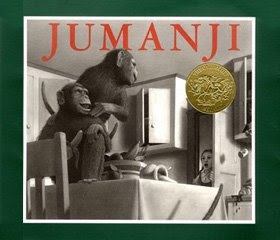
I actually haven’t read the original Jumanji until today, but the movie (as well as the movie novelization) was a childhood favorite.

The storybook is actually a simpler version, without the Robin Williams plotline, but most of the elements from the game are there.

Jumanji is a Caldecott awardee, and Chris van Allsburg’s illustrations, are as always, superb. Monochromatic pencil drawings, clean lines, and masterful use of the play of light and shadow — his art never fails to awe me.

Check the book out here.

Next in the lineup is Monster! a story that deals with the responsibility of keeping a pet, an issue that is close to my heart. I agree that kids need to learn this, because they often think pets are toys, and even as grown-ups some people do not take pet-keeping seriously.

The story is quite effective in driving the message across. It’s about a kid named Jackson who wants a pet so badly, so his dad gets him a hamster, which he immediately names “Monster.” The hamster is a novelty, and after a week he forgets to clean Monster’s cage, and forgets to feed the hamster altogether (tsk, tsk, tsk…).

One day, Monster escapes from the cage, gets into the sack of hamster feed, and grows into a real monster, and things take on a surreal reversal of roles. Jackson becomes the pet and he finds out for himself how it feels to be neglected.

Thankfully, it is all a bad dream, and when he wakes up, he finds his hamster, renames him “Fluffy” and resolves to take better care of him.

The illustrations in this book are interesting too, as upon closer examination, I discovered they’re actually a collage of paper cutouts outlined in dark pencil.

The last book in this lineup is the Caldecott awardee Tuesday by David Wiesner, which I got, hardbound for *drumroll, please* P15! All right, so it’s a library discard and a little beat up, but I don’t really care, it’s nothing a fresh plastic cover and invisible taped won’t fix. I actually mooched a copy from Israel, but it’s been some months now and I think it might have gotten lost in the mail, so this will have to do for now.
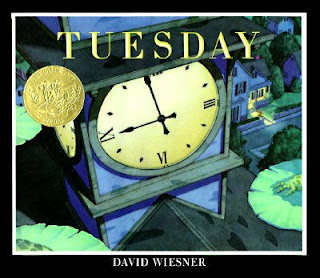
It’s a book with very few words, about some very strange happenings one Tuesday night, when hundreds of frogs (what do you call them in collective anyway? Ooh, google says it’s “army”) fly into the night sky on lilypads, running into lines of laundry, inside windows, down fireplaces, past trees and dogs.

The lilypads lose their flight as soon as the sun rises, and the next morning, to the townsfolk’s puzzlement, the street is littered with lilypads and some people swear they saw things zooming across the sky the night before.

The story ends with a funny twist: next Tuesday, and this time, it’s the pigs that are flying.

I am not fond of frogs so I was actually queasy at the sight of so many throughout the book, but it’s fascinating how each frog’s pattern is painstakingly different from the others. The visual narrative is awesome too — Wiesner is a master of wordless picture books.

Check out the book here!

Sigh. Book Sale is a tre
asure trove for picture book collectors.

***
My copies: To Market, to Market, paperback (P30, from Pick-a-Book warehouse); Jumanji, hardbound but missing dust jacket (P55 from Book Sale); Monster!, paperback (P15 from Book Sale); Tuesday, hardcover with dust jacket (P15 from Book Sale)

My rating: To Market, to Market, 4/5 stars; Jumanji, 5/5 stars; Monster!, 4/5 stars; Tuesday, 5/5 stars

Geisha

Memoirs of a Geisha by Arthur Golden

Book # 22 of 2009

Back in college, everyone was reading Memoirs of a Geisha, naturally sending me running in the opposite direction, especially when the movie came out.

Then when I discovered BookMooch, I decicded to go and get myself a copy, only it turned out to be a mass market paperback (I am admittedly a mass market paperback snob) so I was reluctant to pick it up and I packed it on my RORO trip but a few pages ended up getting squashed inside my luggage (bus compartments and all)… Then I got a trade paperback copy from an FFP book swap, although I still didn’t read it. Finally, I was able to mooch a hardcover copy from Triccie early this year and I’ve pretty much run out of excuses already.

Like The Kite Runner, this book needs no introduction. I read it on and off for a couple of days, and it was interesting enough to keep me reading until the end, but not so compelling that I could not put it down.

My bone to pick with the book is that while it is well-written (style-wise) and gives an insight into the geisha culture, the voice is startlingly Western, as if I was watching an anime character that has been dubbed over by an American accent. Aside from Golden giving the story a “fairy tale” (in Sayuri’s mind) ending, Sayuri’s cluttered train of thought was so distractingly un-Japanese, and I found myself looking for the quiet subtlety I’ve come to admire in Japanese writers.

I actually want to talk about another geisha book, one we read for Great Books class back in college, and was really memorable to me: Snow Country by Yasunari Kawabata.

Kawabata is the first Japanese author to win a Nobel Prize for Literature, and Snow Country is his first full-length novel.

Snow Country, often touted as the convergence of haiku and a novel, is a tragic love story set in a geisha district in snowy Western Japan.

I love the juxtaposition of beauty and sadness (a specialty of Kawabata’s — he has another novel entitled Beauty and Sadness) in Snow Country, the breathtaking but bleak snow-capped mountains providing the perfect backdrop for this theme.

“In the depths of the mirror the evening landscape moved by, the mirror and the reflected figures like motion pictures superimposed one on the other. The figures and the background were unrelated, and yet the figures, transparent and intangible, and the background, dim in the gathering darkness, melted into a sort of symbolic world not of this world. Particularly when a light out in the mountains shone in the center of the girl’s face, Shimamura felt his chest rise at the inexpressible beauty of it.”

The tragic love affair is between the wealthy Shimamura and the hot-spring (provincial) geisha Komako. Shimamura trifles with feelings while Komako’s whole being revolves around them. Komako devotes all of herself to Shimamura, with full knowledge that the more they love each other, the farther apart they’ll become.

As plots go, nothing much happens in this book, but the moving emotion of Kawabata’s writing makes it a masterpiece.

I especially like this passage on journalling books:

“But even more than her diary, Shimamura was surprised at her statement that she had carefully cataloged every novel and short story she had read since she was fifteen or sixteen. The record already filled ten notebooks.

“You write down your criticisms, do you?”

“I could never do anything like that. I just write down the author and the characters and how they are related to each other. That is about all.”

“But what good does it do?”

“None at all.”

“A waste of effort.”

“A complete waste of effort,” she answered brightly, as though the admission meant little to her. She gazed solemnly at Shimamura, however.

A complete waste of effort. For some reason Shimamura wanted to stress the point. But, drawn to her at that moment, he felt a quiet like the voice of the rain flow over him. He knew well enough that for her it was in fact no waste of effort, but somehow the final determination that it was had the effect of distilling and purifying the woman’s existence.”

With all these books about geisha, wired_lain, a BookMooch friend in Japan, tells me that the geisha are getting sick of so much attention from tourists, who bug them to take photos. I can just imagine how irritating that is.

***
My copy: Memoirs of A Geisha, hardcover; Snow Country, trade paperback

My rating: Memoirs of A Geisha, 3/5 stars; Snow Country, 5/5 stars