Lovin’ my Thumbthing!

I wandered into Powerbooks while waiting to be seated at Saisaki for lunch last Sunday and discovered a nifty new gadget that’ll help me reach my target of over 234 books this year: the Thumbthing.
As soon as I saw it on the counter, I just knew I had to have it — it’s perfect for people like me, who attempt to read at practically any given opportunity, regardless of logistics (hehehe, MRT, bathtub, the loo, in bed, jeep, trike, while cooking, while watching tv, while eating, etc…). My sister was like, what, P150, for that little thing?!? But I ignored her, because I considered it a good investment.

The dynamics are hard to explain, so I’m borrowing a diagram from the ThumbThing website to explain:

And here it is in action:


It’s been four days and I’m thoroughly enjoying this little thingamajig, which makes juggling a book so much easier for me, especially when I’m multi-tasking. The ergonomic design allows you to hold a book open with one hand, freeing your other hand to attend to other things. It doesn’t break the spine of the book (yay!), and it doesn’t obscure the text either, because the wings fit neatly in between the lines.

You can also use it as a bookmark, although strictly for leaving books on flat surfaces — it’ll probably get dislodged when you stow it inside a bag.

I’ve tried it on different books, and it works perfectly on everything from mass market paperbacks to standard hardcover novels. Doesn’t work on magazines and coffeetable books, but I think that’s asking for too much. Also doesn’t turn the pages for you, but then again, a page-turning device is also asking for too much.

It comes in a variety of sizes (mine’s a small and it fits perfectly) and colors (I wanted a pink or blue but they didn’t have it in my size so I had to get purple) too. My tiny complaint — I wish they had thought of adding a little hole to thread a handstrap or an id strap through for people like me who tend to lose (knock on wood) or misplace little things like this. Oh, and I haven’t tried it yet, but I’m foreseeing a juggling act reading in the dark with my Lumos booklight on.

Hmm, maybe I should stock up — I could try reading two books at a time, one in each hand!

(Clarification: not a sponsored post, despite my rave review :D)

Rating: 5/5 stars!

Be careful what you wish for… again!

I’ve been unable to read or blog in the past few days because so many things have cropped up last week, flowing over into the weekend and into this week too: a web design seminar, my sister home for a fortnight from Singapore, the INK booth at the Ortigas mini-book fair, a friend’s birthday party, and a surprise business trip looming this week…

I read 17 books in January, and originally wanted to surpass that, but I don’t think I’ll go over a couple of books above that, as this week ends February already. Hopefully I can make up for lost time soon.

On to the book I just finished:
Book #34 for 2009
Book #5 for the Diversity Challenge (American)
A Long and Fatal Love Chase by Louisa May Alcott

I grew up reading Alcott’s Little Women at least once a year starting fourth grade, usually reserving it for the Christmas break. I always loved that first chapter, where Jo grumbles, “Christmas won’t be Christmas without any presents,” and the four sisters each made their own little sacrifice to get Marmee some nice things for Christmas.
I felt sorry for Meg when she had to make do with old gowns at the grand parties, admired Jo for her dogged determination to become a writer, loved Beth and cried when she died, and hated Amy with a vengeance.

I haven’t read it in a while now, not after college as far as I remember, but I can rattle off my favorite episodes from the book– Meg’s hair getting fried with the hot curling tong; Amy and the lime episode, Beth getting her baby piano, Jo getting her hair cut, Amy falling into the lake, the Pickwick Papers, and Mr. March coming home. To this day, I still believe Jo and Laurie should ha ve ended up together. And yes, I still hate Amy.

I was surprised to come across this unfamiliar book written by Louisa May Alcott – I was browsing for a hardbound copy of Little Women (that I still don’t have) on BookMooch when I discovered this, and it sounded so interesting that I mooched it right away.
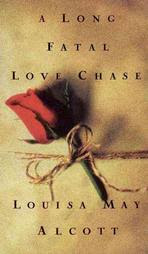
A Long Fatal Love Chase book actually only saw print in this century, as it was deemed too sensational in Alcott’s time (1866). Quite understandable, I think, now that I’ve finished it: if I didn’t know it was Alcott’s work, I wouldn’t have thought she could have written something like it, as it was shockingly different from Alcott’s goody-goody Little Women; Jo’s Boys; and Little Men.

The novel’s main theme is obsessive love, and I was surprised to find that it was comparable to Oscar Wilde’s The Picture of Dorian Gray, which I read last month. Rosamond Vivian is a young girl who lives with her stuffy grandfather on a remote island, with only books to keep her company. She longs for freedom to see the world, and is prepared to pay whatever it takes to be free.

Enter Philip Tempest, a worldly rake and her grandfather’s prize pupil, who sweeps Rosamond off her feet as he visits the island on his dashing boat, Circe. Rosamond thinks he looks like the devil himself (referencing Mephistopheles) but is very much taken with him and goes off with him to leave her old life behind.

Not very long after she lives with Philip, however, it becomes apparent that he is not who she originally thought he was. Rosamond discovers Philip’s dark past, and his streak of cruelty and deceit, and Rosamond escapes from him. The thrilling chase across Europe begins, traversing Italy, Germany and France, as Rosamond attempts to be free of Philip who makes it impossible for her to hide. Rosamond is Philip’s newest obsession, and he has always gotten whatever he wants.

Even in Little Women, Alcott has made it clear that she is very well-read, referencing literary works such as Dr. Zhivago; The Pickwick Papers; and The Pilgrim’s Progress. There is more of that in this book, which is obviously inspired by The Tempest (Caliban and Miranda), and references classical mythology — Hero and Leander; Ganymede; Mephistopheles.

There is also a reference to The Wandering Jew, and surprise, surprise, it’s Faustian too — Rosamond actually says, “I often feel as if I’d gladly sell my soul to Satan for a year of freedom,” and that is actually equivalent to what happens when she runs off with Philip Tempest, who actually cautions her in the beginning: “There is very little real liberty in the world; even those who seem freest are often the most tightly bound.”

Alcott’s writing is formal but not cumbersome or antiquated, making it a pleasure to read .Rosamond as a heroine is smart and spunky, although Philip was really her one weakness. Philip Tempest makes a great anti-hero: a cold and calculating seducer of the innocent, but so powerfully charming (and handsome, I bet! I was imagining Hugh Jackman) that I really couldn’t blame the girl for falling so hard for him.

Here is one of my favorite lines from A Long Fatal Love Chase, both from Rosamond:

“In the books I read the sinners are always more interesting than the saints, and in real life good people are dismally dull. I’ve no desire to be wicked, but I do want to be happy. A short life and a gay one for me and I’m willing to pay for my pleasure if necessary.

The book has given me renewed appreciation for Louisa May Alcott… Now I want to read Little Women again; I need to find a hardbound copy soon!

***
My copy: hardcover with dustjacket, first edition, mooched from the US

My rating: A Long Fatal Love Chase, 4/5 stars; Little Women, 5/5 stars

Shopaholic hits the big screen

(Quick post before I head to a party)
My sisters and I caught the Confessions of a Shopaholic movie on the late night screening last Thursday.
I was not particularly excited to watch this because the Shopaholic series is one of my favorites, and I find Sophie Kinsella one of the smartest chicklit writers I’ve read, and I did not have high hopes for the adaptation.
It was forgettable, both as an adaptation and a chick flick. If I had not read the book, I would have found the movie mildly entertaining but not a must-see, and the whiny Isla Fisher in tacky clothes is more annoying than endearing.
But since I read the book, I have more things to nitpick about the movie:
*** SPOILER ALERT***
1) It’s set in New York and only Luke is British. This is major beef because much of the book’s charm comes from its British crispness.
2) They combined plot elements from Shopaholic Takes Manhattan (Brit: Shopaholic Abroad) to make it easier for them to just move to the 3rd book if they make a sequel. They’ve totally eliminated the pr crisis with Flagstaff life (see #3); the Tarkie-Bex subplot; and all of Becky’s harebrained plans to “economize” — the frames, the curry (I loooooved the curry episode, I think it was one of the defining moments in the book); the headhunter applicaton where she bluffs Finnish — most of the hilarious bits in the book, mainly.
3) Luke is the editor of Successful Saving instead of having his own PR firm (he does set it up by the end of the movie), and Becky takes the job (in the book she already works there) as a stepping stone to the fashion magazine where Alicia Bitch Longlegs (in the book, she is on Luke’s PR team) works.
4) The scarf hullabaloo. Not a major issue, but it was an iridiscent blue-gray in the book, not green, and Becky did not write a column entitled Girl in the Green Scarf (well it does sound better than Girl in the Blue-gray Scarf). The scarf was a significant item that made it all the way to the fifth book, and I think they should have stuck to the 20-quid scene in the book where Becky accidentally blurts it out in the press conference.
5) What was up with the mannequin hallucinations?!?
and 6) Isla Fisher really does not do Becky Bloomwood justice.
Oh well, I guess that’s Hollywood for you.
***
My rating:
Movie 2/5 stars; Book 5/5 stars

All the world’s a stage

I’ve read most of Sharon Creech’s books, and each one has always revealed her excellent insight into the young mind, especially as it grapples with growing up, family, friends, and even heavier issues such as grief and abandonment.
Replay is another feather in Creech’s cap, a touching family story seen through the eyes of Leo, the middle child in a loud Italian family.
Leo often feels like a sardine, squashed in between his moody sister, two gregarious younger brothers, a pair of frazzled parents, and a wild assortment of Italian relatives. There is so much going on in their household that he fantasizes about doing extraordinary deeds to get his family’s attention.
As he prepares for a small role (old crone) in a school production, Leo can’t help but compare the play to his life, and in the process discovers more about himself and the good old family that he loves and loves him back.
While relatively lighter in subject matter than Creech’s other books (my favorites are Walk Two Moons, Absolutely Normal Chaos, and Ruby Holler) Replay is a fresh addition to the collection as the structure of the book plays with the metaphor of the play: it presents the story in scenes and introduces the characters via a cast listing.
Leo makes a great lead: candid and engaging, observant and expressive — a real Sharon Creech trademark. Leo writes in a dramatic exercise in preparation for a play:

“It was like everyone else was in a play and I was the audience. I couldn’t see myself, but maybe everyone feels this way. You never see yourself (unless you look in the mirror). You only see everyone else. I still feel that way.”

The last section of the book also includes a special surprise, a script of the play they did in the book: “Rumpopo’s Porch,” for kids who might want to act it out. I was amused to find the script because I remember how I loved play scripts when I was younger — I would act them out, playing all the characters and giving them different voices while forcing my little brother to sit through all of my performances, haha.
I still have a couple of Sharon Creech books in my TBR — Granny Torelli Makes Soup, and Chasing Redbird; I look forward to reading them this year.
***
My copy: hardcover in dustjacket, from the NBS bargain bin, P50
My rating: 4/5 stars

Spellbound.

The Invention of Hugo Cabret by Brian Selznick
Book #32 for 2009
After a couple of years of reverently stroking this book every time I saw it at the book store (and bitterly regretting the time I saw a copy at National for P399 and didn’t buy it) I finally have a copy, thanks to my boss and to Scholastic.

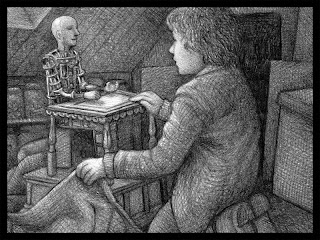
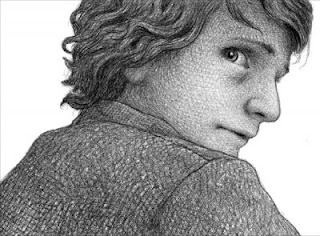
The Invention of Hugo Cabret was awarded the 2008 Caldecott Medal, and was the first non-picture book (in the traditional sense) to win this honor. The story is told in over 500 pages of pictures and words, with 284 pages of Selznick’s trademark monochromatic pencil sketches framed in black.

Selznick, writer and illustrator of The Houdini Box, The Boy of A Thousand Faces, The Robot King, and illustrator of over a dozen more books, describes Hugo Cabret as “not quite a picture book, and it’s not really a graphic novel, or a flip book, or a movie, but a combination of all these things.”

Hugo Cabret is an orphan who lives in a secret room in the clock tower of a train station in Paris. Because he is neglected (and eventually deserted) by his uncle, the timekeeper at the train station, Hugo learns to steal to survive, and takes over the task of winding the clocks at the station.
Across the station is a small toy shop run by a grumpy old man and an eccentric old man, with a girl whose nose is forever buried in the book. Little does Hugo know that as he ventures out across the street, secrets will unfold as their paths cross.
From cover to cover, I was in awe of this spellbinding book, which flows seamlessly from text into illustrations as it tells its intricate tale. I think this shows the amount of planning Selznick put into the book, with each element deliberate, each serving a purpose towards the advancement of the story.
Compared to The Houdini Box, the illustrations are rougher and darker in Hugo Cabret, but serve well in establishing the cinema noir feel of the story and still showcase Selznick’s mastery of light and darkness. I love how Selznick’s illustrations zoom in and out on the details, and how each drawing leads into another, drawing excitement with each turn of the page, especially during the chase sequences, and when clues to the puzzle are revealed.
I also like how the book is enriched with history, paying tribute to the movie great Georges Melies, as well as book illustrator Remy Charlip. This adds even more dimensions to the book,on top of the overarching mystery, but Selznick manages to tie it all in very well.
And I have to point this out — because I wanna throw around some bookspeak I learned last Saturday — the book is exquisitely made — heavy grade paper, stitched section by section, and hollowback with a real headband!

I am sad, though, that I read this book after The Arrival, because had I read Hugo Cabret first, I would have enjoyed the book more . Since the book is hugely plot-driven, I felt it was a bit lacking in depth and character development; a bit more introspection from Hugo’s character would have placed the two books on a more even plane.


Despite that small sentiment on my part, I still give full marks for the book for breaking new ground in books for young readers, especially in illustrated novels. Selznick is definitely in the hall of fame in my bookshelf, and I look forward to collecting more of his works.

***

My copy: hardcover

My rating 5/5