Flippers go TagLish


Finally, the much-awaited Flips Flipping Pages April Book discussion successfully took place, after weeks of preparation, coordinating with National Book Store, Anvil, and the staff of Ricky Lee to mount this memorable event featuring the book Para Kay B.

It was a great discussion, revealing juicy secrets (please, let’s keep everything in confidence!) among the attendees, discussing which chapters we liked best from the book, love, character stereotypes, colloquialism, and Filipino reading habits.

The highlight of the event was getting to meet the author, the famous Filipino scriptwriter Ricky Lee, who fast became a Flipper favorite because of his friendly and engaging personality, candidly answering our questions, and showing genuine interest in what we thought of his book, as well as FFP activities, even the book swap, and BookMooch!

I also think everyone was able to gain better appreciation for the book after being able to discuss it with fellow book club members and with Ricky Lee himself.

Ricky Lee was also kind enough to sign our books, with special dedications for everyone — yup, we compared messages at the dinner buffet at Thai Kitchen!

Here’s mine:

We capped the night off with dessert and chitchat at Cafe Breton.


It was another great book discussion for FFP and I can’t wait for the next one!

More photos here: http://flipsflippingpages.multiply.com/photos/album/42/Flippers_Meet_Ricky_Lee
and here: http://flipsflippingpages.multiply.com/photos/album/41
and here: http://flipsflippingpages.multiply.com/photos/album/40

Surviving the Big C


Some unexpected circumstances gave me the privilege of attending a book launch today, and when I got there, I was surprised to find the book was about a topic that (unfortunately) hits close to home: cancer.

As my friends would know, my dad passed away of colon cancer more than thirteen years ago (right before I turned eleven), and that part of my life went by in a blur because I didn’t really understand what was happening; I didn’t want to believe my dad was sick. Cancer was a like a death sentence then, and every night I made a prayerful bargain with God that I’d be a very good girl if only He wouldn’t take Papa away.

We spent so much time in different hospitals that I developed a phobia for them, and I got so traumatized by the whole ordeal that I began developing psychosomatic symptoms, like running a continuous fever every so often, for no particular reason.

Anyway, I meant to browse through the book Surviving Cancer: Stories of Hope by Singaporean oncologist Ang Peng Tiam (published locally by Anvil), but I ended up reading from start to finish even before the meal was completely served.

Dr. Ang Peng Tiam (who was present at the press conference — sorry, did not have a cam so no photos), is a senior consultant and medical doctor at the Parkway Cancer Centre at Mount Elizabeth Hospital in Singapore. Surviving Cancer is a collection of anecdotal cases that Dr. Tiam has handled, touching on different cancer cases and how he treated them.

According to Dr. Tiam, “Cancer is not about death, but about living. I want to spread a message of hope, for patients to believe that they can get well, and to seek treatment.”

Surviving Cancer
(book #68 for 2009 — bumped up the review because the book was lauched today, will get back to books 63-67 later; also book 12 for diversity challenge – science), while not exactly Chicken Soup for the Soul, is very interesting and candid (for a serious subject) without being unrealistic, and very readable despite the detailed discussion of various medical conditions and treatment options. There are also very graphic photos that made me lose my appetite but were very good in illustrating how effective cancer treatment can be.

I like Dr. Tiam’s psychosocial approach to treating cancer: giving the best possible support for cancer patients so they can have a good life, no matter how long or short the duration would be.

I also liked the chapter devoted to alternative treatments, because Filipinos are so fond of alternative medicine. He states that while patients should first and foremost seek conventional medical treatment, alternative medicine can be used to supplement the treatment as long as it does not pose harmful side effects. He cautions against alternative treatments that discourage all forms of medical procedures, e.g. an alarming case of a “wellness spa” that locks you in for a month and feeds you 150 tablets a day and tells you your cancer will grow/worsen before disappearing completely.

At the end of the book, there is a very useful checklist of signs and symptoms revised from the American Cancer Society, which may not be cancer but should be brought to your doctor’s attention: sores that don’t heal, a lump in the breast or other parts of the body, unusual bleeding, change in bowel habits or bladder functions, recent change in a wart or mole, indigestion or difficulty in swallowing, nagging cough or hoarseness, and problems with hearing.

It’s very good reading for cancer patients and their families, and even local oncologists I think, who can pick up a thing or two from Dr. Tiam’s methodology. I’m actually passing the book on to a friend who will have great use for this right now, and I hope this helps the family get through this trying time.

The book is available at National Book Store branches nationwide, approx. P360 (?).

***
My copy: trade paperback, to be passed on

My rating: 5/5 stars

Reading in TagLish

The fourth book I read during the 24-hour read-a-thon is Para Kay B by Filipino scriptwriter Ricky Lee (book 63 of 2009, book 11 of diversity challenge- FFP book discussion selection), the assigned reading for April for my book club Flips Flipping Pages, which will hold the discussion tomorrow (which prevents me from attending Dianne’s graduation party, but I’m really looking forward to the discussion).

Even before this book was chosen for discussion, I was meaning to get a copy because all the storefronts of National Book Store (to my international readers, NBS is the biggest book store chain in the Philippines) had a poster of the book and I was really intrigued by the full title, which reads: Para Kay B (O, kung paano dinedevastate ng pag-ibig ang 4 out of 5 sa atin) which roughly translated is: For B (Or how love devastates 4 out of 5 of us).

The novel, written in TagLish, a combination of Tagalog (a dialect which is the basis for the national language Filipino) and English, is comprised of five different love stories: a) Irene and Jordan (who made a childhood promise to marry her and then disappeared from her life); b) Sandra and Lupe (who happens to be her brother); c) Erica (who is from the love-less island of Maldiaga) and Jake (the son of the woman who takes Erica under her wing); d) the widow Ester and her maid Sara; and e) the voluptuous Bessie and the young, naive Lucas. The stories appear to be unrelated until the last few chapters, which reveal the link that binds them all.

Filipino was one of my better subjects in school (even in college when Filipino class was quite difficult), but reading this was harder for me than I anticipated because I haven’t read anything with this much Tagalog in a long time. To my non-Filipino readers, Tagalog (and Filipino) and the rest of the local dialects in the Philippines are read phonetically (sounded out syllable per syllable), as opposed to English, where words can be recognized on sight.

The second part I had difficulty with is the structure of the novel — no quotation marks. Quotes are mostly narrative, although there are some dialogues that read as a script. I have always had trouble reading novels that are straight narration (or with little dialogue) because I get bored, and when my concentration slips the text tends to meld together in my mind and I get lost reading. Perhaps it’s his background as a scriptwriter, or an intention to defy the conventional structure of the novel, but it took awhile before I got used to it.

During the readathon, the infernal heat was also driving me crazy so I had to haul my patootie to the McDonalds a few blocks away so I could concentrate.

The voice was also an acquired taste for me. When I read, I usually hear the narrator’s voice in my head (which I used to think was strange, but my Flipper friends tell me they do it too), and I hear a different pacing of the words for every book, and the voice and accent vary with the narrator (yes, Harry Potter in a British accent). I found Para Kay B too talkative, like the narrator was trying to get out so many words all at once, and I sensed a shrillness to it that grated on my nerves at some points in the book.

I liked the statistics proposed by the title, hahaha, because so far I’ve always been in the 4 out of 5 (loooooong story, and never mind) and I think a lot of people will agree with the statistic. In his end note, Ricky Lee states how (paraphrased) he wants to be read by everyone — the people riding the mrt, those watching over loved ones at the hospital, parents putting their kids to sleep — and not just his fellow writers or literature students. Love (or the absence of love) is a universal theme that most anyone can relate to, and Lee’s use of TagLish makes it more accessible to the average Filipino.

*Spoiler alert: do not read beyond this point if you plan on reading the book. Am writing about the resolution because a lot of my readers probably won’t get to read the book, seeing as it’s written in TagLish. I was contemplating writing this entry in TagLish like some of my Flipper friends but checking my stats, I found that only 41% of my readership is located in the Philippines, and I didn’t want to deprive them from reading this entry*

I did perk up later in the book when one of the characters (not Ricky Lee) turns out to be the writer of the five stories mentioned above. The stories are not resolved in their respective chapters, and are left hanging because of the writer’s (the character who is the writer, and not Ricky Lee) belief that 4 out of 5 love stories do not get a happy ending.

As the writer looks over his first draft, the 5 female characters suddenly appear in front of him, and they are disgruntled about the lack of resolution in their stories. They question his integrity and skill as a writer, fight among themselves, and even present the writer with a demand letter because they don’t want to be part of the 4 out of 5 statistic.

The character-talking-to-author ruse is a popular for stories about authors or illustrators, but I still found this to be the most enjoyable part of the novel because it was so funny in TagLish.

Finally, the writer issues his own demands — that the characters not pop up from out of the blue, that he write the story that he wants to tell, that he has the right to edit or revise as he chooses, and that the final say is his.

But he does change his mind about the story, and revises his draft to a conclusion that would satisfy both himself and his characters. He also realizes the difference between writing and real life, (paraphrased) how the writer has the power to change everything even after he’s written the story down — the bad changed to good and the tragic ending made happy — while in real life, that’s it, no revisions (I like this passage a lot).

Towards the end of the novel, he brushes off his theory on love, stating that theories are for insecure people, but he backtracks, posing the question, who isn’t insecure when they’re in love?

Edit at 11:24 pm: Am clarifying why I like this last part (more than the rest of the novel) after reading Gege’s review because I realized I didn’t elaborate on this aspect to the story.

My reading of the novel is that it’s an attempt (albeit it comes off a bit contrived, very movie-ish) at postmodernism, defying the traditional structure of the novel: one of the characters turns out to be writing the story (but is not the author), the characters become self-aware (that they’re characters of the story), voice out exactly what they think of the story (and attempt to vote off the writer) and have a hand in manipulating the outcome.

As the Flippers well know, I like postmodernist techniques in books (whether it’s picture books or novels) and I was pleasantly surprised to find it in this book because I wasn’t sure I was going to like it.

Para Kay B wasn’t exactly my cup of tea, but in the end I enjoyed it, and I’m glad the discussi
on moved it up my reading list. I’m looking forward to discussing it tomorrow and meeting Ricky Lee in person.

One last, a drawing I made for the journal (token) we’re giving Ricky Lee at the discussion tomorrow. Will post some photos of the event in another entry this weekend :)


***
My copy: paperback, from NBS Bestsellers (10% discount from Anvil). Just a little rant: the binding is terrible, it’s glued at the edges and then stapled down, and the binding was giving way even before I read the book.

Oh, and props to INKie Ivan Reverente for the great illustrations, and I’m glad he joined us at INK this year.
My rating: 3.5/5 stars

Once upon a time, it was a dark and silly night… (Little Lit Roundup)

and I found myself with two great graphic anthologies!

The Little Lit series is a set of comic compilations for kids, edited by the great Art Spiegelman. I have two of them, because I lucked out on new copies at bargain prices — Folklore and Fairy Tale Funnies (from the NBS Book-sak sale, P200) and It Was a Dark and Silly Night (from the Book Sale warehouse, P170). I decided to read them for the 24-hour read-a-thon because they were easy to read and I wanted to get some variety in my read-a-thon books.

When I first saw the Little Lit books, I was literally agape at their visual impact — it’s a smorgasbord of creative juices from an amazing roster of top-caliber cartoonist and children’s book artists. Even now that I’ve had the books for some time now, I still thumb through the pages with reverence. It’s like holding an art gallery in your hands!

Revealing the actual stories would take away the fun from reading the Little Lit books, so let me just touch lightly on them, so you have an idea of what’s inside.

Folklore and Fairy Tale Funnies (book #61 for 2009) showcases a humorous collection of old and new story selections from different parts of the world, told through comics.

Aside from Spiegelman this book includes the works of Barbara McClintock, Chris Ware, Kaz, J. Otto Seibold, William Joyce, Bruce McCall, David Macaulay, and many more.

My favorites from this book include Barbara McClintock’s leonine version of the Princess and the Pea, the reprint of Walt Kelly’s (of Pogo Fame) 1943 comic The Gingerbread Man, Art Spiegelman’s hilarious Prince Rooster, Claude Ponti’s The Enchanted Pumpkin and Chris Ware’s interactive Fairy Tale Road Rage boardgame.


My second Little Lit Book is It Was a Dark and Silly Night… (book #62 for 2009), this time a showcase of imagination, with different comic stories that take off from the starting phrase “It was a dark and silly night… .”

This time, the masterminds are not only comic book artists and children’s book illustrators, but also novelists such as Neil Gaiman and Lemony Snicket.

My favorite selections from this book include Lemony Snicket and Richard Sala’s hilarious story about a girl and the Yeti, J.Otto Seibold and Vivian Walsh’s penguin treasure story, and Patrick MacDonnell’s moon story.


I still lack Strange Stories (my cousin Dianne has this one, though, I must borrow it sometime) and the Big Fat Little Lit collection. Hopefully I’ll get lucky and find bargain copies again for my Little Lit collection one day; they cost about P800 each at the bookstore.

*All book photos from the Little Lit website.

***
My copies: both hardcover

My rating: both 5/5 stars!

Dahl’s Chickens!

I’ve been a fan of Roald Dahl ever since I discovered he was the brains behind Willy Wonka and the Chocolate Factory (I saw the Gene Wilder movie dozens of times before I found the book in the library in fifth grade) and my favorite Willy Wonka candies that I bought at the school canteen — Gobstoppers, Pixy Sticks (the jumbo ones!), Runts (I loved the bananas!), Nerds, Dweebs (chewy Nerds), Tart & Tinys, Fun Dips, and SweeTarts — which led me to believe that Willy Wonka was a real person and that he had a chocolate factory somewhere. In fact, I was devastated (Santa Claus part II) when I eventually found out Nestle was making the candies!
UPDATE: My Roald Dahl Collection

After Charlie and the Chocolate Factory and Charlie and the Great Glass Elevator, I was fascinated with The Witches and Matilda, both of which I’ve read dozens of times.

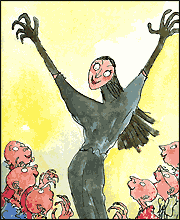
I know a lot of people who were terrified as kids when they watched Angelica Huston’s portrayal of the Grand High Witch in the movie, but I didn’t get to see the movie until it was aired on Disney Channel several years ago, so I never had that problem. Like Roald Dahl himself, I was disappointed that they changed the ending in the movie.

I also liked Matilda, because our school’s parents association sponsored the film premiere when I was in sixth grade and I begged and begged my mom to get me a copy of the book after we saw the movie.

Matilda is one of my favorite characters because I could totally relate to her when I was younger– I was the kid who was always at the library until closing time, and I was always happy to be holed up alone in a room with a book. Hahaha, when I was younger I would set up a pencil on a dresser and try to levitate it like Matilda did, attempting to use my eyes to move the pencil and mouthing “Move!” fiercely. Today, I use Matilda as my BookMooch avatar.

To this day, the Grand High Witch and Miss Trunchbull are still in my list of the best book villains.

Other favorites include the BFG (which I only read recently, and I wanted to burst into applause after), George’s Marvelous Medicine, The Vicar of Nibbleswicke (hilarious!), The Twits (also hilarious!), Revolting Recipes and Even More Revolting Recipes.

Having grown up on Roald Dahl books, Quentin Blake also became one of my all-time favorite illustrators. I love how you can look at his work and know without doubt that it’s his. Very simple, yet enormous comic appeal!
In college, I started reading Roald Dahl’s short story collections, and I found a whole new – but equally engrossing – way to enjoy his works. The stories are dark and humorous, highly imaginative and original, and always with a surprise twist in the end. It was surprising to find out he could write outside of children’s books, and he is excellent at both writing for kids and for adults.

This isn’t actually a review of Roald Dahl’s books (although it’s starting to veer in that direction), but a review of D is for Dahl (Book 60 for 2009), an A-Z book about one of Britain’s most celebrated children’s authors.

The book is not very thick, but still filled with a lot of interesting factoids I never knew about one of my favorite authors.

I read this book to “cleanse the palate” after reading Silverlock during the read-a-thon, and I was laughing from start to end.

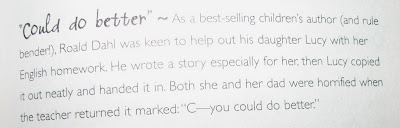
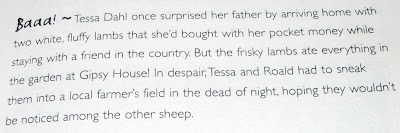
Am sharing my favorite entries:

The lamb debacle

Come to think of it, they don’t have names!

Heeheehee.

The cutest story ever!

Who would’ve thought?

***
My copy: trade paperback, mooched from Triccie

My rating: 5/5 stars