Midway through the 24-Hour Read-a-thon

Ack! So sorry for the delayed post. I just parked myself in front of the computer because I slept over at my cousin’s after attending her graduation last night.

May I just introduce you to my cousin Dianne, who is every bit of a bookworm as I am. We’ve loved books since we were kids, and while growing up we had each others’ books going back and forth between us, and now we feed off each others’ book compulsions. Well, she just graduated from med school (starting internship in May), and I couldn’t miss it for the world.

Graduation day for Dianne!

Not to worry, I got some reading done for Dewey’s 24-hour Read-a-thon last night and this morning and here I am to turn in my mid-event report.

1. What are you reading right now?
I’m reading The Secrets of the Pistoulet by Jane Kolpen — I’m starting it after posting this blog

2. How many books have you read so far?
4- Silverlock by John Myers Myers, D is for Dahl , and two Little Lit books

Silverlock

D is for Dahl

Little Lit

3. What book are you most looking forward to for the second half of the Read-a-thon?
Hmm, this book on Antique Book Collection that I’ve been saving up for a good read.

4. Did you have to make any special arrangements to free up your whole day?
I only found out about my cousin’s graduation a few hours before, so that was an unexpected event that cut through the read-a-thon, but she’s a big part of my life, and it was an important event to celebrate.

5. Have you had many interruptions? How did you deal with those?
Fell asleep in the middle of Silverlock, have started making up for it this morning and will continue to do so for the next hours.

Eek!

6. What surprises you most about the Read-a-thon, so far?
That it’s not as easy as I thought it would be, especially in this infernal heat in our country — it’s over 30 degrees out here!

7. Do you have any suggestions for how to improve the Read-a-thon next year
Perhaps a holiday edition? So more people can read because they’re on vacation

8. What would you do differently, as a Reader or a Cheerleader, if you were to do this again next year?
Make sure my schedule is free!!! Next time I want to pull an all-nighter.

9. Are you getting tired yet?
Not really, am just getting warmed up! I hope I can get 4 more books in later

Marathon!

10. Do you have any tips for other Readers or Cheerleaders, something you think is working well for you that others may not have discovered?
Alternating genres, to cleanse the palate…

Up, Up, and Away

(blogging about another old favorite, as I’m still in the middle of reading Silverlock and am majorly swamped, hay…)

When I was in 4th grade, my dad usually picked me up after work so I had a few hours to kill while waiting. I usually read books if I didn’t have any homework to work on, or if I didn’t feel like doing it, which was more often the case.

Now in those days, we decorated the room with special corners for each subject — Christian Doctrine, Science, Math, Social Studies, etc. Of course, my favorite corner was the Reading Corner, where everyone brought a book or two to share with the class and we would have a mini-library to escape to in between classes or during DEAR (Drop Everything And Read) time, so we wouldn’t get listed down as “noisy girls”. Haha, magically by the end of the school year the books would have dwindled to a couple mo.tley ones; I lost a lot of books to the Reading Corner, although I gained some other kids’ books too, wink, wink.

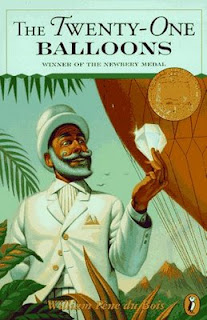
One of the books I discovered in our 4th grade reading corner is the 1947 Newbery Award winner The Twenty-One Balloons by William Pene du Bois, which I first read while waiting to get picked up from school one rainy afternoon at Gate 1.

The Twenty-One Balloons one of the best escapist stories I have ever had the pleasure of reading, and I’ve lost count of how many times I’ve read it and how many copies I’ve worn out and lost (e.g. loaned and never returned to me! grr).

I really love the premise: Professor William Waterman Sherman decides to retire from teaching arithmetic to grubby kids, and decides to fly off on a grand vacation — drifting aimlessly on a hot-air balloon! I loved the detailed description of how The Globe (Prof. Sherman’s hot air balloon) was constructed — a small wicker house with an observation deck, and everything made from the lightest materials — even a small library of paper-bound books in tiny print!

Professor Sherman left San Francisco intending to fly across the Pacific Ocean, and three weeks later, he mysteriously turns up floating in the Atlantic Ocean, in a wooden wreckage with 21 balloons!

Where exactly has he been? On the island of Krakatoa (he flies over the Philippines!), which turns out to be an extremely wealthy island-nation of eccentric citizens!

The Diamond Mines

I love the idea of Krakatoa in The Twenty-One Balloons, and this book has made me daydream about living there, and given the choice, I’d drop everything and go. The island has an expansive diamond mine right under the volcano Krakatoa. According to Krakatoan history (as narrated by Mr. F), a sailor got shipwrecked on the island and discovered its treasures. As soon as he was able to return to America, he handpicked 20 families of diverse talents and interests. Each family was renamed with a letter of the alphabet, e.g. Mr. A, Mr. B, A-1, and A-2 and so on until the Ts, and the small nation lives a leisurely life financed by discreetly selling a small load of diamonds each year.

The Coat of Arms of Krakatoa: “Not New Things, but New Ways”

What’s most interesting about Krakatoa is its “Gourmet Government.” Each day of their 20-day calendar (A through T) is assigned to a specific family, who is tasked to serve meals at their house, which functions as a restaurant specializing in a particular cuisine — A for American, B for British, C for Chinese, D for Dutch, etc. It’s a lot of fun, as each house resembles the architecture of the country too — from an Egyptian pyramid to a Russian tea house to an Italian Bistro and a miniature Versailles! — and the families are very competitive in coming up with great dining experiences for one another, and they have theme months too, like “Month of Lamb,” depending on their surplus stock. I imagine every day to be a gastronomic adventure!

There are also a lot of imaginative Krakatoan inventions in the book, including a bed that automatically changes sheets, a collapsible dining room, living room bumpcars, sky beds, and flying merry-go-rounds. William Pene du Bois is not only a gifted writer, he illustrated the book as well, and the illustrations are great fuel for the imagination.

M-1 and M-2’s Sky beds

Of course, you will have to read the book to find out how Professor Sherman ends up in the wrong ocean with 21 balloons. It’s a great book for all ages; kids and adults alike will appreciate the rich experience that Pene du Bois lays out for the reader.

Interesting factoid: the story came out around the same time as F. Scott Fitzgerald’s “A Diamond as Big as the Ritz” in 1947, which has a similar plot although very different ideas. William Pene du Bois writes a horrified note as an introduction and quips,”The fact that F. Scott Fitzgerald and I apparently would spend our billions in like ways right down to being dumped from bed into a bathtub is altogether, quite frankly, beyond my explanation.”

***
My copy: trade paperback. Looking for a hardcover copy!

My rating: 5/5 stars

Blast from the Past: My Girl

When I was in high school, I went through a movie novelization phase because our library was well-stocked with movies turned into books. I remember reading Mrs. Doubtfire, Honey I Blew up the Kid, Soul Food, Waiting to Exhale, A Walk in the Clouds, Jumanji, Danielle Steel’s The Promise, and perhaps a dozen more books I can’t remember off the bat.

While I’ve long outgrown this phase — I now steer clear of movie covers for my book collection — there is one movie novelization left on my shelf: My Girl, adapted by Patricia Hermes (written by Laurice Elehwany).

I was a big fan of the movie, and I think I must’ve checked the book out of the library five times until I got my own copy from a bargain book store in college, and I’ve read it countless of times since.

Having lost my dad right before I turned 11, there was a time I was really engrossed in young adult novels that dealt with grief and loss, and My Girl was 1/3 of my figurative shrink’s couch, along with Sharon Creech’s Walk Two Moons and Judy Blume’s Tiger Eyes.

Vada Sultenfuss is a weird but lovable protagonist – a sad 11-year old girl in need of attention from her dad and senile grandmother; a hypochondriac obsessed with death, convinced she killed her own mother by being born; a tomboy constantly bullying her geeky best friend Thomas J; and a teenybopper head over heels in love with her English teacher Mr. Bixler.

It’s a summer that changes Vada’s life forever, as she befriends an offbeat makeup artist, Shelley, who eventually becomes her dad’s girlfriend (and wife). She steals money from Shelley’s cookie jar to attend Mr. Bixler’s adult writing classes at the community college, becomes blood brothers with Thomas J (hahaha I used to find it fascinating — one of them snags a finger on a fish hook and the other picks a scab!); and gets her first kiss, also from Thomas J.

Of course we all know what happens next (don’t read if you haven’t seen the movie) — Shelly and her dad start dating, she finds out Mr. Bixler is engaged to be married, and Thomas J gets stung by bees to retrieve Vada’s mood ring, and he dies from an allergy to bee stings.

My favorite part, both in the movie and the book, is Vada’s Weeping Willow poem, which she writes for Thomas J and recites in Mr. Bixler’s class. still manages to make me cry even though I’ve practically memorized it.

[youtube=http://www.youtube.com/watch?v=JP007VCD67A]

Weeping willow with your tears running down,
why do you always weep and frown?
Is it because he left you one day?
Is it because he could not stay?
On your branches he would swing,
Do you long for the happiness
that day would bring?
He found shelter in your shade,
he thought his laughter would never fade.
Weeping willow stop your tears,
for there is something to calm your fears.
You think death has ripped you forever apart,
but I know he’ll always be in your heart.

How I wish this book had a hardcover edition…

***
My copy: mass market paperback, creased after so many readings

My rating: 5/5 stars

Mosca Mye, Saracen and Eponymous Clent

When I saw this book on a bookstore shelf, I was instantly intrigued by the description at the back of the book: “Frances Hardinge’s breathtaking debut novel has at its heart an inspiring truth — that the power of books can change the world.”

I instantly added it to my BookMooch wishlist, waited several months for a copy to turn up, and finally mooched one from the UK. I was quite eager to read this book, but it didn’t turn out to be how I expected…

Fly by Night by Frances Hardinge (book #58 of 2009) is set in a world called “The Fractured Realm,” an alternative 18th-century world that is “shattered” by the loss of a ruling monarch.

Mosca Mye is the twelve-year old heroine, an orphan who runs away from her oppressive aunt and uncle, taking with her a snow-white goose named Saracen. Mosca applies for employment under the shady and notorious Eponymous Clent, and as they make their way on a perilous journey, Mosca finds herself at the heart of a dark plot looming over the capital city.

Mosca and Saracen make quite a team — Mosca is spunky and headstrong with an insatiable thirst for knowledge, and Saracen can be quite fearsome, known to single-handedly (single-web-footedly?) capture sailing vessels and bring grown men to their knees.

Hardinge’s prose is rich and musical, a cacophony of sounds and textures that roll off your tongue and are a pleasure to savor:

“Around and through the village, water seethed down the breakneck hillside in a thousand winding streamlets. They hissed and gleamed through dark miles of pine forest above the village, chafing the white rocks and learning a strange milkiness. Chough itself was more a tumble than a town, the houses scattered down the incline as if stranded there after a violent flood.”

I think, though, that the nvel was weighed down by too many plot components that made it difficult to understand. I found that there was so much political conflict (and too many pages) revolving around characters that were of no concern to the reader, and the novel suffered whenever the focus was taken away from its heroine, because it became difficult to follow. I couldn’t tell you the details of the political uprising in a way you can understand, because even I didn’t get it… Perhaps a bit more exposition on the setting, and an insight on the other characters and their significance to the story would have elicited more sympathy towards the political cause.

Obviously, I was also looking forward to the part about the power of books, and I was sorely disappointed that it was only vaguely covered (read: huh???) throughout the book.

If the language wasn’t well crafted I would probably have thought less of the book; it was an okay read, although it had the potential to be so much more.

***
my copy: trade paperback, mooched from the UK

my rating: 3/5 stars

A Swashbuckling Thriller

Back in my first semester at my university (don’t ask how many years ago), I took up fencing as a PE (phys ed) requirement, and for someone as “allergic” to sports as I am, I actually enjoyed the class and was passably competent at it.

Arturo Perez-Reverte’s The Fencing Master (book 57 of 2009) appealed to me not only because I find his writing intelligent; I’ve also always found fencing terribly romantic — the proprietary rituals rooted in honor and courtesy; the graceful thrusts and parries combined with a dance of intricate footwork and sprightly movement; the melodic clink of meta foils; and the immense satisfaction of making contact.

In this mystery thriller, the fencing master is Jaime Astarloa, a distinguished gentleman who is a throwback to the olden days, even in 19th century Spain. He is the master of a dying art, upholding the virtues of honorable duel at a time when pistols were fast becoming the weapon of choice and fencing was evolving into a recreational sport.

Don Jaime lives off a modest income from his few remaining students, and leads a peaceful existence, engrossed in perfecting an irresistible sword thrust, until the fiery, violet-eyed Adela de Otero shows up on his doorstep and applies for his tutelage. Grudgingly, Don Jaime takes on his first female pupil, and gets more than he bargained for as he finds himself entangled in a grand web of intrigue and deceit, and he must rely on his old-fashioned values and the ancient art of fencing to keep himself alive.

At 212 pages, The Fencing Master is a fast read, a mix of rich, languid text; highly detailed swashbuckling sequences; and political discourse.

This is the third Arturo Perez-Reverte book I’ve read; I enjoyed The Club Dumas (on which the movie Ninth Gate — starring Johnny Depp — was based) and The Flanders Panel also. I like reading Perez-Reverte’s works because he writes with flowing, florid sentences that take you into the heart of the action. Perhaps this is the Spanish sensibility towards romance showing, similar to Carlos Ruiz Zafon‘s writing, albeit Zafon is the more lyrical of the two.

I also like how Perez-Reverte can write credibly about a variety of subjects — The Three Musketeers and De Umbrarum Regni Novem Portis in The Club Dumas; chess in The Flanders Panel; and fencing in this book, not to mention a host of other novels that carry other motifs. I appreciate the research he undertakes for each novel because they don’t appear halfhearted or contrived.

I love Don Jaime’s character — elegant, refined and upright, never compromising his values nor his genteel ways. I found it sad that he appeared to be born into the wrong era, with his dapper, turn-of-the-century suits; the old house adorned with dusty memorabilia; empty fencing gallery displaying rusty swords; and his passe art.

He laments:

“Duels with foils are rare events, given that the pistol is so much easier to handle and does not require such rigorous discipline. Fencing has become a frivolous pastime… Now they call it a sport, as if it were on par with performing gymnastics in your undershirt.

In this century and after a certain age, dying a proper death is becoming increasingly difficult.”

The hitch with reading Perez-Reverte’s novels in succession, though, is being able to detect a formula in his writing. He likes a lengthy exposition, peaking sharply and falling fast too. He also likes to gamble with shocking twists towards the resolution, which don’t always pay off.

Despite this drawback, I still find Perez-Reverte to be one of the better writers in the spectrum of multiple-book mystery writers. I still have a bunch of his books in my TBR, and I look forward to reading them in the future.

***
My copy: trade paperback, mooched from the UK

My rating: 4/5 stars