The Lionboy series by Zizou Corder (Conclusion)

Books 4 and 5 for 2009
Lionboy: The Chase
Lionboy: The Truth

My first read for 2009 was the first book of the Lionboy series, which I deemed average, as it started out slow and took a while to pick up.

But getting through the first book was worth it, as the next books in the series prove why Lionboy holds up admirably as a fantasy series.

The series is quite inventive – a boy who can speak Cat; a world with no petroleum; a money-grubbing pharmaceutical giant that creates illnesses to generate a demand for its products; a pack of lions who want to go home – and the whole bliddy circus!

I think the mother-daughter team behind Zizou Corder really got into their groove with the next two books, which had me swiftly turning pages to the end. The story’s framework falls into place, and the story flows more fluidly.

I like the character development in the books, both for the human characters and the animals. Charlie Ashanti, the protagonist, grows on you, with his spunk, intelligence, and Dickensian goodness that shines through without appearing clichéd or contrived.

The rest of the humans make a delightful supporting cast – the misguided (and unlucky) Rafi; Charlie’s unconventional but loving parents Aneba and Magdalen; the half-crazed lion trainer Maccomo; the jolly adventurer King Boris and the loyal (and I suspect dreamy!) Claudio – but it is the animals who steal the show.

I have to say it again, I’m not a fan of talking animals, because they’re normally just two things – twee and cutesy, or excessively symbolic, but the main animal characters in Lionboy stand out because of the right mix of animal-ness and personification. It was also particularly enjoyable for me because of the instrumental roles that felines play in the series, although those who are freaked out by cats (I can think of certain people) would likely cringe while reading this book.

Of the lions, my favorites are Primo the smilodon, who evokes the raw earthiness of a prehistoric animal; and the feisty Elsina. Sergei the cat makes a wonderful wisecracking sidekick, while Ninu the chameleon was a stroke of genius.

Another thing I like about the book: the vivid descriptions. They live in a world similar to ours but gone off on a tangent, and it is successfully established in the little details incorporated into the story rather than handed out in tidy exposition. The adventure is also more exciting because the highly imaginative settings were truly fleshed out: the Circe, the floating circus, because it was wild and raucous as a circus should be; Venice, (I love books set in Venice – there’s just something magical and madly romantic about the place); the exotic Essaouira; and even the Corporacy communities – you could just feel what it’s like to live there.

Fred Van Deelen’s whimsical maps and illustrations also serve as the perfect complement to the vivid descriptions. There are score sheets interspersed with the text, too — the series has a soundtrack by Robert Lockhart, I hope I can find it on the Internet.

As the series progresses, it delves more and more into themes of environmentalism and stewardship, genetics, and even discrimination, and it’s admirable how it’s presented in a way a young reader would understand, without any preachy-ness to it, because they’re all incorporated into the story.

And one last highlight: the book is so bliddy British! I generally like British authors more than American ones (especially in fantasy, and in chicklit) because they write better, and the humor is just so spot on. And yes, you can read this book with an accent, and have loads of fun with the Britspeak, particular when Sergei or Rafi are speaking.

Yep, I’ve definitely had my kip.

***
My copy: Lionboy: The Chase, large paperback from the NBS bargain bin, about P99; Lionboy: The Truth, paperback, also from the NBS bargain bin, P30. See, impulse buys can pay off, and it feels much better when a bargain book turns out to be a great read! :)

My rating: Lionboy: The Chase, 4/5 stars; Lionboy: The Truth, 4/5 stars.
Lionboy series: 4/5 stars.

Photos from fantastic fiction UK

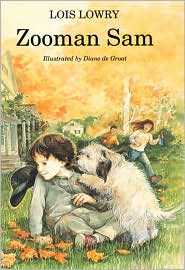
Books 2 & 3 for 2009: Zooman Sam and All About Sam by Lois Lowry

I, like thousands of readers all over the world, am a big fan of the wacky Krupnik family from the Anastasia series, whose books are among the American Library Association’s 100 Frequently Most Challenged Books, because (according to Wikipedia) of “references to beer, Playboy magazine, and a casual reference to a character who wanted to kill herself.” Apparently it was also criticized for one of the funniest books in the series, “Anastasia at this Address,” where Anastasia replies to a personal ad and lies about her age (and invents a fantasy life too) to an older man — it sounds bad but it’s actually quite innocent and funny as hell.

After 9 Anastasia books (I wish there were more), Lowry moves on to a series featuring Anastasia’s younger brother, Sam, starting with All About Sam. Zooman Sam is the most recent
addition to the series.

Aside from most of the Anastasia books, I have both Attaboy Sam, and See You Around, Sam!
on my shelves, and I was glad to get both All About Sam and Zooman Sam in one weekend
(Book Sale and then Chapters and Pages).

All About Sam is about Sam’s life story told from his point of view, mostly featuring events that happened throughout the Anastasia series. Meanwhile Zooman Sam is about Sam’s Future Career day and how he wants to be a zookeeper.

They’re short reads (not very short — they’re still chapter books but one-sitting short), and
although I miss Anastasia’s whacked out (and sassy!) point of view, Sam’s candidness and own whacked-out point of view are endearing too. It’s also delightful to see that Anastasia and Steve Harvey are getting on very well, and Myron and Katherine Krupnik are still the coolest parents ever!

***
My copies: both Dell paperbacks

My rating: All About Sam 3/5 stars, Zooman Sam 4/5 stars

Photos courtesy of Barnes & Noble

Book 1 for 2009: Lionboy by Zizou Corder

I’m not a big fan of talking animals, but this series has been sitting in my TBR shelves for quite a while and I figured it was about time I read it.

Lionboy is a fantasy series about Charlie Ashanti, a nine-year old boy who can speak Cat, who must rely on this special talent and his wits to save his kidnapped parents.

Lionboy is set sometime in the future, when the world’s petroleum resources have all run out. The world reverts to sea travel as the main form of overseas transport, and everything runs on alternative energy; only the very powerful are allowed to have cars. The world is ruled by a superpower known as the Empire, asthma is a widespread condition (blamed on cats) and a pharmaceutical giant known as the Corporacy controls the world’s major industry. Charlie’s parents have discovered the cure for asthma, and the Corporacy has held them captive to safeguard their business.

Although not as engaging as I would have liked it to be, Lionboy, the first book in the series, sustains the interest, especially as Charlie stows away on a circus ship, the Circe, which houses Thibaudet’s Royal Floating Circus and a host of interesting personalities. Charlie forms a friendship with six circus lions and helps them escape, as he gets one step closer to finding his parents.

The cats are particularly amusing, especially the strays, because of their different personalities — a prissy French cat, a wisecracking Russian cat, and an ingenious marmalade. Even the lions are distinct, although they’re all regal.

It’s also worth noting that Zizou Corder is actually the mother-daughter team of English novelist Louisa Young and Isabel Adomakoh Young (middle school age). It’s a good collaboration for an exciting adventure, but also touches on important issues such as the environment, race, and prejudice.

***
My copy: Puffin trade paperback, mooched from Singapore

My rating: 3.5/5 stars

Photo courtesy of http://www.mrbsemporium.com/frontcovers/Lionboy1.jpg

The Time Traveler’s Wife by Audrey Niffenegger

The Time Traveler’s Wife is a novel about the unconventional love story of Henry de Tamble and Clare Abshire. Clare, an artist, and Henry, a [hot — hehe] librarian, attempt to live normal lives, pursuing familiar goals — steady jobs, good friends, children of their own. All of this is threatened by something they can neither prevent nor control: Henry suffers from Chrono-Displacement disorder, which causes him to time travel involuntarily, pulled back and forth in the sea of time to significant moments of his past, present and future, while Clare’s life progresses normally with the rest of the world. The novel depicts the effects of time travel on their relationship, and how they test the boundaries of love.

I’d been eyeing this book since December when I saw it at Fully Booked. I was waiting for Powerbooks to get it in stock (for the Powercard points), but I was also wary at first, because I thought it might get too sci-fi for me. After reading Camille’s review, and because Powerbooks had it in stock already, I decided to get it, and I read right through it in one night because I couldn’t put it down.

I can’t even begin to explain how the story flows because if you try and think about the chronology you’ll get the chicken and egg dilemma — Clare and Henry met when Clare was 6 and Henry was 36, and were married when Clare was 22 and Henry 30 – and it’ll thoroughly test your concept of time and space.

It’s a very engaging read, with the words flowing like poetry. The characters come to life on the page, their emotions drawn out so vividly that they seem palpable to any reader. Even though Henry’s condition isn’t something we experience in real life, Niffenegger paints a picture that makes you feel pretty damn close to experiencing it.

***

HENRY: How does it feel? How does it feel? Sometimes it feels as though your attention has wandered for just an instant. Then, with a start, you realize that the book you were holding, the red plaid cotton shirt with white buttons, the favorite black jeans and the maroon socks with an almost-hole in one heel, the living room, the about-to-whistle tea kettle in the kitchen: all of these have vanished. You are standing, naked as a jaybird, up to your ankles in ice water in a ditch along an unidentified rural route. You wait a minute to see if maybe you will just snap right back to your book, your apartment, et cetera. After about five minutes of swearing and shivering and hoping to hell you can just disappear, you start walking in any direction, which will eventually yield a farmhouse, where you have the option of stealing or explaining. Stealing will sometimes land you in jail, but explaining is more tedious and time-consuming and involves lying anyway, and also sometimes results in being hauled off to jail, so what the hell.

Sometimes you feel as though you have stood up too quickly even if you are lying in bed half asleep. You hear blood rushing in your head, feel vertiginous falling sensations. Your hands and feet are tingling and then they aren’t there at all. You’ve mislocated yourself again. It only takes an instant, you have just enough time to try to hold on, to flail around (possibly damaging yourself or valuable possessions) and then you are skidding across the forest-green-carpeted hallway of a Motel 6 in Athens, Ohio, at 4:16 a.m.,Monday, August 6, 1981, and hit your head on someone’s door, causing this person, a Ms. Tina Schulman from Philadelphia, to open this door and start screaming because there’s a naked, carpet-burned man passed out at her feet. You wake up in the County Hospital concussed with a policeman sitting outside your door listening to the Phillies game on a crackly transistor radio. Mercifully, you lapse back into unconsciousness and wake up again hours later in your own bed with your wife leaning over you looking very worried.

Sometimes you feel euphoric. Everything is sublime and has an aura, and suddenly you are intensely nauseated and then you are gone. You are throwing up on some suburban geraniums, or your father’s tennis shoes, or your very own bathroom floor three days ago, or a wooden sidewalk in Oak Park, Illinois, circa 1903, or a tennis court on a fine autumn day in the 1950s, or your own naked feet in a wide variety of times and places.

How does it feel?

It feels exactly like one of those dreams in which you suddenly realize that you have to take a test you haven’t studied for and you aren’t wearing any clothes. And you’ve left your wallet at home.

When I am out there, in time, I am inverted, changed into a desperate version of myself. I become a thief, a vagrant, an animal who runs and hides. I startle old women and amaze children. I am a trick, an illusion of the highest order, so incredible that I am actually true.

Is there a logic, a rule to all this coming and going, all this dislocation? Is there a way to stay put, to embrace the present with every cell? I don’t know. There are clues; as with any disease there are patterns, possibilities. Exhaustion, loud noises, stress, standing up suddenly, flashing light-any of these can trigger an episode. But: I can be reading the Sunday Times, coffee in hand and Clare dozing beside me on our bed and suddenly I’m in 1976 watching my thirteen-year-old self mow my grandparents’ lawn. Some of these episodes last only moments; it’s like listening to a car radio that’s having trouble holding on to a station. I find myself in crowds, audiences, mobs. Just as often I am alone, in a field, house, car, on a beach, in a grammar school in the middle of the night. I fear finding myself in a prison cell, an elevator full of people, the middle of a highway. I appear from nowhere, naked. How can I explain? I have never been able to carry anything with me. No clothes, no money, no ID. I spend most of my sojourns acquiring clothing and trying to hide. Fortunately I don’t wear glasses.

It’s ironic, really. All my pleasures are homey ones: armchair splendor, the sedate excitements of domesticity. All I ask for are humble delights. A mystery novel in bed, the smell of Clare’s long red-gold hair damp from washing, a postcard from a friend on vacation, cream dispersing into coffee, the softness of the skin under Clare’s breasts, the symmetry of grocery bags sitting on the kitchen counter waiting to be unpacked. I love meandering through the stacks at the library after the patrons have gone home, lightly touching the spines of the books. These are the things that can pierce me with longing when I am displaced from them by Time’s whim.

And Clare, always Clare. Clare in the morning, sleepy and crumple-faced. Clare with her arms plunging into the papermaking vat, pulling up the mold and shaking it so, and so, to meld the fibers.

Clare reading, with her hair hanging over the back of the chair, massaging balm into her cracked red hands before bed. Clare’s low voice is in my ear often.

I hate to be where she is not, when she is not. And yet, I am always going, and she cannot follow.

***

And Clare, Clare is really something else.

***
CLARE: It’s hard being left behind. I wait for Henry, not knowing where he is, wondering if he’s okay. It’s hard to be the one who stays. I keep myself busy. Time goes faster that way.

I go to sleep alone, and wake up alone. I take walks. I work until I’m tired. I watch t
he wind play with the trash that’s been under the snow all winter. Everything seems simple until you think about it. Why is love intensified by absence?

Long ago, men went to sea, and women waited for them, standing on the edge of the water, scanning the horizon for the tiny ship. Now I wait for Henry. He vanishes unwillingly, without warning. I wait for him. Each moment that I wait feels like a year, an eternity. Each moment is as slow and transparent as glass. Through each moment I can see infinite moments lined up, waiting.

Why has he gone where I cannot follow?

***

Sigh. For a strange premise worthy of science fiction, Niffenegger manages to create a hauntingly bittersweet romance that has you laughing and crying all throughout, experiencing love and loss along with Henry and Clare. Beautiful!

***
My copy: trade paperback upgraded into hardcover with dustjacket (mooched from Vee in CA)

My rating: 5/5 stars

The Liberation of Gabriel King by KL Going

“My best friend, Frita Wilson, once told me that some people were born chicken,” begins Gabriel King, and he is convinced he is one of them. He is afraid of thirty eight things, among them: fifth grade, bullies Matt Evans and Frankie Carmen, spiders, alligators, earwigs, loose cows, robbers, centipedes, falling into the toilet, and calling a teacher “momma” by accident.

It is the summer of 1976 in a small town in Georgia, where Gabe is the most picked-on boy in school, while Frita is the only black girl in town. Frita convinces Gabe that it’s time he conquered his fears and all summer, she helps him cross off each of the 38 fears on his list before they move up to fifth grade together. But it turns out that Frita has her own list, and while she and Gabe are facing the things they’re afraid of, she’s secretly avoiding her greatest fear: the Ku Klux Klan that’s active in their town.

This is one of the few books for young readers I’ve read that deal with the nature of fear and confront it in a very mature way, showing how you can be scared and yet be brave at the same time. I also like how the book reveals the reality of racism, and tempers it with friendship, understanding, and family, and balances the gravity of the issues it tackles without taking any fun out of the book.

Plus points for book design,too :)

***
My copy: put up for mooching last year

My rating: 4/5 stars