Author interview: Gina Apostol

IMG_2190

A couple of weeks ago, I had the pleasure to meet US-based Filipino author Gina Apostol, whose work I first encountered in the anthology “Manila Noir,” so I quickly agreed to interview her when I received the invitation some months back.

I read her two books, “The Gun Dealers’ Daughter” and “The Revolution According to Raymundo Mata,” which proved to be quite an interesting experience. I enjoy non-linear narratives (because they mess with your mind, haha constantly make you think), and while these were not easy reads (the vocabulary is intimidating!), these two books showcase some darn fine storytelling, not to mention a historiographic wonderland for both postcolonials and postmodernists.

I read “The Gun Dealers’ Daughter” first and was surprised to find it was a coming of age novel. Soledad “Sol” Soliman is a young woman trying to come to terms with a traumatic past, struggling to emerge from her dreamy haze to piece together her memories and discover what her psyche is blocking out. And while there are entirely too many novels set in Martial Law Philippines, I enjoyed the deeply personal way the novel tackles this period in history, making it Sol’s own story and telling it in a different way.

“The Revolution According to  Raymundo Mata” is a metafictional delight set in my favorite period of Philippine history, the Philippine Revolution. Raymundo Mata is a fictionalized historical character, whose journals are being translated and annotated by scholars. As Raymundo tells his story, another story is being told in the footnotes, as the translator Mimi C. Magsalin and two rival scholars Diwata Drake and Estrella Espejo begin to create meaning out of the text (and then some!). I loved the way Raymundo Mata was neatly slotted into history (as a childhood friend of Aguinaldo and a patient of Rizal), but I enjoyed the comedy happening in the footnotes even more: the petty catfight brewing between Diwata and Estrella, and the ongoing commentary on the text, reflecting the way history is never fully objective. As they get deeper into the text, more questions arise, leaving the reader to form their own opinions on this historical mystery.


Continue reading “Author interview: Gina Apostol”

ATD Festival of Learning

IMG_2243

I’ve volunteered for ATD (All Together in Dignity) Fourth World Philippines before, but last Saturday was my first time to join their annual Festival of Learning, together with my Flipper friends Sana (a long-time ATD volunteer) and Joko (who volunteers regularly for the annual festival).

It was a bright Saturday afternoon when we gathered at the North Cemetery, one of ATD’s communities in the Philippines. I had written a piece on this particular community for one of ATD’s reports last year, and I had read through a lot of documents and watched some video footage to write it, but I’d never actually set foot in the place before, and it was quite a moving experience to fill in my mental image of the area with the faces of the people from the community.

Continue reading “ATD Festival of Learning”

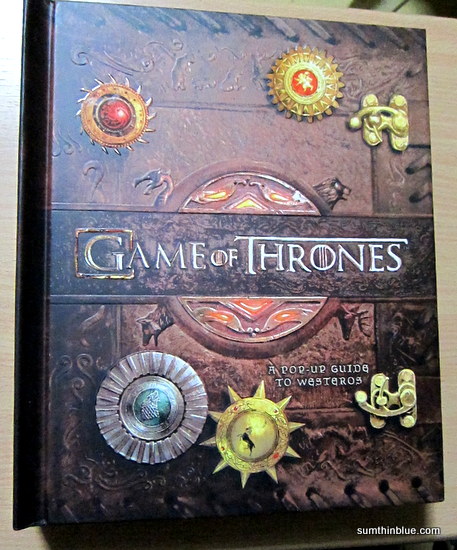
Game of Thrones: A Pop-Up Guide to Westeros

IMG_2378

Ever since it was announced on Matthew Reinhart’s Facebook page, “Game of Thrones: A Pop-Up Guide to Westeros” has been an exercise in EQ (of the “Shut up and take my money!” sort), so when I finally saw it today at the bookstore, I was powerless to resist.

Paper engineered by Matthew Reinhart, with illustrations by Michael Komark, this deluxe pop-up book is an incredible volume that  takes the reader through Westeros and beyond, featuring five spreads of key locations in the series and over thirty smaller pop-ups, folding out into a 46″x30″ map of the kingdom.

Continue reading “Game of Thrones: A Pop-Up Guide to Westeros”

Becca Fitzpatrick in Manila

IMG_2000

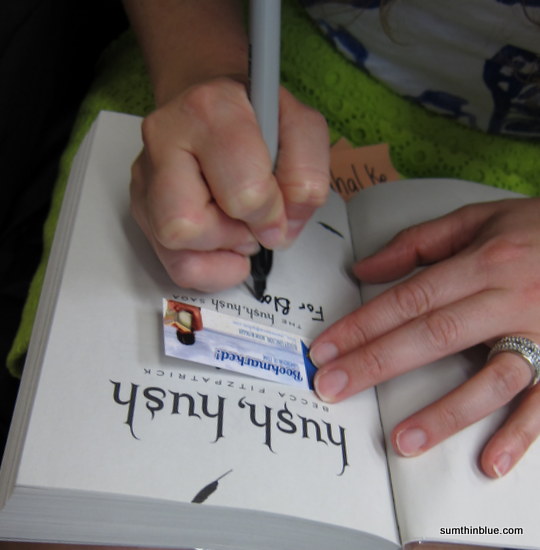
Last Saturday, I had the chance to interview New York Times bestselling author Becca Fitzpatrick, who had book signing events at National Book Store Glorietta 1 and Ayala Center Cebu over the weekend.

Becca Fitzpatrick is famous for her “Hush, Hush” saga, comprised of the novels “Hush, Hush,” “Crescendo,” “Silence” and “Finale.” The young adult paranormal romance saga is centered around Nora Grey, who is drawn to the mysterious Patch, a fallen angel whose fate is intertwined with hers. I  read “Hush, Hush” in time for the interview, and the genre  — plus the fallen angels theme — isn’t my cup of tea. As YA paranormal characters go, Nora wasn’t really a standout for me and beyond the mysterious, brooding image, Patch doesn’t strike me as a particularly likeable character. I did appreciate the mythology — part of the puzzle has been revealed in the first book, and while the poses more questions than the answers it gives, I felt that it had let out enough rope on the anchor for the next books. I was actually apprehensive about reading the book because I’ve heard and read a lot of criticism on the series, and while I can’t judge the whole series on the basis of one book, I thought that it wasn’t half bad, and for a debut novel, the prose was clean and a lot more readable compared to its contemporaries in the popular genre.

What I was more excited about, actually, was Becca Fitzpatrick’s upcoming standalone novel, “Black Ice,” set for release in October. It’s a YA thriller about Britt Pfeiffer, who is geared up to backpack across the Teton mountains of Wyoming with her best friend, but ends up abducted by two fugitives who force her into guiding them off the mountain in exchange for their life. One of the fugitives, Mason, confuses Britt with his kindness, but as Britt uncovers evidence of serial murders across their trail, Britt isn’t sure who she can trust. As luck would have it, Becca had brought over a delightful surprise for those of us who had attended the bloggers’ forum prior to her signing: ARCs of “Black Ice,” which prompted squees (!) all around.

Continue reading “Becca Fitzpatrick in Manila”

Flowers for Algernon

“Flowers for Algernon” by Daniel Keyes has been in my to-be-read pile for some time now, and it came so highly recommended by my book club friends Peter and Orly, so I decided to bump it up last January.

Originally a Hugo award-winning short story written in 1958, “Flowers for Algernon” was expanded into a full length novel, which subsequently won the Nebula award in 1966. The story is told from the point of view of Charlie Gordon, a mentally-challenged man who becomes the subject of a study, causing his IQ to dramatically increase after he undergoes brain surgery.

Continue reading “Flowers for Algernon”