Posts tagged illustrated novel
The Venetian’s Wife
Jun 28th
Pardon the sporadic posts. I’m still not feeling quite up to scratch but I know need to whack away at the growing pile of books I have to review or else I’ll never catch up.
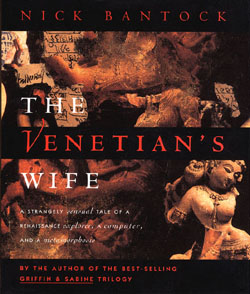
I’ve always been in awe of Nick Bantock’s Griffin and Sabine series, and I’ve wanted to read Nick Bantock’s The Venetian’s Wife (book #105 for 2009) for some time now, just to see how he fares outside of Griffin and Sabine.
The Venetian’s Wife, subtitled “A Strangely Sensual Tale of a Renaissance Explorer, a Computer, and a Metamorphosis,” is another epistolary tale from Nick Bantock, tracing the email correspondence between a museum researcher, Sara Wolfe, and N. Conti, a centuries-old ghost trapped within the confines of modern technology. Conti hires Sara to track down the pieces of a peculiar art collection, and Sara discovers more of herself — and her destiny — in the process.
Taking fan art to the next level
Mar 9th
In May last year, the Flippers’ first book discussion was on the book Life of Pi by Yann Martel.
Before the discussion, I’d seen the book around but never felt the urge to pick it up. I rarely pick up books with spiritual/ inspirational themes because they trigger an involuntary gag reflex in me, so I was dreading reading this book.
Surprisingly, the gagging never came because I actually liked the book. Not in a love-it-to-bits sense, but I appreciated it, and was glad the book discussion required me to read it.
Life of Pi is the story of Piscine “Pi” Molitor Patel, a boy of multiple religions, who is a shipwreck survivor floating adrift in the ocean on a lifeboat with a circus tiger named Richard Parker.
I like the book because it questions perception, and because it reminds us that sometimes the journey is more important than the destination.
To my surprise, I also enjoyed the book’s humor. I really appreciate good humor in a book, and I did not expect this book to make me laugh, but it did, especially the part when Pi was practicing the three religions and the family runs into all three religious leaders and his multi-belief system is revealed; the Pi Patel Indo-Canadian, Trans-Pacific, Floating Circus; the encounter with the Frenchman (whom Pi mistook to be Richard Parker at first); and the interrogation scene at the end of the book.
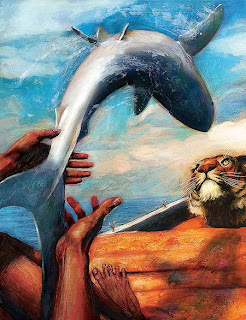
But this review isn’t about the story of Life of Pi, it’s about a particular edition of the book: the deluxe illustrated edition, featuring the paintings of Croatian Tomislav Torjanac.
In 2005, an international competition was launched to find an illustrator for the novel. Thousands of entries were sent in from all over the world, and Torjanac was selected to illustrate the deluxe edition.
From Amazon Outtakes:
Here are some illustrations, from http://www.torjanac.com/lifeofpi.html and http://lifeofpi.co.uk (copyright Tomislav Torjanac)
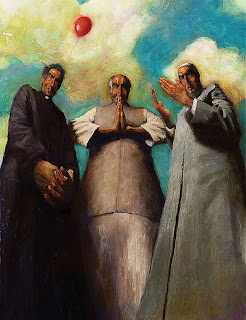
I think it’s great, how Yann Martel and the publishers thought of involving readers this way. I can imagine the feeling, if for instance, JK Rowling did it for one of the Harry Potter books (or if a local publisher comes up with a Filipino translation and mounted a similar contest — hahaha, my fantasy), or if any of my other favorite books were up for illustration.
I would think it’s exciting and scary at the same time, to be given a chance to illustrate a a new edition of a book you’ve loved for a long time, with the knowledge that hundreds of people around the world have loved it too and are eagerly awaiting your illustrations.
I remember a discussion about illustrated novels posted at Flips Flipping Pages last year. Someone commented that a lot of bestsellers are getting illustrated, and he wasn’t quite sure if it was a marketing ploy, or if readers had such short attention spans that they needed to have books with pictures. b
Those reasons probably hold true, and I say, if it gets more people to read, so much the better.
But speaking as an illustrator, I see the illustrations as an extension of the reading experience, not mere accompaniments to the text. Illustrations translate one art form (literature) into another (visual art), much like a book made into a movie, and can convey a meaning beyond the text, as the illustrator adds his or her own nuances in interpreting the text.
And speaking as a big fan (and obsessive bargain-hunting collector) of illustrated novels, I say there is nothing wrong with enjoying an illustrated book; it doesn’t mean you lack imagination or need a visual aid. It’s about appreciating it for what it is – art!
***
My copy: hardbound US (Harcourt) with dustjacket, a birthday gift from Triccie
(Back story: I lent my brother my trade paperback, he took it to his dorm and it was devoured by termites — he now grovels if he wants to borrow a book)
My rating: Life of Pi Illustrated Edition 5/5 stars; Life of Pi trade paperback 3.5/5 stars
My best book for 2008
Feb 1st
2008 was a landmark year for me and my books – my books tripled in quantity (thanks to BookMooch), my to-be-read stack (TBR) reached crazy heights (now I have a separate shelf for TBR) and was able to read a total number of 230 books.
It was challenging to pick out my best book, as I had a lot to choose from, including:
Shadow of the Wind by Carlos Ruiz Zafon
Persepolis by Marjane Satrapi
Perfume by Patrick Suskind
The Graveyard Book by Neil Gaiman
Ptolemy’s Gate by Jonathan Stroud
The Eyre Affair by Jasper Fforde (reread)
The BFG by Roald Dahl
The Book Thief by Markus Zusak
Daughter of Venice by Donna Jo Napoli
I Capture the Castle by Dodie Smith
After much deliberation I decided to choose a book that blew me away:
The Arrival by Shaun Tan.
From the moment I held the book in my hands, I was awed by how beautiful it was, and how it seemed to elicit from me a sense of reverence as I turned the pages. Turning the book on its back cover, the critical acclaim is staggering – it is all praises from an all-star roster of authors and illustrators: Art Spiegelman, Marjane Satrapi, Jeff Smith, Jon J. Muth, Brian Selznick, Craig Thompson, and David Small.
You might be surprised to learn that my best book for 2008 is wordless – The Arrival is told entirely in pictures, in a series of breathtaking pencil sketches that silently convey so much emotion.
The Arrival depicts the story of a man who starts a new life for himself and his family in a foreign land. Tan perfectly captures the emotional roller coaster ride the character goes through: sadness at leaving his family behind; the stress of a long journey; the relief of reaching the destination; the bewilderment towards a new way of life; the slow acclimatization to a different culture; and the joy of being reunited with family.

Surrealism isn’t ordinarily my thing (see my review for The Republic of Dreams), but I loved how it is used in this book, especially in the new country. Everything is strange and outlandish– from the landscape to alphabet, alien creatures (the origami birds remind me of the paper birds chasing Haku in Spirited Away and the pet-like animals remind me of daemons in Philip Pullman’s His Dark Materials trilogy), food, customs, and transportation – and creates a perfect metaphor for the immigration experience. It also makes a grown-up theme simple enough for a young reader to understand without making it childish.

The book exemplifies the power of imagery – it’s pretty hard to “read” this book and not feel the emotions wash over you, and its cinematic quality makes you feel you’re watching the events unfold right before your very eyes. It made me smile and laugh and sigh, and as I turned the last page, I wanted to burst into applause.

This is definitely a book to treasure, and a must-read for illustrators.
***
(The Arrival images from www.shauntan.net)
My copy: hardcover
My rating: 5/5 stars
Voila!
Jan 26th
Book #13 for 2008
+
Houdini: The Handcuff King by Jason Lutes & Nick Bertozzi
By sheer chance, I now have two Houdini books in my possession, both from Book Sale, and although I read them a few months apart, I thought they’d go together nicely in a review.
Last year I found the hardbound Houdini: The Handcuff King at the Glorietta branch, in excellent condition, for about P170. It’s a graphic novel presented by the Center for Cartoon Studies, America’s premiere cartooning school.
And then, a few months later, en route to a Christmas party in December, we happened to make a stop (bathroom break) at Cherry Foodarama, where there was a tiny book sale booth, and there I found The Houdini Box, for P60.
While both books are about the famous escape artist, Houdini: The Handcuff King is biographical, while The Houdini Box is about a boy who idolizes Houdini.
I like both books because they offer a rich visual experience.
Houdini: The Handcuff King is a graphic novel, in vintage style, done in a monochromatic pen and ink, tinged with blue shadows. I like the way the visual narrative plays out, as well as the interesting perspectives the panels take on — of course, since it’s a CCS publication, they know what they’re doing.
I also like the back portion of the book, where key details of the novel are discussed, shedding light on their context: Boston and Cambridge, Massachusetts in 1908; locks of the time and how Houdini picked them; Bess Rahner and Harry Houdini’s lo
ve story; the hat-wearing American society; advertising and journalism in 1908; anti-semitism; public address systems and American college rivalry.
The CCS ad on the back page is great too, visually outlining the cartooning process from idea to production.
The Houdini Box, although not strictly about Houdini, has a charm of its own. The story is about Victor, a boy who idolizes Houdini. When he runs into Houdini at a train station, he begs the escape artist to teach him his secrets, and the answer comes a few weeks later, in the form of a mysterious box. The story is short, funny, and engaging, and captures the magic of Houdini.
The Houdini Box comes before the Caldecott-winning The Invention of Hugo Cabret, but it is clear that Brian Selznick has his own magic in storytelling. His trademark pencil drawings come alive on the page, and his skewed proportions add character to the art.
Houdini is one of the most interesting personalities of the 20th century, and both books certainly do him justice.
***
My copy: The Houdini Box, trade paperback; Houdini the Handcuff King, hardcover
My rating: The Houdini Box, 5/5 star; Houdini the Handcuff King, 5/5 stars
The Republic of Dreams: A Reverie by G. Garfield Crimmins
Jan 16th
Book #7 for 2009
I’ve always been fascinated with illustrated novels, and when I came across a copy of G. Garfield Crimmin’s “The Republic of Dreams” on bookmooch, I was eager to add it to my growing collection.
I had high hopes as I first skimmed the book, delighted to find that the contents were intact, even the detachable ephemera — maps, a passport, telegrams, a license card, and a whole set of postcards.
But as I read the story, my initial excitement deflated, replaced with that horrible, hollow feeling I get when a book that promises so much turns out to be a big disappointment.
The novelty of the illustrated novel is in seeing two different media — the written word and visual art– meld together in a visual narrative. My beef with The Republic of Dreams is that while the book is lovely to look at (and it must’ve cost a fortune to publish the book too), the story leaves so much more to be desired.
I found the story hard to follow, with a contrived hedonism that made it cheesy.
The author G. Garfield Crimmins finds himself in La Republique de Reves (The Republic of Dreams), where he is known as Victor La Nuage – the alter-ego of his waking self. Victor realizes he is a citizen of the Republic of Dreams, and he was sent on a mission to the “real world” to combat the Republic’s greatest enemy: The League of Common Sense, a movement bent on stifling imagination and pleasure.
(It reminds me of something out of a Jasper Fforde novel except it’s not funny because Crimmins is serious about it, which makes me think he was either a) horny (haha I had no idea this would turn out to be erotica!) b) high c) very very drunk or d) all of the above while he was creating this).
I get the feeling Crimmins wanted the Republic of Dreams to be a place everyone would want to live in, but I think he was trying too hard. He was overzealous in the exposition — “The Republic of Dreams is the true home of every dreamer, noncomformist, artist, eccentric, lover, and poet — all those who have an instinctive dislike of the narrow limitations of common sense. Its citizens love love, youth, old age, beauty, splendor, wisdom, generosity, music, song, the feast, and the dance. The weather is ideal and festivals occur daily” — and that is just in the flap of the book.
He goes on to devote 16 pages (out of 95) to a “visitor’s guide” to the Republic, and it pushes the envelope already.
Adding to the cheese factor are the bad puns throughout the novel — the national ID is called “Licence Poetique,” Madame Ricochet’s salon is a date hotspot located at the intersection of Avenue of Quivers and Shudders and Sweet Tongue Lane (there is also a Street of Sweet Escape); the capital city is Polis Poeton (city of poets) surrounded by Lake Eros — everything was just really hokey to me, too over the top, and it doesn’t help that you can’t make heads or tails out of the story.
I guess I’ll be keeping the book, just for the heck of it, at the very least it would look good (literally) on my shelf, hahaha, but I don’t think I’ll be reading it again.
You don’t believe me? Read the excerpt here http://www.wwnorton.com/catalog/fall98/crimmins.htm, and you’ll see what I mean.
***
My copy: hardbound, mooched from the US
My rating: 1/5 stars
Photo courtesy of wwnorton.com (http://www.wwnorton.com/cover/004633.gif, http://www.wwnorton.com/catalog/fall98/images/rep10.gif)


The Curious Sofa: A Pornographic Work by Ogdred Weary


Yodelayheehoo! (The Very Persistent Gappers of Frip)
Nov 20th
Posted by Sumthinblue in Bargain Books
No comments
Lane Smith (of The Stinky Cheese Man and Other Fairly Stupid Tales, Hooray for Diffendoofer Day, The True Story of the Three Little Pigs and many others) is one of my all-time favorite illustrators, and I’ve got a growing collection of his books (mostly the result of foraging in bargain bins!).
I’d been eyeing the book The Very Persistent Gappers of Frip by George Saunders (illustrated by Lane Smith) at a specialty bookstore for ages. Earlier this year, I finally scored a copy at one of the book store sales for only P59!
More >