I spent most of last week in Davao City, toting along my review copy of Miguel Syjuco’s Ilustrado, winner of the 2008 Man Asian Literary Prize and the Palanca Award. It’s a metafictional novel that pieces together the life of Filipino writer-in-exile Crispin Salvador as his student, Miguel weaves together fragments of Salvador’s body of work, personal interviews, blog entries, newspaper clippings, and many other sources as he investigates his teacher’s mysterious death.
I spent most of my spare time engrossed in the novel — at the airport, on flights, and before hitting the sack at the hotel room — and I was looking forward to coming back to Manila to attend the press conference and launch at National Book Store.
The review will have to wait; I just finished the novel and I’m reviewing it for Manila Bulletin, so here’s a recap of the launch, the first release of Ilustrado anywhere in the world!
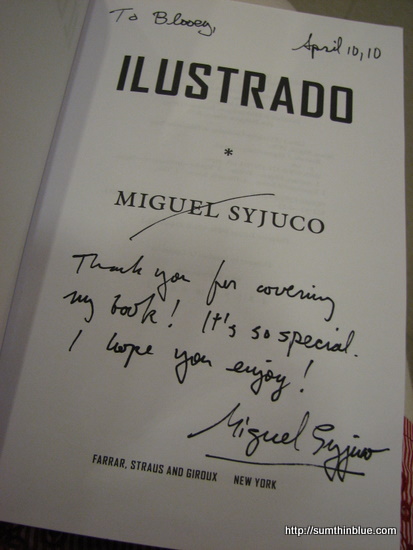
I got to the NBS Glorietta 5 branch early, so I was one of the first to get my copy of the book signed. Off the bat, Miguel Syjuco noticed I’d covered my book in protective plastic — of course I did! Hahaha, you all know I can’t read a book without a gauge 5 plastic cover, and no way was I taking a naked book across the country with me!
Hence the dedication on the title page:
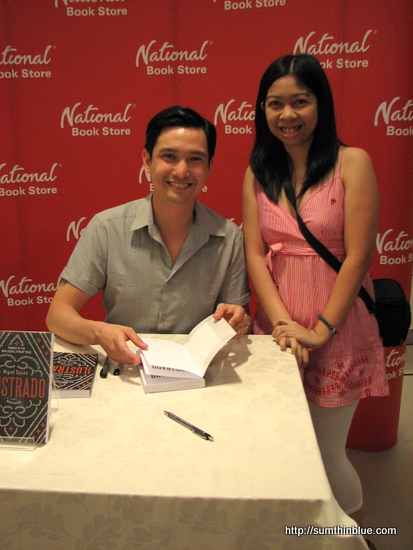
I got my requisite book signing photo too (and I think this is so much better than lining up for Neil Gaiman)!
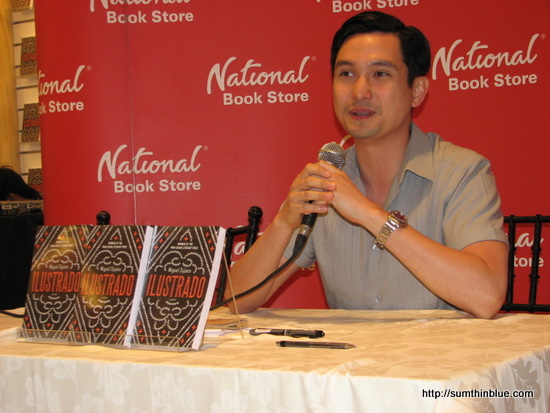
At the launch, Miguel talked about how the book came to be, inspired by a stint as a fact-checker for the Paris Review in New York.
“I was fact-checking the Writers at Work interviews, and I had to cobble together facts from literary biographies, interviews, introductions from books, excerpts from novels and poems and managed to create a profile of each writer, ” he reveals. “I thought it was an interesting way to present the portrait of an artist, and that’s what I ended up doing in the past four years, creating the character of Crispin Salvador based on the things a Filipino writer abroad has to deal with.”
He also reveals Ilustrado as a tribute to his literary influences (Vonnegut, Pynchon, Rizal, Bolaño and many more), and even references to art and music.
“There are a lot of references in the book, rewarding those who recognize it. Those who get it will feel that Easter egg feeling; it’s hidden treasure, a little wink wink,” he quips. “They’re inside jokes; I wanted to layer fiction upon fiction upon fiction to create a chord that would resonate in literature, I’m trying to establish that we’re all part of the same literary tradition.”
He also voices his views on the Filipino writer, stating that a lot of Filipinos jump on the magic realism bandwagon and tend to exoticize themselves, writing about carabaos in the field and mango-colored sunlight. He also expounds on the high expectations for Filipino writers.
“In the Philippines, people expect each novel to be the great Filipino novel, and they come away disappointed because the expectations are much too high.”
He echoes Roberto Bolaño’s belief that there are no masterpieces, that each work is part of a larger literary tradition. He quotes from Bolaño’s 2666 (which, incidentally I’d started before Ilustrado, except my hardcover copy is too heavy to lug around):
“Now even bookish pharmacists are afraid to take on the great, imperfect, torrential works, books that blaze paths into the unknown. They choose the perfect exercises of the great masters. Or what amounts to the same thing: they want to watch the great masters spar, but they have no interest in real combat, when the great masters struggle against that something, that something that terrifies us all, that something that cows us and spurs us on, amid blood and mortal wounds and stench.”
He also stresses the personal significance of launching a Philippine edition of the book:
“I wanted it to be affordable, and I wanted it to be published at home, before the [2010] elections. The book is very political, and I hope that the universal truths book tries to bring out to encourage people to think more about their vote. I know I’m not going to change the world or the country, but if I can make some small ripple, it will all be worthwhile.”
I’ll be posting the review of Ilustrado here after it’s published, but in the meantime, here’s a clip of Miguel Syjuco inviting you to read his book:
Ilustrado is available at all National Book Store branches at the special introductory price of P308 (20% discount, SRP P385) from April 8 to 30, 2010.
Yay Chuck! So proud of this guy, who I first met in Math 11 class during my first semester at the Ateneo. It was his 3rd try, and therefore last chance to pass the class, so he sat right in the front, under the teacher’s nose, and finally got the grade he needed. Later, he asked me to introduce him to the woman he still calls the love of his life – my best friend. It’s amazing to see how far he’s come. I didn’t take a camera to the Fully Booked launch of Ilustrado last night, but their photogs may have some shots. May Chuck continue to blaze a literary trail for the Filipinos of our generation – and may more of us dare to follow in his footsteps.
Wow, small world, Iya! :)
Blooey, will you post your article here once it’s been published in the Bulletin? I’d love to read it!
Yup. Will post article here when its out :)
Blooey, I still don’t get what this book is about. But, I guess I’ll have to wait for your review on it. :D
Coming up soon, jo. Am just inundated with work…
Hi Blooey, this is Gabi (we “met” at the Fully Booked Book Geek Finals :) ). Was hoping that you would be interested in helping out our NGO, Ex Libris Philippines, by helping publicize our upcoming fundraising concert for our Scholarship Project. For more info, please go to http://exlibrisphilippines.multiply.com/journal/item/20/Concert_for_a_Cause_Ex_Libris_Philippines_Scholarship_Fundraising_Project_2010
Thank you so much and God bless you and your family always!
Hi Gabi! Ok will blog about this within the week. Just battling some technical problems at the moment, I hope to resume regular blogging within the week.
Lucky, lucky, lucky you Blooey! Meeting the author in person and having a photo op too. Your book review makes me wanna buy Illustrado, that is, when I am well enough to go out again….pretty soon, I hope!
Hi Arlene! Hope you do get well enough to go and buy it. Take care always!
i’m so inggit!
waaaah! i read ilustrado last weekend. and i think i have a crush on miguel syjuco now. mwahahaha!
sayang he can’t be at the discussion! I wonder when he’ll be back in the Philippines?